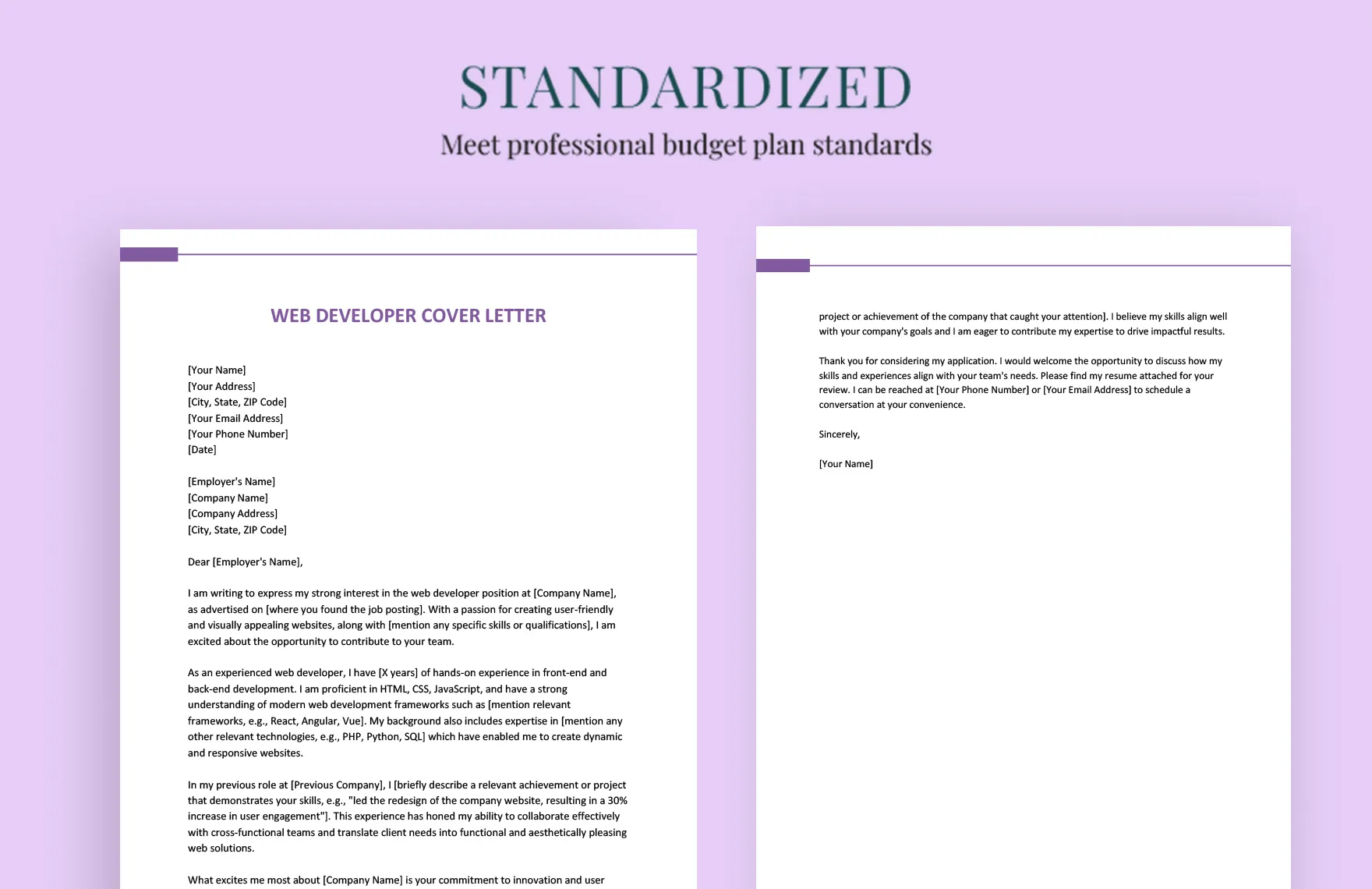
The Purpose of a Web Developer Cover Letter
A web developer cover letter is more than just a formality; it’s your first chance to make a strong impression and convince a potential employer that you’re the perfect fit for their team. Unlike your resume, which provides a factual overview of your skills and experience, the cover letter allows you to showcase your personality, express your enthusiasm, and explain why you’re particularly interested in the specific role and company. It offers a narrative, connecting your skills and experiences to the requirements of the job. A well-crafted cover letter can significantly increase your chances of landing an interview, setting the stage for a successful job application process. Without one, you’re missing an opportunity to distinguish yourself from other candidates and highlight what makes you unique and valuable.
Highlighting Relevant Skills
One of the most crucial aspects of a web developer cover letter is highlighting your relevant skills. Don’t just list them; demonstrate how you’ve used them to achieve results. This is where you bridge the gap between your resume and the job description. The goal is to convince the hiring manager that you possess the specific technical skills required for the position. This includes detailing your proficiency in programming languages like JavaScript, HTML, CSS, and frameworks such as React, Angular, or Vue.js. But it extends beyond technical abilities to encompass soft skills like problem-solving, communication, and teamwork. Provide specific examples of situations where you’ve used these skills to overcome challenges, build successful projects, or contribute to a team’s success. This demonstrates your practical application of these skills.
Technical Proficiency

When addressing technical proficiency, be precise about the technologies you master. Instead of saying ‘proficient in web development’, specify the programming languages, frameworks, and tools. For example, ‘Proficient in JavaScript (ES6+), HTML5, CSS3, and experienced with React.js for front-end development, and Node.js for back-end development.’ Also, indicate your understanding of version control systems like Git, and familiarity with relevant databases like MySQL or MongoDB. Always align your technical skill set with the job description. If the role emphasizes front-end development with React, make sure this skill is prominently featured. Mentioning specific projects where you utilized these skills provides concrete evidence of your expertise, making your application more convincing and relevant to the employer.
Problem-Solving Abilities
Highlight your ability to solve complex problems. Web development often involves troubleshooting, debugging, and finding creative solutions to technical challenges. Describe instances where you overcame obstacles. For example, ‘Successfully debugged and optimized a sluggish e-commerce website, reducing page load times by 40% by identifying and rectifying inefficient database queries.’ Share your approach to problem-solving. Mention your ability to analyze issues, formulate solutions, and implement them effectively. Detail your experience in tackling bugs, enhancing performance, or integrating new features. This demonstrates your value in a practical, results-oriented manner. Emphasize how your problem-solving skills contribute to the project’s success and the overall business objectives, which is what employers look for.
Adaptability and Learning
The field of web development is constantly evolving, so demonstrating adaptability and a commitment to learning is crucial. Mention any new technologies, frameworks, or programming languages you’ve recently learned or are currently exploring. This could include cloud computing platforms, new JavaScript libraries, or advanced CSS techniques. Highlight any online courses, certifications, or workshops you’ve completed to enhance your skills. Show that you’re proactive in staying up-to-date with industry trends. For example, ‘Completed a course on cloud computing and integrated AWS services to enhance the scalability and performance of a web application.’ Adaptability involves quickly grasping new concepts and applying them effectively. By showing your eagerness to learn and adapt, you’ll assure employers that you’ll be a valuable asset as technology continues to change.
Showcasing Project Experience
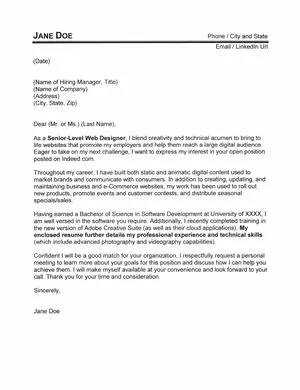
Your project experience is your portfolio, your chance to prove your skills. Instead of merely listing projects, describe your role and contributions within each project. Start by outlining the scope of the project, your responsibilities, and the technologies employed. Focus on projects that are most relevant to the job description. Use the cover letter to narrate how you approached and executed these projects, emphasizing your specific involvement and the positive results you achieved. This is also an excellent opportunity to showcase any personal projects, open-source contributions, or freelance work. Tailor the projects you discuss to align with the specific needs and requirements outlined in the job description, highlighting your accomplishments in a way that directly appeals to the hiring manager.
Detailing Specific Projects
When detailing specific projects, provide clear descriptions of your tasks, the technologies used, and the outcomes. For example, instead of saying ‘Worked on an e-commerce website’, provide more details: ‘Developed the front-end of an e-commerce platform using React.js, focusing on creating responsive and user-friendly interfaces. Integrated APIs for payment processing and inventory management.’ Include links to the projects if possible, such as a live website URL or a link to your GitHub repository. If the project is confidential, you can still describe your involvement and the results achieved without revealing sensitive information. Always explain your contributions to the project. What were your specific roles and responsibilities? How did you contribute to the team’s success? What challenges did you overcome? The more detail you provide, the more impactful your cover letter will be.
Quantifying Achievements
Quantifying your achievements is a powerful way to demonstrate the value you bring. Whenever possible, use metrics and data to showcase the impact of your work. Instead of saying ‘Improved website performance’, say ‘Improved website load times by 30% through code optimization’. If you increased user engagement, state by what percentage. If you reduced bug reports, mention the reduction rate. For example, ‘Decreased bug reports by 25% through rigorous testing and code reviews’. If you optimized a process, indicate the time saved or the cost reduced. These metrics make your achievements more tangible and convincing. They show the hiring manager that your skills translate into measurable results, which is highly valuable in web development.
Formatting and Presentation

The format and presentation of your cover letter is crucial as it reflects your attention to detail and professionalism. Ensure your letter is well-structured, easy to read, and free of grammatical errors and typos. Use a professional font like Arial, Calibri, or Times New Roman, with a font size between 10 and 12 points. Use clear headings and subheadings to organize the content, making it easy for the reader to scan and quickly find the information they need. Keep paragraphs concise and to the point, and use bullet points when listing skills or achievements. Ensure the letter is properly formatted, with appropriate margins and spacing. Proofread meticulously to ensure that the message is clear and well-presented. A well-formatted cover letter shows that you care about the details.
Professional Tone and Language
Maintain a professional tone and use clear, concise language throughout your cover letter. Avoid overly casual language or slang. Address the hiring manager by name if possible, which shows that you have done your research. Avoid using generic phrases. Tailor your language to match the company’s brand and culture, if possible. When describing your skills and experience, use action verbs to start your sentences, such as ‘Developed’, ‘Managed’, ‘Implemented’, ‘Optimized’, and ‘Created’. Avoid jargon that might not be understood by a non-technical reader. Ensure your language is enthusiastic but professional. The overall goal is to convey your skills and experience while demonstrating your professionalism and suitability for the role.
Tailoring the Letter
A generic cover letter is unlikely to make a strong impression. Always tailor your cover letter to each specific job application. Review the job description carefully and identify the key requirements and keywords. Customize your letter to directly address these requirements, highlighting the skills and experiences that align with the job. Research the company and its culture. Show that you understand the company’s mission, values, and current projects. Mentioning specific projects or initiatives of the company demonstrates that you’ve taken the time to learn about the organization. Customization shows that you’re genuinely interested in the specific role and not just sending out mass applications. This attention to detail significantly increases your chances of making a positive impression.
Proofreading and Editing

Proofreading and editing your cover letter are critical steps. A single typo or grammatical error can undermine your credibility. After you’ve finished writing your cover letter, review it multiple times, paying close attention to grammar, spelling, punctuation, and sentence structure. Read it aloud to catch any awkward phrasing or unclear sentences. Use a grammar checker tool such as Grammarly. Get a second pair of eyes. Ask a friend, family member, or career counselor to review your cover letter. They can provide valuable feedback on clarity, tone, and overall effectiveness. Ensure that all the details are accurate, including dates, names, and contact information. The final draft should be polished, error-free, and effectively convey your qualifications and enthusiasm for the job.
Call to Action and Closing
Your cover letter should always end with a clear call to action. State your interest in the position and what you hope to achieve. Encourage the hiring manager to review your resume and contact you for an interview. Show the initiative by stating something like ‘I am eager to discuss my qualifications further and how I can contribute to your team’. Reiterate your enthusiasm for the role and the company. End the letter with a professional closing such as ‘Sincerely’ or ‘Best regards’, followed by your full name. Avoid overly formal or generic closings. A well-crafted closing leaves a lasting positive impression and clearly communicates your intention to move forward in the hiring process. This encourages the reader to take the next step.
Expressing Enthusiasm
Expressing enthusiasm in your cover letter is vital. Hiring managers want to see that you’re genuinely interested in the role and the company. Convey your excitement about the opportunity to contribute to their team. Explain why you’re particularly interested in the specific role, the company, or the projects they are working on. For example, ‘I am particularly excited about the opportunity to contribute to [specific project]’. Use positive and energetic language throughout the letter. Show that you’ve researched the company and are excited about their mission and values. Enthusiasm should be genuine and specific. Your eagerness will increase your chances of making a positive impression and differentiating yourself from other candidates.
Providing Contact Information

Make it easy for the hiring manager to contact you by providing accurate and up-to-date contact information. Include your full name, phone number, email address, and any relevant links such as your LinkedIn profile or personal website. Ensure that your email address is professional-sounding and appropriate for a job application. Double-check your phone number and email address to avoid any errors. Consider adding a link to an online portfolio or a personal website that showcases your projects and skills. This allows the hiring manager to quickly access your resume and learn more about your experience. Always make sure your contact information is prominent and easy to find, to ensure that the hiring manager can quickly reach you to schedule an interview.