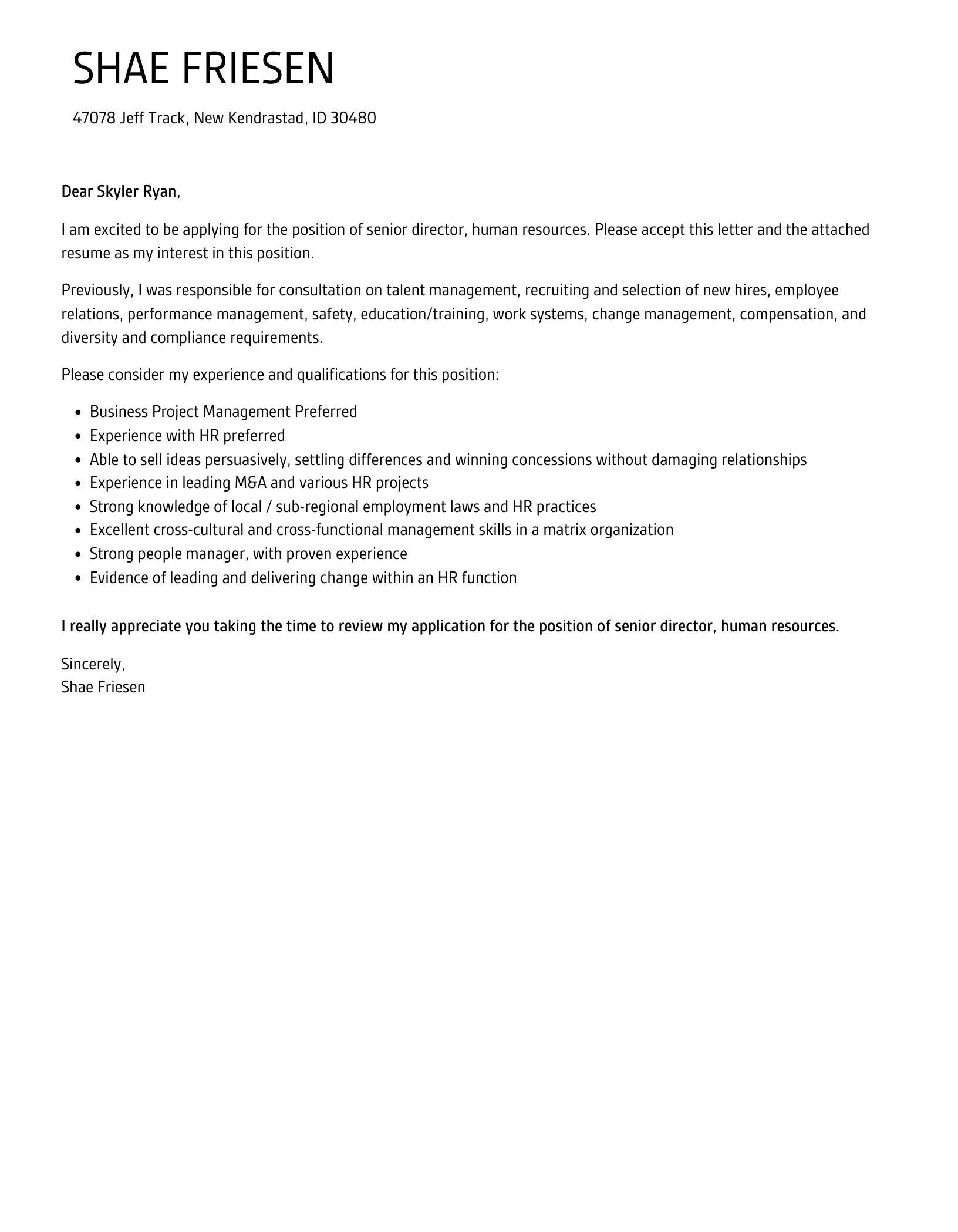
Crafting a Senior HR Director Cover Letter That Impresses
A Senior HR Director cover letter is your first introduction to a potential employer, often setting the tone for whether you’ll secure an interview. It’s not just a formality; it’s a strategic tool to showcase your expertise, leadership capabilities, and alignment with the company’s culture and needs. This crucial document provides an opportunity to highlight your most relevant skills and experiences, making a strong case for your candidacy. The goal is to capture the reader’s attention immediately and compel them to learn more about you. A well-crafted cover letter complements your resume by providing context, detailing accomplishments, and demonstrating your genuine interest in the specific role and the organization.
Understanding the Role of a Senior HR Director
Before crafting your cover letter, it’s essential to understand the expectations and responsibilities associated with a Senior HR Director position. This role is a leadership position focusing on the strategic direction of human resources within an organization. It involves overseeing various HR functions, including talent acquisition, employee relations, compensation and benefits, performance management, and organizational development. Senior HR Directors work closely with executive leadership to align HR strategies with overall business goals. They are responsible for creating and maintaining a positive work environment, ensuring legal compliance, and fostering a culture of engagement and growth. A clear understanding of these responsibilities will help you tailor your cover letter to demonstrate your suitability for the role.
Essential Skills for a Senior HR Director

The ideal Senior HR Director possesses a combination of hard and soft skills that enable them to effectively lead and manage an HR department. These essential skills should be highlighted within your cover letter. Strong leadership and management abilities are critical, allowing you to effectively direct and motivate your team. Strategic thinking and business acumen are vital for aligning HR initiatives with the company’s objectives. Excellent communication and interpersonal skills are needed to build relationships, resolve conflicts, and communicate effectively across all levels of the organization. Knowledge of HR laws and regulations, along with experience in talent management, compensation and benefits, and employee relations, is crucial for success. Problem-solving and decision-making skills are also essential for navigating complex HR challenges and making informed judgments.
Key Components of a Compelling Cover Letter
A compelling cover letter includes several key components designed to capture the reader’s interest and present you as a strong candidate. The letter should begin with a professional header including your contact information and the date, along with the recipient’s information. The opening paragraph should be concise and engaging, immediately highlighting your interest in the position and the company. The body of the letter should detail your relevant experience, showcasing your accomplishments and quantifiable results. The letter should demonstrate your leadership and strategic thinking, tailoring your experience to the specific job description. Remember to include a strong closing paragraph that calls to action, and always proofread the letter to ensure it is polished and error-free.
Header and Contact Information
Your cover letter should start with a professional header containing your contact information. This header provides essential details that allow the hiring manager to reach you. Include your full name, professional title (if applicable), phone number, email address, and optionally, your LinkedIn profile URL. Ensure your email address is professional; avoid using nicknames or informal language. Position this information at the top of the letter, usually aligned to the left or right. Following your contact information, include the date and the recipient’s information, such as the hiring manager’s name, title, company name, and address. This formatting demonstrates attention to detail and professionalism, setting a positive tone from the start.
The Opening Paragraph Captivating the Reader

The opening paragraph is crucial; it’s your chance to grab the hiring manager’s attention. Start by clearly stating the position you’re applying for and where you found the job posting. Immediately express your strong interest in the role and the company. A compelling opening might mention something specific that attracted you to the position or the organization. Tailor your opening to the specific company and role. Briefly summarize your most relevant qualifications or experiences. Show enthusiasm and make a strong, positive first impression. Avoid generic phrases like “I am writing to express my interest.” Instead, try a more engaging approach that captures the reader’s attention immediately.
Highlighting Your Senior HR Director Experience
The body of your cover letter should showcase your experience as a Senior HR Director. Detail your experience, highlighting the roles, companies, and timeframes involved. Focus on the skills and experiences most relevant to the specific job description. Provide specific examples of how you’ve successfully managed HR functions such as talent acquisition, employee relations, compensation and benefits, and performance management. Mention any significant projects you led, challenges you overcame, and results you achieved. Frame your experience in a way that demonstrates your leadership capabilities, strategic thinking, and ability to drive positive change within an organization. Use action verbs to describe your responsibilities and accomplishments. Show, don’t just tell, by providing concrete examples.
Showcasing Accomplishments and Quantifiable Results
In your cover letter, go beyond listing your job duties; showcase your accomplishments. The best way to do this is by providing quantifiable results. Use numbers and data to illustrate the impact of your work. For example, instead of saying “Improved employee retention,” say “Increased employee retention by 15% within one year.” Mention any cost savings, revenue increases, or efficiency improvements you achieved. Highlight any awards or recognition you received. Quantifiable results demonstrate the value you brought to previous roles and provide concrete evidence of your capabilities. Use metrics to show that you can drive positive outcomes and contribute to the company’s bottom line. This will make your cover letter significantly more impactful and memorable.
Demonstrating Leadership and Strategic Thinking

As a Senior HR Director, leadership and strategic thinking are vital skills. Your cover letter must reflect these qualities. Describe how you have led and mentored HR teams, fostering a positive and productive work environment. Mention any strategies you developed and implemented to align HR initiatives with business goals. Highlight how you contributed to organizational development, change management, and strategic planning. Include examples of how you anticipated and addressed HR challenges. If you have experience with mergers and acquisitions, restructuring, or significant organizational changes, be sure to describe your role and contributions. Show that you can think critically, solve problems, and drive strategic initiatives that contribute to the organization’s success.
Tailoring Your Cover Letter to the Job Description
One of the biggest secrets to a successful cover letter is tailoring it to each job you apply for. Carefully review the job description and identify the key requirements, skills, and qualifications the employer is seeking. Customize your cover letter to address these specific requirements. Highlight the relevant experiences, skills, and accomplishments that align with the job description. Use keywords and phrases from the job posting to demonstrate your understanding of the role. Avoid using a generic cover letter. Tailoring your letter shows the employer that you have taken the time to understand their needs and that you are genuinely interested in the specific position. This personalized approach significantly increases your chances of getting an interview.
Using Keywords Effectively
In today’s job market, using keywords effectively is crucial for your cover letter to get noticed. Applicant Tracking Systems (ATS) often scan cover letters and resumes for relevant keywords. Research the job description to identify the key skills, qualifications, and phrases the employer is looking for. Integrate these keywords naturally into your cover letter. Use the same language and terminology that the employer uses. However, be careful not to stuff your cover letter with keywords. Ensure that your writing is clear, concise, and easy to read. The goal is to make it through the ATS and catch the eye of the hiring manager. Using the right keywords helps you demonstrate that you are a good fit for the role.
Emphasizing Cultural Fit

Employers often seek candidates who will fit in well with their company culture. In your cover letter, demonstrate your understanding of the company’s culture and values. Research the company’s mission, values, and initiatives. Tailor your cover letter to reflect these values. Highlight experiences or accomplishments that show how you’ve thrived in similar environments. Give examples that showcase your personality, work style, and how you collaborate with others. Show your enthusiasm for the company’s culture. Explain why you want to work for the company and what you can contribute to their team. A strong cultural fit increases your chances of making a positive impression and securing an interview.
Addressing Potential Concerns
If you have any potential concerns or gaps in your resume, such as a career break or a job change, address them briefly and positively in your cover letter. Be honest and explain the situation. Frame the situation in a way that highlights your skills and what you learned from the experience. For example, if you took a career break, explain how you used the time to develop new skills or pursue personal growth. Focus on the positive aspects of your experience. Address any concerns proactively and concisely. This shows that you are transparent and confident, and that you have a plan to succeed.
The Closing Paragraph: Call to Action
Your closing paragraph is your last chance to make a strong impression. End with a clear call to action. Thank the hiring manager for their time and consideration. Reiterate your interest in the position and the company. Express your eagerness to discuss your qualifications further. Include a statement like “I am eager to learn more about this opportunity and discuss how my skills and experience can benefit your team.” Mention how you will follow up, such as that you will call within a week, or simply say you look forward to hearing from them soon. Make it easy for the hiring manager to take the next step. A strong call to action encourages the reader to contact you and schedule an interview.
Formatting and Proofreading Your Cover Letter

The formatting and proofreading of your cover letter are just as important as the content. A professionally formatted letter demonstrates your attention to detail and professionalism. Use a clear, easy-to-read font, such as Times New Roman, Arial, or Calibri, with a font size between 10 and 12 points. Maintain consistent formatting throughout the letter. Use standard margins (1 inch on all sides). Ensure that your paragraphs are well-structured, and the letter is properly aligned. Avoid using jargon. Use bolding or italics sparingly for emphasis. Use bullet points for lists. Proofread your cover letter carefully for any errors in grammar, spelling, and punctuation. Have someone else review your letter before submitting it, as a fresh pair of eyes can catch mistakes you might miss.
Formatting Tips for a Professional Look
To create a professional cover letter, follow these formatting tips. Choose a clean, professional font such as Times New Roman, Arial, or Calibri. Use a font size between 10 and 12 points. Keep your letter concise, ideally no more than one page. Use standard 1-inch margins on all sides. Use single spacing between lines within paragraphs and double spacing between paragraphs. Left-align your text, as this is the most common and readable format. Use bold or italics sparingly. Ensure that your header includes your contact information and the date. Be consistent with your formatting throughout the document. A well-formatted cover letter is visually appealing and easy to read, which helps make a positive impression on the hiring manager.
Proofreading and Editing for Clarity
Proofreading and editing your cover letter is critical for ensuring its clarity and professionalism. Carefully review your letter for any errors in grammar, spelling, and punctuation. Check that your sentences are well-constructed and that your ideas are presented logically. Ensure that your writing is concise and avoids unnecessary jargon. Make sure your tone is professional and appropriate for the position and company. Read your cover letter aloud to catch any awkward phrasing or errors. Have someone else review your letter before submitting it. A fresh pair of eyes can catch mistakes you might have missed. A well-proofread and edited cover letter demonstrates your attention to detail and increases your chances of getting an interview.
Senior HR Director Cover Letter Examples

Reviewing senior HR director cover letter examples can provide valuable insight into how to structure your letter and highlight your qualifications effectively. Look for examples that are tailored to specific industries or roles. Analyze the language used, the format, and how the candidate showcases their achievements. Pay attention to the opening and closing paragraphs. Many online resources offer cover letter templates and examples that you can adapt to your own experience and skills. Use the examples as a guide, but always personalize your cover letter. Avoid simply copying and pasting from a template; the goal is to create a letter that reflects your unique qualifications and experience. Tailor your cover letter, and make sure it speaks to the specific requirements of the job you are applying for.