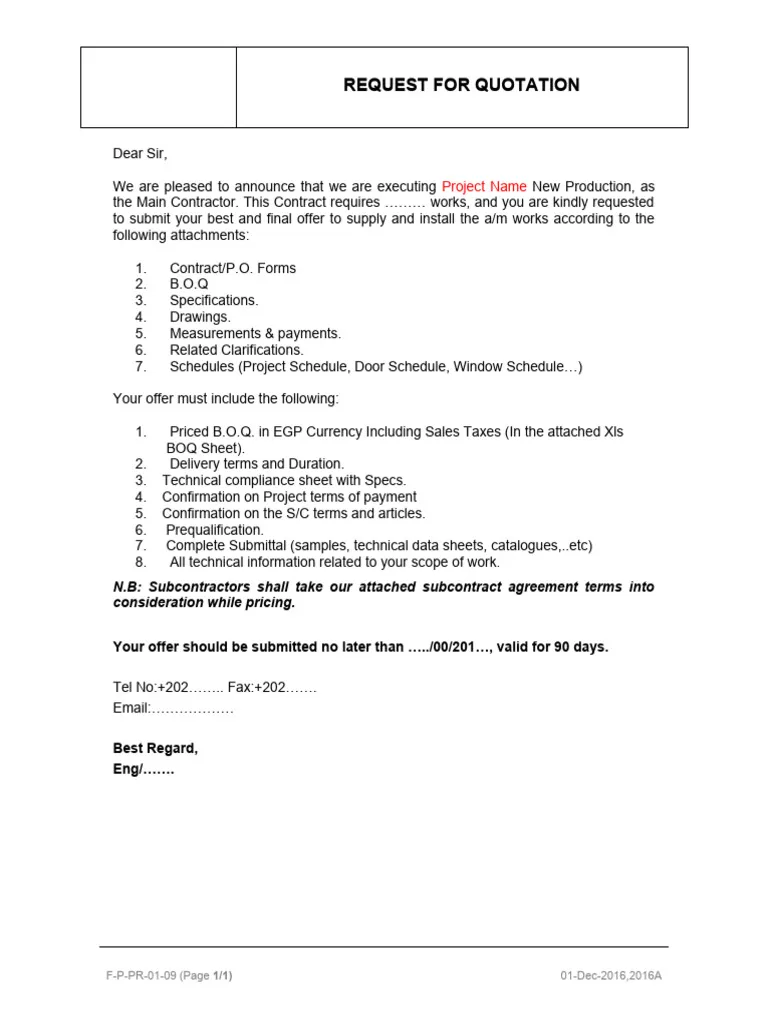
Understanding the RFQ Cover Letter
An RFQ (Request for Quotation) cover letter is a critical document in the business world. It serves as your introduction to a potential client or partner, and it’s your first chance to make a positive impression. Unlike a standard cover letter for a job application, an RFQ cover letter is specifically tailored to respond to a request for quotation. Its primary purpose is to persuade the recipient that your company is the best choice to fulfill their needs, whether they are seeking services, products, or solutions. A well-crafted cover letter does more than just acknowledge the RFQ; it actively demonstrates your understanding of the client’s requirements and presents a compelling case for why they should choose you. It highlights your unique value proposition, showcases your expertise, and lays the foundation for a successful business relationship. The effectiveness of your RFQ cover letter can significantly influence your chances of winning the bid and securing valuable business opportunities. Therefore, careful attention to detail and a strategic approach are essential.
Importance of a Strong RFQ Cover Letter
The significance of a strong RFQ cover letter cannot be overstated. It is the cornerstone of your response and the primary tool for capturing the attention of the evaluating team. A well-written cover letter is your chance to stand out from the competition, demonstrate your understanding of the project, and showcase your company’s capabilities. Without a compelling cover letter, even the most competitive pricing or technically superior proposal might be overlooked. The cover letter sets the tone for the entire response, creating a sense of trust and professionalism that can significantly influence the decision-making process. It allows you to present your company’s unique selling points, articulate your value proposition, and address the specific requirements outlined in the RFQ. Furthermore, a well-crafted cover letter reflects your commitment to detail and your dedication to providing a high-quality response. It demonstrates that you have taken the time to understand the client’s needs and are prepared to offer a tailored solution. In essence, the RFQ cover letter is your sales pitch and an essential component of a winning proposal.
Tip 1 Highlight Your Expertise

One of the most crucial aspects of an RFQ cover letter is showcasing your expertise. This involves clearly and concisely demonstrating your qualifications and experience in relation to the specific requirements outlined in the RFQ. Begin by emphasizing your core competencies and how they align with the client’s needs. Use specific examples to illustrate your past successes, highlighting projects or initiatives that are similar to the one described in the RFQ. Quantify your achievements whenever possible, providing tangible evidence of your capabilities. For example, instead of saying, “We have extensive experience in project management,” you might say, “We have successfully managed over 50 projects, delivering them on time and within budget.” Tailor your expertise to the specific RFQ, focusing on the aspects of your experience that are most relevant to the client’s needs. Avoid generic statements and instead, provide concrete evidence of your ability to deliver the desired outcomes. This approach builds credibility and makes a compelling case for why your company is the best choice for the project. Demonstrate your understanding of the client’s industry and the specific challenges they face, further enhancing your credibility.
Demonstrating Relevant Experience
When demonstrating relevant experience, the focus should be on providing specific examples that directly relate to the requirements of the RFQ. Instead of merely listing past projects, provide a brief overview of each project, including the scope, your role, and the key outcomes achieved. Use action verbs to describe your contributions and responsibilities, and quantify your results whenever possible. For example, instead of stating, “We provided consulting services,” you could say, “We provided consulting services that resulted in a 20% increase in operational efficiency.” Highlight any awards, certifications, or recognition your company has received, as these serve as further validation of your expertise. Ensure that the projects you showcase are recent and relevant, demonstrating that your skills and knowledge are up-to-date. Tailor the experience you highlight to the specific industry and type of project outlined in the RFQ, showing that you have a deep understanding of the client’s context. If you have experience working with similar clients or in similar environments, be sure to highlight that as well.
Tailoring to RFQ Requirements
Tailoring your cover letter to the specific requirements of the RFQ is crucial for demonstrating your understanding and responsiveness. Carefully review the RFQ document, paying close attention to the specific needs, objectives, and evaluation criteria outlined by the client. Use the client’s language and terminology throughout your cover letter, showing that you have thoroughly understood their requirements. Address each of the key points and objectives explicitly, and provide clear, concise responses. Do not simply rehash information; instead, provide insights, demonstrate your understanding, and showcase your proposed solutions. Highlight how your company’s capabilities, experience, and proposed approach directly address the client’s needs. Structure your cover letter in a way that aligns with the RFQ’s structure, making it easy for the client to find the information they need. Always double-check your cover letter to ensure that you have included all the required information and that you have not omitted anything essential. By tailoring your cover letter, you show that you are attentive to detail, and serious about winning the bid.
Tip 2 Focus on Value Proposition

A compelling value proposition is at the heart of a successful RFQ cover letter. This is where you articulate the unique benefits that your company offers and why the client should choose you over the competition. Clearly state the value you bring to the table and what makes your company the best choice. Highlight your unique selling points, such as specialized expertise, innovative solutions, or cost-effectiveness. Differentiate yourself from other bidders by focusing on what sets your company apart. Articulate your understanding of the client’s pain points and explain how your solutions can alleviate those problems. Show how your company can help the client achieve their goals, improve their operations, or increase their profitability. Your value proposition should be concise, impactful, and easy for the client to understand. It should go beyond simply stating what you do and focus on the positive outcomes the client will experience by working with you. Back up your claims with evidence, such as case studies, testimonials, or quantifiable results from past projects.
Quantifying Benefits for the Client
Quantifying the benefits for the client is a powerful way to strengthen your value proposition and make a compelling case for your company. Instead of making generic statements, provide specific, measurable results that demonstrate the positive impact you can have. Use data, statistics, and concrete examples to illustrate the value you bring. For example, if you’re offering a cost-saving solution, quantify the potential savings in terms of dollars or percentage. If you’re offering a time-saving solution, quantify the time savings in terms of hours or days. If you have improved a client’s efficiency, quantify the improvement in terms of productivity gains or reduced errors. Use metrics that are relevant to the client’s goals and objectives. Show how your solutions align with their key performance indicators (KPIs). This approach transforms your value proposition from a general statement into a concrete set of benefits that the client can readily understand and appreciate. Always back up your claims with evidence from past projects or studies, providing further validation and increasing your credibility.
Addressing the Client’s Needs
Addressing the client’s specific needs is crucial for demonstrating that you have thoroughly understood the RFQ and are capable of delivering a tailored solution. Carefully review the RFQ document and identify the key requirements, objectives, and challenges that the client has outlined. Demonstrate your understanding of the client’s industry, business, and specific project needs. Explain how your proposed solution directly addresses each of these needs. Highlight any specific challenges the client is facing and provide a detailed plan of how your company will address these issues. Show that you have a deep understanding of the client’s context and the outcomes they are seeking. Tailor your response to fit their specific needs. Avoid generic answers and provide concrete solutions and examples that resonate with the client’s requirements. Clearly state how your company’s capabilities, experience, and proposed approach directly align with the client’s needs, and how you will deliver the desired results. Show that you are not only qualified but also genuinely committed to helping the client succeed.
Tip 3 Maintain Professionalism

Professionalism is paramount in an RFQ cover letter. This encompasses all aspects of your communication, from the tone of your writing to the formatting of your document. Maintain a professional tone throughout your cover letter, avoiding slang, jargon, or overly casual language. Address the client with respect and use their preferred terminology. Proofread your cover letter carefully to eliminate any grammatical errors, spelling mistakes, or typos. Use clear and concise language to convey your message effectively. Ensure that your cover letter is well-organized, easy to read, and visually appealing. Use a professional-looking font, appropriate spacing, and clear headings and subheadings. Always use formal business letter formatting, including a proper salutation and closing. Present your company’s logo and contact information in a clear and professional manner. Maintain consistency in your branding throughout your cover letter and all accompanying documents. Your cover letter is a direct reflection of your company and its values, so every aspect of your communication should project a sense of professionalism and competence.
Formatting the Cover Letter
Proper formatting is essential for creating a professional and polished RFQ cover letter. Use a standard business letter format, including your company’s letterhead, the date, the client’s name and address, a formal salutation, the body of the letter, a closing, and your signature. Choose a professional-looking font, such as Times New Roman, Arial, or Calibri, and maintain consistency throughout the document. Use a font size that is easy to read, typically 11 or 12 points. Use clear and concise headings and subheadings to organize your content and make it easy for the reader to find the information they need. Use bullet points and numbered lists to highlight key points and make the information more digestible. Use appropriate spacing between paragraphs and sections to improve readability. Ensure that your document is free from any formatting errors, such as inconsistent margins or line breaks. Before submitting your cover letter, review it carefully to ensure that it is well-formatted and professional in appearance. Your formatting choices play a significant role in how the client perceives your company.
Proofreading for Accuracy
Proofreading your RFQ cover letter is a crucial step that should never be overlooked. Errors in grammar, spelling, or punctuation can undermine your credibility and create a negative impression. Thoroughly proofread your cover letter to eliminate any errors. Read your cover letter slowly and carefully, paying attention to every word. Consider having a colleague or friend proofread your cover letter as well. Use spell check and grammar check tools, but do not rely on them entirely, as they may not catch all errors. Check for consistency in your use of language, terminology, and formatting. Ensure that all names, titles, and dates are correct. Verify that your contact information is accurate. Proofread your cover letter multiple times, as errors can be easily overlooked. Take a break before proofreading, and then review your cover letter with fresh eyes. Your attention to detail in proofreading demonstrates your professionalism and commitment to providing a high-quality response. A polished and error-free cover letter reflects positively on your company and significantly increases your chances of winning the bid.
Tip 4 Showcase Understanding of the RFQ

Demonstrating a thorough understanding of the RFQ is critical for a successful cover letter. This shows the client that you have carefully read the document and have taken the time to understand their needs, objectives, and requirements. Begin by referencing the specific RFQ number and title in your cover letter. Acknowledge the purpose of the RFQ and express your interest in responding to it. Highlight the key elements of the RFQ, such as the scope of work, the desired outcomes, and the evaluation criteria. Demonstrate your comprehension of the client’s goals and how they align with the overall project objectives. Show that you have identified the client’s challenges and are prepared to offer solutions. Provide a brief overview of your proposed approach, highlighting how you will address the client’s needs. Avoid simply repeating the information from the RFQ. Instead, provide insights, demonstrate your understanding, and articulate your vision for the project. The better you understand the RFQ, the more effectively you can tailor your response to meet the client’s expectations.
Addressing Key Objectives
Effectively addressing the key objectives outlined in the RFQ is a core element of a compelling cover letter. The RFQ will contain specific objectives that the client hopes to achieve. Clearly state that you understand those objectives and you are committed to helping the client achieve those goals. Detail how your proposed approach directly supports the achievement of those objectives. Provide specific examples of past successes that demonstrate your ability to deliver similar results. Outline your approach in a clear and concise manner, highlighting the key strategies and tactics you will use. Show how your proposed approach is aligned with the client’s priorities and evaluation criteria. Use quantifiable metrics and data to demonstrate the potential benefits of your solution. By carefully addressing the key objectives, you show that you are fully prepared to meet the client’s needs and that you are the right choice for the project. A strong connection to the objectives creates trust.
Demonstrating Comprehension
Demonstrating your comprehension of the RFQ goes beyond simply stating that you understand the requirements. It requires you to actively show how you have interpreted the information provided and how you plan to address the client’s needs. Use the client’s language and terminology throughout your cover letter, demonstrating that you have a solid understanding of their context. Summarize the key challenges and objectives from the RFQ in your own words, confirming your comprehension. Provide examples of your experience that specifically relate to the requirements of the RFQ. Explain how your proposed solution addresses the client’s pain points and helps them achieve their goals. Show that you have considered potential risks and challenges and have developed a plan to mitigate them. Demonstrate your understanding of the project’s scope, deliverables, and timeline. Your comprehension demonstrates your ability to execute the work effectively. By showing your understanding of the RFQ, you build confidence in your ability to deliver a successful outcome. This level of detail can make your application the winner.
Tip 5 Include a Clear Call to Action

A clear and compelling call to action (CTA) is essential for an RFQ cover letter. It guides the reader on the next steps you want them to take. The CTA should be specific, concise, and easy to understand. Do not assume that the client will automatically know what you want them to do. Clearly state what you want the client to do next, whether it’s scheduling a meeting, requesting additional information, or contacting you to discuss the proposal. Make it easy for the client to respond by providing your contact information and any other relevant details. Use action-oriented language to encourage the client to take the desired action. For example, instead of saying “We hope to hear from you soon,” say “Please contact us to schedule a meeting to discuss this proposal.” The call to action should be located at the end of your cover letter, just before the closing. Make sure your call to action aligns with the overall purpose of the cover letter and reinforces your value proposition. A well-crafted call to action increases the likelihood that the client will take the next step and consider your proposal.
Encouraging Further Engagement
Encouraging further engagement is a key element of a successful call to action. Once you have captured the client’s attention with your cover letter, it’s essential to provide a clear pathway for them to learn more or take the next step. Offer to provide additional information, such as a more detailed proposal, case studies, or references. Invite the client to schedule a meeting or call to discuss the project in more detail. Provide multiple options for contact, such as phone, email, and website. Ensure that your contact information is accurate and up-to-date. Show that you are available and eager to answer any questions the client may have. Make it easy for the client to reach out to you by providing clear and concise contact instructions. Consider providing a link to your website or portfolio. Reinforce the value of your proposal by restating key benefits or your unique selling points in your call to action. A strong call to action demonstrates your commitment to building a relationship with the client and increases your chances of winning the bid.
Providing Contact Information
Providing accurate and accessible contact information is a fundamental aspect of the RFQ cover letter. This allows the client to easily reach you and learn more about your company and your proposed solution. Include your company’s full name, address, phone number, email address, and website address. Ensure that your contact information is accurate and up-to-date. Make sure your contact information is prominently displayed in your cover letter, typically at the top or bottom. Provide the name and title of the primary contact person for the project. Consider including a direct phone number and email address for the contact person. Ensure that all contact information is clearly legible and easy to read. Before submitting your cover letter, double-check all of your contact information to verify that it is accurate and complete. The easier it is for the client to contact you, the greater the likelihood that they will follow up on your proposal. Your availability is a strong selling point.