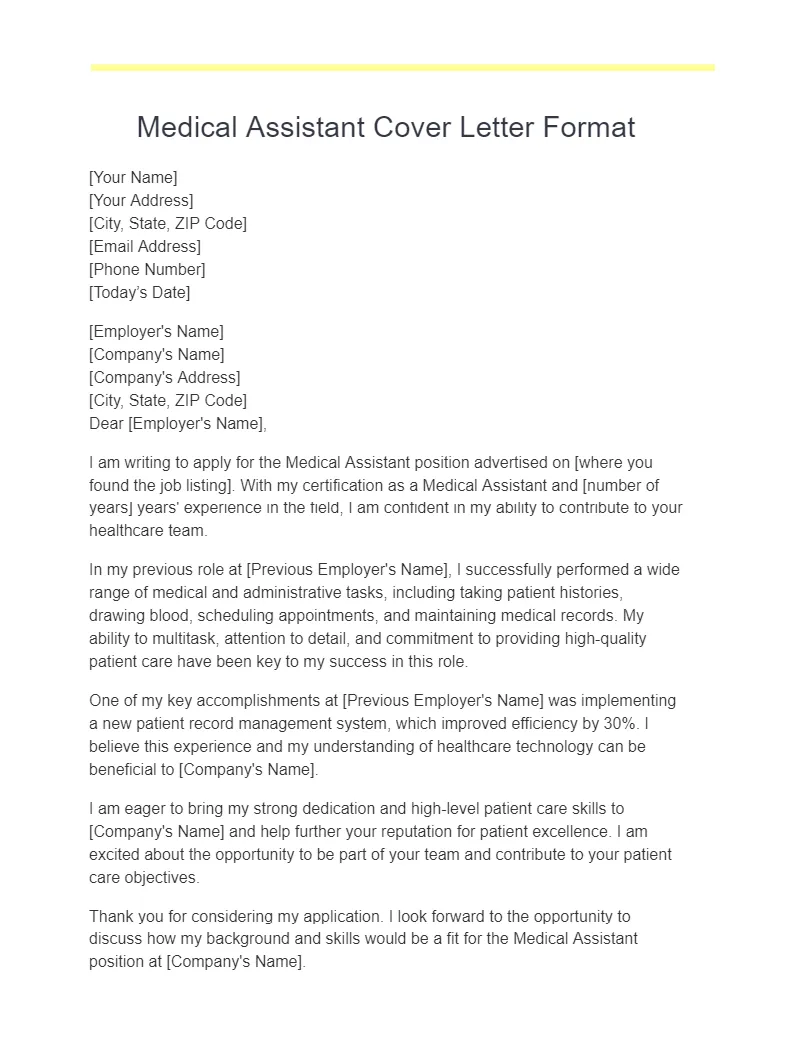
Cover Letter for Medical Assistant: The Ultimate Guide
Landing a job as a Medical Assistant requires more than just a stellar resume. A well-crafted cover letter is your opportunity to shine, showcasing your personality, passion, and qualifications. This guide provides a comprehensive walkthrough of how to create a compelling medical assistant cover letter that grabs the hiring manager’s attention and increases your chances of getting an interview. We’ll cover everything from the essential components to common pitfalls to avoid, ensuring your application stands out from the competition.
Understanding the Purpose of a Cover Letter
The primary purpose of a cover letter is to introduce yourself, express your interest in the position, and highlight why you’re the perfect fit for the role. It allows you to expand on your resume, providing context and detail that a list of skills and experiences cannot convey. Think of it as your personal marketing document, designed to persuade the employer to learn more about you.
Why a Cover Letter Matters for Medical Assistants

In the competitive field of healthcare, a cover letter gives you a distinct advantage. It demonstrates your communication skills, attention to detail, and genuine interest in the specific opportunity. It also provides a platform to showcase your understanding of the medical assistant role, including patient care, administrative tasks, and technical skills. A well-written letter can significantly improve your chances of being selected for an interview.
Key Components of a Medical Assistant Cover Letter
Your Contact Information and Date
At the top of your cover letter, include your full name, phone number, email address, and optionally, your LinkedIn profile URL. Directly beneath this, include the date you are sending the cover letter. This information is essential for the employer to easily contact you.
The Hiring Manager’s Contact Information

If possible, address your cover letter to a specific person, such as the hiring manager or the practice administrator. Research the company website or LinkedIn to find the appropriate name and title. Addressing the letter to a specific person shows initiative and demonstrates your genuine interest in the position. If you cannot find a specific name, use a professional greeting like “Dear Hiring Manager.”
Greeting the Hiring Manager
Begin your cover letter with a professional greeting. “Dear Mr./Ms. [Last Name]” is a standard and respectful choice. If you are unsure of the hiring manager’s gender, use their full name or a gender-neutral greeting. Avoid generic greetings such as “To Whom It May Concern.”
Crafting a Compelling Opening Paragraph
Your opening paragraph should immediately grab the reader’s attention. State the position you are applying for and where you found the job posting. Briefly express your enthusiasm for the role and the organization. You could also mention a key skill or accomplishment that makes you stand out.
Highlighting Relevant Skills and Experience

This is where you showcase your relevant skills and experience. Provide specific examples of how your skills align with the job requirements. Use action verbs to describe your accomplishments and responsibilities. For example, instead of saying “Assisted with patient care,” say “Administered medications and assisted with patient examinations, resulting in improved patient outcomes.” Tailor this section to match the specific requirements outlined in the job description.
Quantifying Your Achievements
Whenever possible, quantify your achievements to demonstrate your impact. For instance, instead of saying “Managed patient records,” say “Managed patient records for over 100 patients, ensuring accuracy and confidentiality.” Numbers and statistics make your accomplishments more tangible and compelling.
Showcasing Your Soft Skills
Medical assisting requires a blend of technical and soft skills. Highlight your interpersonal abilities, such as communication, empathy, and teamwork. Give examples of how you’ve used these skills to interact with patients and colleagues, resolve conflicts, or contribute to a positive work environment. These skills are as important as your technical abilities.
Expressing Your Enthusiasm and Interest

Convey your genuine enthusiasm for the position and the organization. Explain why you are drawn to the role and what you hope to contribute. Research the organization’s mission, values, and recent accomplishments to demonstrate your understanding and interest. This shows that you have done your homework and are genuinely interested in being part of their team.
Closing the Cover Letter Effectively
In your closing paragraph, reiterate your interest in the position and thank the hiring manager for their time and consideration. Include a call to action, such as stating that you look forward to hearing from them soon or that you are available for an interview at their earliest convenience. Reiterate your contact information, as well.
Proofreading and Editing Your Cover Letter
Before submitting your cover letter, carefully proofread and edit it for any errors in grammar, spelling, and punctuation. Ask a friend, family member, or career counselor to review your letter as well. A polished, error-free cover letter demonstrates your attention to detail and professionalism.
Formatting Your Cover Letter for Readability

Font and Style Recommendations
Choose a professional and readable font, such as Times New Roman, Arial, or Calibri. Use a font size between 10 and 12 points. Maintain consistent formatting throughout the document, including spacing, margins, and alignment. This ensures your cover letter is easy to read and visually appealing.
File Format and Submission Guidelines
Unless otherwise specified, save your cover letter as a PDF to preserve the formatting. Follow the employer’s submission instructions carefully. If the job posting requests specific formatting or file names, adhere to those instructions to ensure your application is properly received and reviewed.
Medical Assistant Cover Letter Examples

Example 1 Clinical Setting
Dear [Hiring Manager Name],
I am writing to express my keen interest in the Medical Assistant position at [Clinic Name], as advertised on [Platform]. With [Number] years of experience in a fast-paced clinical environment, I am confident in my ability to provide exceptional patient care and support the smooth operation of your practice. In my previous role at [Previous Clinic], I consistently assisted physicians with examinations, administered medications, and managed patient records with accuracy and efficiency. My strong communication skills and compassionate approach enable me to build rapport with patients and ensure their comfort. I am eager to contribute my skills and dedication to your team. Thank you for your time and consideration.
Sincerely, [Your Name]
Example 2 Administrative Setting
Dear [Hiring Manager Name],
I am writing to apply for the Medical Assistant position at [Clinic Name], as advertised on [Platform]. My background in medical administration has equipped me with a strong understanding of patient intake, scheduling, and insurance processing. I am proficient in [Relevant Software] and possess excellent organizational and communication skills. I am passionate about delivering outstanding patient service and streamlining administrative processes. I am particularly drawn to [Clinic Name]’s commitment to [Mention Company Values], and I am confident that I can contribute to your team’s success. Thank you for your time and consideration.
Sincerely, [Your Name]
Common Mistakes to Avoid
Generic Cover Letters
Avoid using a generic cover letter that is not tailored to the specific job or company. Hiring managers can easily identify generic applications, which often get overlooked. Always customize your cover letter to reflect the specific requirements of the position and the values of the organization.
Typos and Grammatical Errors
Typos and grammatical errors create a negative impression and suggest a lack of attention to detail. Proofread your cover letter carefully, and use spell-check and grammar-check tools. Ask someone else to review your letter before submitting it. A flawless cover letter showcases your professionalism.
Focusing Solely on Job Duties
Instead of merely listing your job duties, focus on your accomplishments and how you have made a positive impact in previous roles. Quantify your achievements whenever possible, and highlight your transferable skills and personal qualities. This will make your cover letter much more engaging and memorable.
Tailoring Your Cover Letter
Researching the Employer
Before writing your cover letter, thoroughly research the employer and the specific role. Understand their mission, values, and any recent developments. This research will help you tailor your letter to reflect your understanding of their needs and demonstrate your genuine interest in the opportunity.
Matching Your Skills to the Job Description
Carefully review the job description and identify the key skills and qualifications required. Highlight your relevant skills and experiences and provide specific examples to demonstrate how you meet those requirements. Use keywords from the job description to ensure your cover letter is easily scanned by applicant tracking systems.
In conclusion, a well-crafted medical assistant cover letter is a crucial component of your job application. By following these guidelines, you can create a compelling cover letter that showcases your skills, experience, and enthusiasm, and increases your chances of securing an interview. Remember to tailor your letter to each specific job, proofread carefully, and highlight your achievements. Good luck with your job search!