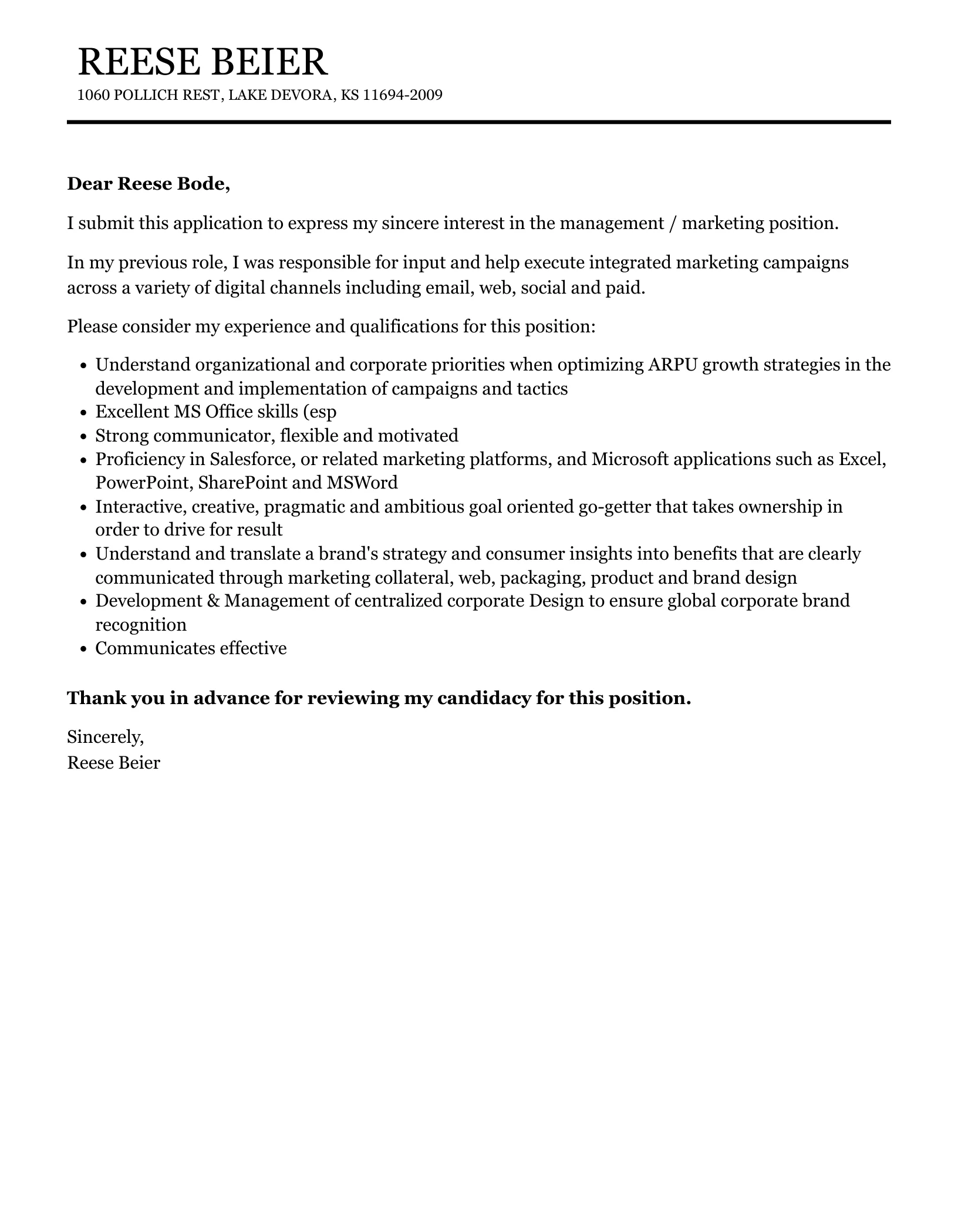
Understanding the Marketing Management Cover Letter
A marketing management cover letter is your first opportunity to impress a potential employer and showcase your qualifications for a marketing management position. Unlike a resume, which provides a factual overview of your experience, a cover letter allows you to tell your story, highlighting your passion, skills, and suitability for the specific role. It’s a crucial tool in any job seeker’s arsenal, providing a personalized introduction and a compelling reason to consider your application. Your cover letter acts as a marketing piece itself, selling your abilities and demonstrating your understanding of marketing principles. A well-crafted cover letter goes beyond simply listing your accomplishments; it connects your experience to the employer’s needs and demonstrates how you can contribute to their success. Therefore, taking the time to write a strong, tailored cover letter is essential for landing your dream job in marketing management.
Key Components of a Marketing Management Cover Letter
A successful marketing management cover letter consists of several key components that work together to create a compelling narrative. These elements should be carefully crafted to present a professional and persuasive argument for why you are the best candidate for the job. Each part serves a specific purpose, contributing to the overall impact of your application. From the initial greeting to the final call to action, every sentence should be intentional and focused on conveying your value and enthusiasm. By mastering these components, you can create a cover letter that stands out from the competition and effectively communicates your qualifications.
Contact Information & Salutation

Begin with your contact information, including your name, address, phone number, and email address. Then, address the letter to the hiring manager or the specific contact person if possible. Using their name immediately personalizes your application and shows you’ve done your research. If the name isn’t available, a professional salutation such as “Dear Hiring Manager” is appropriate. Avoid generic greetings like “To Whom It May Concern.” This sets a professional tone from the start and demonstrates attention to detail. Ensuring accuracy in this section is also critical, as it provides the employer with the means to contact you.
Highlighting Your Value Proposition
This section is where you introduce yourself and immediately capture the reader’s attention. Clearly state the position you’re applying for and briefly summarize your most relevant qualifications. Your value proposition is a concise statement of what you bring to the table – your unique skills, experiences, and accomplishments. Highlight what makes you stand out and why the employer should be interested in you. This section should be compelling enough to encourage the reader to continue reading. It’s your initial pitch, designed to spark interest and establish your suitability for the role. Focus on demonstrating how your skills align with the specific requirements of the job.
Quantifiable Achievements
Instead of merely listing your responsibilities, quantify your achievements whenever possible. Use numbers, percentages, and specific examples to demonstrate your impact in previous roles. For instance, instead of saying “Managed social media campaigns,” say “Increased social media engagement by 30% within six months.” This approach provides concrete evidence of your abilities and allows the employer to easily assess your value. Quantifiable achievements showcase your ability to deliver results and provide a clear understanding of your past successes. Use the STAR method (Situation, Task, Action, Result) to structure your examples effectively, providing context and highlighting the tangible outcomes of your work.
Relevant Skills & Experience

This is where you detail your skills and experience, directly linking them to the job requirements. Focus on the skills and experiences that are most relevant to the position you’re applying for. Use keywords from the job description to demonstrate your understanding of what the employer is looking for. Provide specific examples of how you’ve used your skills in previous roles, and explain the results you achieved. This section is about demonstrating your competency and showing the employer that you possess the necessary qualifications. Tailor this section to each job, highlighting the most relevant aspects of your background. Focus on both hard skills (e.g., data analysis, SEO) and soft skills (e.g., communication, leadership).
Tailoring to the Job Description
Carefully review the job description and tailor your cover letter to match its requirements. Identify the key skills, experiences, and qualifications the employer is seeking. Then, use the cover letter to demonstrate how your skills and experience align with those requirements. Avoid using a generic cover letter; instead, personalize each letter to reflect the specific needs of the role. This demonstrates your understanding of the position and shows the employer that you’ve taken the time to consider their needs. Refer to specific aspects of the job description and explain how you meet or exceed their expectations. This personalization significantly increases your chances of getting an interview.
Showcasing Your Passion & Enthusiasm
Express your genuine enthusiasm for the role and the company. Explain why you’re interested in the specific opportunity and what excites you about the prospect of working there. Your passion can be a significant differentiator. Show how you have followed the company and its activities. Use language that conveys your excitement and demonstrates your understanding of the company’s mission and values. Enthusiasm is infectious and can make a positive impression on the hiring manager. This part shows that you are not just looking for a job but are genuinely interested in contributing to the company’s success. Share specific aspects of the company or the role that appeal to you.
Call to Action & Closing

End your cover letter with a clear call to action, such as expressing your interest in an interview and stating your availability. Thank the reader for their time and consideration. A strong call to action encourages the employer to take the next step. Reiterate your interest in the role and reiterate your contact information. Use a professional closing, such as “Sincerely” or “Best regards,” followed by your name. This is your final chance to leave a lasting impression, so make it concise and professional. Ensure the closing is polite and reinforces your enthusiasm for the opportunity. Proofread the entire letter one last time before submitting.
Formatting and Presentation Best Practices
The formatting and presentation of your marketing management cover letter are just as important as its content. A well-formatted letter demonstrates professionalism and attention to detail, making it easier for the hiring manager to read and understand your qualifications. Poor formatting can create a negative impression, regardless of the quality of your writing. Adhering to formatting best practices enhances readability and ensures your letter presents you in the best possible light.
Font and Style
Choose a professional and easy-to-read font, such as Times New Roman, Arial, or Calibri. Keep the font size between 10 and 12 points. Maintain a consistent font throughout the letter. Use appropriate spacing and alignment to improve readability. Use bolding or italics sparingly for emphasis. Avoid using excessive colors, fancy fonts, or graphics, as they can detract from the professionalism of your cover letter. A clean, uncluttered layout makes the content more accessible and allows your message to be received effectively. Select a font that is suitable for business correspondence.
Length and Structure

Keep your cover letter concise and focused, ideally no more than one page long. Organize your content logically with clear paragraphs and headings. Start with an engaging introduction, followed by the body paragraphs that highlight your qualifications, and end with a strong conclusion. Use bullet points to highlight key skills or achievements when appropriate. Maintain a professional tone and use clear, concise language. Break up large blocks of text to improve readability. Structure your cover letter in a way that presents the most important information first, capturing the reader’s attention from the start.
Proofreading and Editing
Proofread your cover letter carefully for any errors in grammar, spelling, and punctuation. Errors can reflect poorly on your attention to detail. Consider having a friend or career advisor review your letter for feedback. Pay attention to sentence structure and clarity. Ensure your language is professional and avoids slang or jargon. Edit your letter multiple times, looking for any inconsistencies or areas where the writing can be improved. A polished, error-free cover letter demonstrates your professionalism and commitment to excellence.
Common Mistakes to Avoid
Certain mistakes can significantly diminish the effectiveness of your marketing management cover letter. These errors can create a negative impression and reduce your chances of getting an interview. By understanding these common pitfalls, you can avoid them and create a more compelling application. Being aware of these mistakes ensures that your cover letter presents you in the best possible light.
Generic Cover Letters

Avoid using a generic cover letter that isn’t tailored to the specific job or company. Generic letters show a lack of interest and attention to detail. Each cover letter should be customized to reflect the specific requirements of the role and the company’s values. Research the company and tailor your letter to address their specific needs. Demonstrate that you have taken the time to understand the position and the organization. Personalization makes a significant difference in setting you apart from the competition. Adapt the letter to match the company’s brand voice.
Typos and Grammatical Errors
Typos and grammatical errors are a significant turn-off for employers. They reflect a lack of attention to detail and can undermine your credibility. Always proofread your cover letter multiple times. Use spell-check and grammar-check tools, but also read the letter carefully yourself. Have someone else review your letter to catch any errors you may have missed. A clean, error-free cover letter demonstrates professionalism and respect for the employer. Ensure every sentence is grammatically correct and that all words are spelled correctly.
Exaggerated Claims
Avoid making exaggerated or unsubstantiated claims about your skills or experience. Be honest and accurate in your self-representation. While it’s important to highlight your accomplishments, don’t overstate them. Exaggerated claims can damage your credibility and lead to disappointment if you’re hired. Focus on providing verifiable examples and quantifiable achievements. Ensure your claims align with your resume and interview responses. Honesty is the best policy when it comes to portraying your skills and experiences.
Examples of Successful Marketing Management Cover Letters

Reviewing examples of successful marketing management cover letters can provide valuable insights into crafting your own. These examples can show you how to structure your letter, highlight your qualifications, and effectively communicate your value proposition. Analyzing successful examples will help you understand what makes a cover letter persuasive and memorable. Consider the tone, language, and structure of each example. Pay attention to how the applicants showcase their skills and experience. Adapt the strategies used in these examples to your own unique situation. Look for examples that are tailored to specific roles and industries. This will give you a good idea of the kind of language, tone, and style that appeals to hiring managers.