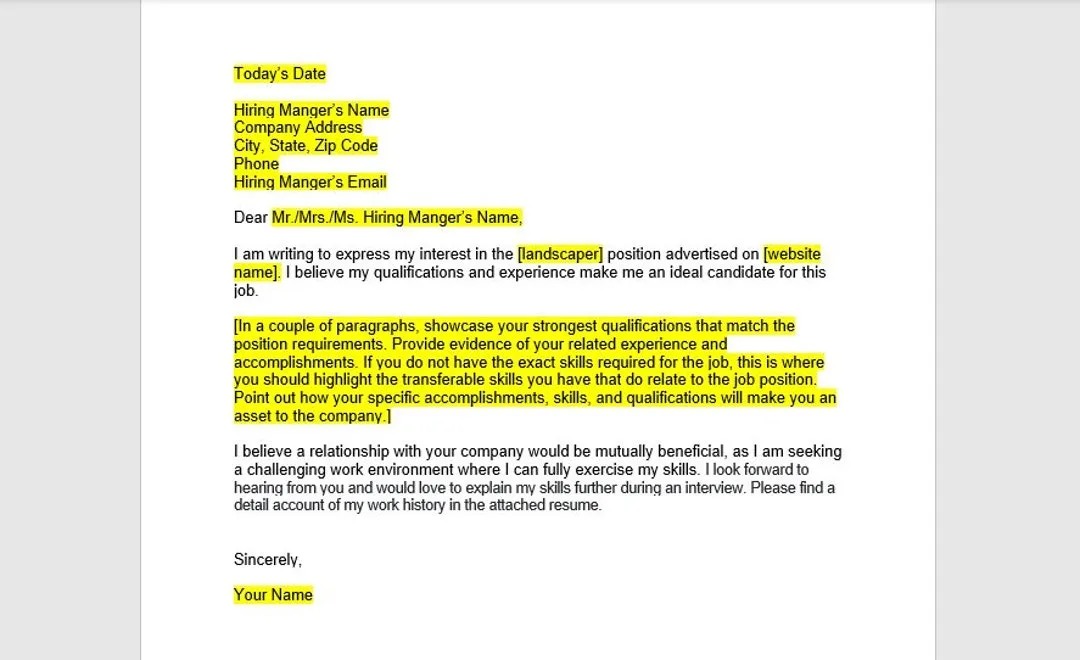
What is a Landscaping Cover Letter?
A landscaping cover letter is a document that accompanies your resume when applying for a landscaping job. It serves as your first introduction to a potential employer, offering a personalized overview of your skills, experience, and why you’re the ideal candidate. Unlike a resume, which is a factual summary, a cover letter allows you to showcase your personality, express your passion for landscaping, and highlight specific accomplishments relevant to the job description. It provides context, allowing you to elaborate on experiences, explain any gaps in your employment, and demonstrate how your qualifications align with the company’s needs. Think of it as your personal sales pitch, designed to grab the hiring manager’s attention and encourage them to delve deeper into your qualifications.
Why is a Cover Letter Important for Landscaping Jobs?
In the competitive field of landscaping, a cover letter can significantly boost your chances of getting hired. It demonstrates your communication skills and attention to detail, traits highly valued in any professional setting. Moreover, a well-crafted cover letter allows you to tailor your application to the specific job and company, proving that you’ve put in the effort to understand their needs. This personalized approach makes you stand out from generic applicants. Cover letters provide a space to highlight your unique skills, such as expertise in specific plants, experience with landscape design software, or proficiency in operating specialized equipment. They also allow you to express your enthusiasm for the role and the company’s mission, demonstrating your genuine interest, and potential to integrate into the team.
Key Elements of a Winning Landscaping Cover Letter

A compelling landscaping cover letter includes several essential components that work together to present a complete picture of your qualifications and personality. From the header to the closing, each section plays a vital role in securing an interview. Understanding these key elements will allow you to craft a cover letter that effectively communicates your skills and aligns with the needs of the employer. Let’s explore each section in detail to ensure you create a standout cover letter that gets you noticed and ultimately gets you hired for your dream landscaping job.
Your Contact Information
Begin your cover letter with your contact information in the header. This should include your full name, phone number, email address, and optionally, your LinkedIn profile URL or a link to your online portfolio if you have one. Ensure your contact information is accurate and professional. This makes it easy for the hiring manager to reach you. Using a professional email address is crucial – avoid using nicknames or informal language. The header should be concise and easy to read, typically left-aligned or centered at the top of the document, setting a clean and organized tone for the entire letter. Properly formatted contact details show your attention to detail.
The Date and the Recipient’s Information
Following your contact details, include the date and the recipient’s information. The date is the day you are sending the letter. Below the date, include the name of the hiring manager (if known), their job title, the company name, and the company’s address. If you are unsure of the hiring manager’s name, research the company website, check LinkedIn, or call the company to ask. Addressing the letter to a specific person shows you have taken the time to research, and demonstrates initiative, professionalism, and your genuine interest in the role. If you cannot find a specific name, use a general salutation like ‘Dear Hiring Manager’.
The Salutation

The salutation is the greeting of your cover letter. Use ‘Dear Mr./Ms./Mx. [Last Name]’ if you know the hiring manager’s name. If you do not know the name, use ‘Dear Hiring Manager’ or ‘Dear [Company Name] Hiring Team.’ Avoid generic greetings like ‘To Whom It May Concern,’ as they lack personalization. The salutation sets the tone for the rest of your letter. Make sure it’s formal and professional. The salutation’s purpose is to start a positive interaction, immediately setting the stage for your qualifications. A well-chosen salutation shows respect and attention to detail, crucial in any landscaping job.
Highlighting Your Skills and Experience
This section is the heart of your cover letter, where you showcase your skills and experience, and make the connection to the job. Use concise and impactful language to highlight your abilities and experience relevant to the landscaping position. Demonstrate how your skills align with the job requirements. This helps the hiring manager see you as the best fit. Explain the value you bring to the company by drawing parallels between your expertise and the duties outlined in the job description. Use specific examples from your previous roles to support your claims and back them up with solid achievements.
Emphasize Relevant Skills
Carefully review the job description and highlight the skills the employer is seeking. These might include: knowledge of plant care, experience with irrigation systems, proficiency in operating landscaping equipment (mowers, trimmers, etc.), landscape design skills (if applicable), knowledge of sustainable landscaping practices, or experience in hardscaping or softscaping. Give specific examples of how you have used these skills in previous roles. For example, if the job requires experience with irrigation systems, mention that you have designed, installed, or maintained them. Focus on the skills that are most important to the job and provide clear evidence of your abilities, such as training or certifications.
Showcase Your Experience

Detail your landscaping experience, including the name of the companies you have worked for, your job titles, and the dates of employment. Briefly describe your responsibilities and achievements in each role. Focus on experiences relevant to the job. Use action verbs to describe your accomplishments. Instead of saying you ‘worked on’ a project, you could say you ‘managed’ a project, ‘designed’ a landscape, or ‘maintained’ a garden. Be specific about your responsibilities. For example, if you have experience with client interactions, mention the number of clients you served or the satisfaction rate of the clients. The goal is to provide the hiring manager with enough information to understand your background and your potential value to the company.
Quantify Your Achievements
Whenever possible, quantify your achievements to demonstrate your impact in previous roles. Instead of saying you ‘improved’ a process, mention that you ‘reduced costs by 15%’ or ‘increased efficiency by 20%’. Use numbers and metrics to showcase your accomplishments. Did you manage a team and increase productivity? Did you design landscapes that increased property value? Did you receive any awards or recognition? Quantifying your achievements provides concrete evidence of your abilities and the positive results you have generated. This data shows the hiring manager the direct value you can bring. These specific, measurable achievements will set you apart from other applicants.
Expressing Your Enthusiasm and Passion
Your cover letter is your chance to convey your passion for landscaping and your enthusiasm for the specific job. Explain why you are interested in working for the company and the role, highlighting aspects that resonate with you. Research the company’s values, projects, and mission. Demonstrate that you understand their work and how you could contribute to their success. Show your passion for landscaping. Share what you find inspiring about working with plants, designing outdoor spaces, or creating beautiful landscapes. Mention any specific projects that caught your eye or any company values that align with your own. Your enthusiasm will make you more memorable.
Tailoring Your Cover Letter

Customizing your cover letter for each job application is essential for success. Generic cover letters are easily recognized and often discarded. Customization shows the hiring manager that you’ve invested time and effort into understanding the company’s needs and the job’s requirements. It demonstrates your genuine interest and increases the likelihood of securing an interview. Tailoring goes beyond simply changing the company name; it involves aligning your skills and experience with the specific needs of the job and company, showing that you’re a perfect fit. This personalized approach will make you stand out from the other candidates.
Research the Company
Before you begin writing, research the company. Visit their website, read about their projects, and review their social media presence to understand their values, mission, and the types of projects they undertake. Identify the specific services they offer, the types of clients they serve, and any awards or recognition they have received. This research will allow you to tailor your cover letter. Mention specific projects or aspects of the company that you admire, showing that you have taken the time to learn about them. Understanding the company’s culture and values will help you align your cover letter with their needs, making your application more effective.
Match Skills and Needs
Carefully review the job description and identify the required skills, experience, and qualifications. Then, align your skills and experiences with these requirements. Highlight the skills and experiences that match what the employer is looking for. Give specific examples of how you have successfully utilized those skills in previous roles. Use keywords from the job description in your cover letter. This will help the hiring manager immediately see that you are a good fit. Explain how your unique skills and experience can help the company achieve its goals, such as improving efficiency, delivering superior results, or enhancing client satisfaction. Your letter shows how you can contribute to their success.
Proofreading and Formatting

Proofreading and formatting are essential to present your cover letter professionally. A well-formatted and error-free cover letter shows attention to detail, professionalism, and respect for the recipient. Pay close attention to formatting, readability, and accuracy. Errors can detract from your qualifications and make it appear you lack attention to detail. Proper formatting and thorough proofreading will create a positive first impression and increase your chances of making it to the interview stage. Taking these steps will reflect your commitment to excellence and enhance your credibility.
Formatting for Readability
Choose a clean and easy-to-read font, such as Times New Roman, Arial, or Calibri, in a standard size (11 or 12 points). Use a professional font. Use appropriate spacing and margins (1-inch margins on all sides). The text should be justified to the left. Use single spacing within paragraphs and double spacing between paragraphs to make the text easy to follow. Break up large blocks of text with bullet points or short paragraphs. These make the information more digestible and easier to scan. Ensure your cover letter is well-organized. The document should be visually appealing and easy to read to create a positive first impression for the hiring manager.
Proofreading for Errors
Thoroughly proofread your cover letter for any grammatical errors, spelling mistakes, or typos. Carefully check the accuracy of your contact information, the recipient’s name, and the company details. Use grammar and spell check tools. But remember that these tools are not foolproof, so also read your letter carefully yourself. It is a good idea to have someone else review your letter, as a fresh pair of eyes can often catch errors you might miss. Proofreading is essential. It shows your attention to detail and professionalism. A polished cover letter is essential to make a positive impression and increase your chances of being considered for the landscaping job.
Call to Action and Closing

The closing of your cover letter is your final opportunity to make a positive impression and motivate the hiring manager to take action. A strong call to action, coupled with a professional closing, can significantly increase the likelihood of securing an interview. This section should summarize your key qualifications. It should reiterate your enthusiasm and provide clear instructions for the next steps. It ensures a lasting impression and clearly communicates your intention to take the next step in the hiring process, demonstrating your professionalism and proactive approach.
The Closing
End your cover letter with a professional closing, such as ‘Sincerely,’ ‘Respectfully,’ or ‘Best regards.’ Avoid overly casual or informal closings. Follow the closing with your typed name. If you are submitting a physical copy, leave space for your signature above your typed name. Ensure your closing is consistent with the tone of your entire letter, and conveys your professionalism and gratitude. The closing should be concise. It should leave a positive and memorable impression, signaling your commitment to the landscaping job and your professionalism. This will help to end your letter on a positive note.
Contact Information
Reiterate your contact information. Provide your phone number and email address. Make it easy for the hiring manager to reach you. You can also mention your availability for an interview. Express your enthusiasm once more. Reiterate your interest in the role and your enthusiasm to be a part of the team. You can also state you look forward to hearing from them soon. End with a thank you. Express your gratitude for their time and consideration. A polite thank you is essential and shows respect. This final action reinforces your professional attitude and leaves the hiring manager with a positive impression of your application.
Examples of Strong Landscaping Cover Letters

Reviewing examples of successful landscaping cover letters can provide valuable insights and inspiration. These examples demonstrate how to structure your letter, showcase skills, and tailor your message to specific job requirements. Pay attention to the language used, how the applicant highlights experience, and the overall tone. Adapt the examples to your qualifications, but also ensure your cover letter is original. Tailor these examples to your unique skills and experiences. This helps ensure your letter is relevant to the job and company. Using these examples as a starting point will give you a framework to create an effective cover letter that gets you noticed.
Common Mistakes to Avoid
Avoid common mistakes that can hurt your chances. These are usually easy to fix. One common mistake is using a generic cover letter that is not tailored to the specific job. Always address the letter to the hiring manager by name (when possible) and address the requirements listed in the job description. Ensure there are no typos. Always proofread your letter. Don’t include irrelevant information that doesn’t relate to the job. Keep your cover letter focused. Focus on relevant skills and experience. Do not use overly casual language. Keep your language professional and formal. Avoid negative statements or complaints. Be positive and emphasize your strengths.
Sending Your Cover Letter
When sending your cover letter, pay close attention to the details to ensure your application makes a positive first impression. If submitting online, save your cover letter as a PDF file, unless the job description specifies a different format. This ensures that your formatting remains consistent, regardless of the recipient’s software. Name your file with your name and the job title. (e.g., John_Doe_Landscaper_CoverLetter.pdf). In the email subject line, include the job title and your name. (e.g., Landscaper Application - John Doe). Make sure to attach your cover letter and resume to the email. In the body of the email, include a brief message reiterating your interest in the position and thanking the recipient for their consideration.