Understanding the Importance of a Cover Letter for Internal Promotion
Applying for an internal promotion is a significant step in your career. While your work history and performance reviews speak volumes, a well-crafted cover letter provides a crucial opportunity to showcase your skills, aspirations, and suitability for the role. Many candidates often underestimate the impact of a cover letter, viewing it as a formality. However, it serves as a personalized introduction, allowing you to connect with the hiring manager on a deeper level and demonstrate your enthusiasm for the new position. It’s your chance to highlight why you are the best fit, beyond what is evident in your resume, and articulate your career goals within the company.
Why a Cover Letter is Crucial
A cover letter is far more than just a formality; it is a strategic tool. Firstly, it enables you to demonstrate your genuine interest in the specific role. By tailoring the letter to the new position, you can express your excitement and show that you’ve taken the time to understand the requirements. Secondly, it provides a platform to explain any career transitions, gaps in employment, or other relevant factors that might need clarification. This proactive approach ensures the hiring manager understands your full story and can accurately assess your application. Finally, a cover letter allows you to set yourself apart from other candidates. By highlighting your unique strengths and aligning them with the company’s needs, you can make a compelling case for your promotion.
Highlighting Your Achievements

One of the most critical aspects of a cover letter for internal promotion is highlighting your achievements. This section allows you to showcase your contributions to the company and demonstrate your value. Instead of simply listing your responsibilities, focus on quantifiable results. For example, instead of stating “Managed social media accounts,” write “Increased social media engagement by 40% in six months, resulting in a 20% rise in lead generation.” Use action verbs and provide specific examples to illustrate your skills and impact. This could include project leadership, problem-solving abilities, or improvements to existing processes. By focusing on your accomplishments, you effectively communicate your potential to excel in the new role.
Key Components of a Winning Cover Letter
A successful cover letter includes several key components that work together to create a strong first impression and convey your qualifications effectively. A well-structured letter follows a clear format, presenting your information in a logical and compelling manner. Each section serves a specific purpose, guiding the reader through your qualifications and demonstrating your suitability for the promotion. Failing to include these key components or formatting them poorly can diminish your chances of success. The following outlines the essentials for crafting a compelling cover letter that will stand out to the hiring manager and improve your chances of getting the internal promotion you are seeking.
Header Information
The header of your cover letter sets the tone and provides essential contact information. Begin by including your full name, address, phone number, and professional email address. Ensure that your email address is professional and appropriate for business correspondence. Next, include the date and the recipient’s information. This typically includes the hiring manager’s name (if known), their title, and the company’s address. Always double-check this information to ensure accuracy. A well-formatted header not only looks professional but also makes it easy for the hiring manager to contact you, showcasing your attention to detail.
Recipient’s Information

Addressing your cover letter to the right person is a critical step that demonstrates your initiative and attention to detail. Whenever possible, address the letter to the hiring manager or the specific individual responsible for making promotion decisions. Research the company’s organizational chart or reach out to HR to determine the appropriate contact. If the hiring manager’s name is unavailable, use a professional salutation such as “Dear Hiring Manager” or “Dear [Department Name] Team.” Avoid generic greetings like “To Whom It May Concern.” A personalized approach shows that you have taken the time to research the company and are genuinely interested in the opportunity.
Opening Paragraph
The opening paragraph is your first chance to grab the hiring manager’s attention and set the stage for the rest of your cover letter. Start by clearly stating the position you are applying for and where you saw the opening (e.g., internal job board, company announcement). Then, concisely express your enthusiasm for the role and the company. Briefly mention your current role and your tenure within the organization. You might also include a brief statement about why you are excited about this opportunity and what you hope to achieve in the new position. This introduction should be engaging and show that you understand the requirements of the role and are eager to take on the challenge.
Body Paragraphs
The body paragraphs are the heart of your cover letter, where you present your qualifications and skills in detail. These sections should elaborate on your relevant experience, achievements, and how they align with the requirements of the new role. Focus on demonstrating your value through specific examples and quantifiable results. Tailor the content to the specific job description, highlighting the skills and experiences most relevant to the position. The body of the cover letter is your primary opportunity to connect your past contributions to the future needs of the company. Each paragraph should build upon the previous one, creating a cohesive narrative that supports your application.
Highlighting Relevant Skills and Experience

In the body paragraphs, specifically address the skills and experience that make you a strong candidate. Review the job description carefully and identify the key requirements. Then, provide examples from your previous roles where you have demonstrated those skills. This may include technical skills, leadership abilities, project management experience, or any other qualifications listed in the job posting. Use action verbs to describe your accomplishments and provide context. Explain the situation, the actions you took, and the results you achieved (the STAR method is useful here). This approach proves that you have the competencies required to succeed in the new role.
Quantifying Your Accomplishments
Whenever possible, quantify your accomplishments to provide concrete evidence of your success. Instead of saying you “improved customer satisfaction,” state that you “increased customer satisfaction scores by 15% within six months.” Use numbers, percentages, and specific data to illustrate your impact. This helps the hiring manager understand the value you brought to previous roles and how you can contribute to the company’s success in the new position. This approach not only enhances your credibility but also makes your achievements more memorable and impactful. Quantifiable results highlight your value.
Addressing Your Career Goals
A cover letter for an internal promotion offers an opportunity to express your career goals and how the new role aligns with your professional aspirations. Briefly explain why you are interested in the promotion and how it fits into your long-term career plan within the company. Show that you have considered your growth and development. If you have any specific training or education related to the new role, mention it here. This shows the hiring manager that you are not just looking for a new job, but are committed to your development and the company’s success, making you a more attractive candidate for promotion.
Closing Paragraph

The closing paragraph of your cover letter should be concise and impactful. Thank the hiring manager for considering your application and reiterate your enthusiasm for the role. State your interest in an interview and make it easy for them to contact you. You can also briefly mention your availability. Avoid using generic phrases; instead, make your closing paragraph personalized and enthusiastic. This is your final chance to leave a positive impression. A strong closing paragraph can motivate the hiring manager to act and take the next step in the hiring process, improving your chances of an interview.
Format and Tone
The format and tone of your cover letter are essential aspects of conveying professionalism and making a positive impression. The right format ensures your information is easy to read, while the tone reflects your personality and enthusiasm. These elements must work together to make a strong statement about your qualifications and interest in the internal promotion. Both the format and tone contribute significantly to the impact of your cover letter. Mastering these elements will improve the clarity and effectiveness of your application. A polished appearance with an appropriate tone shows your attention to detail and professionalism.
Formatting Your Cover Letter
Proper formatting is vital for creating a visually appealing and easy-to-read cover letter. Use a professional and readable font, such as Arial, Calibri, or Times New Roman, and maintain a consistent font size (typically 11 or 12 points). Set margins to one inch on all sides and use single-line spacing. Keep your cover letter concise; aim for no more than one page. Use bullet points or numbered lists to highlight key accomplishments or skills, making the information easily digestible. Proper formatting reflects professionalism and respect for the reader’s time. A well-formatted cover letter is more likely to engage the reader and highlight your qualifications.
Choosing the Right Tone

The tone of your cover letter should be professional, enthusiastic, and tailored to the company culture. Use a positive and confident tone throughout, emphasizing your accomplishments and your interest in the role. Show your passion for the company. Avoid using overly casual language or slang. If the company culture is more formal, use a correspondingly professional tone. If the company culture is more relaxed, a slightly more approachable tone may be appropriate. Always proofread your cover letter to eliminate any grammatical errors or typos, as they can detract from the overall message. Choosing the right tone can significantly enhance your cover letter.
Sample Cover Letter for Internal Promotion
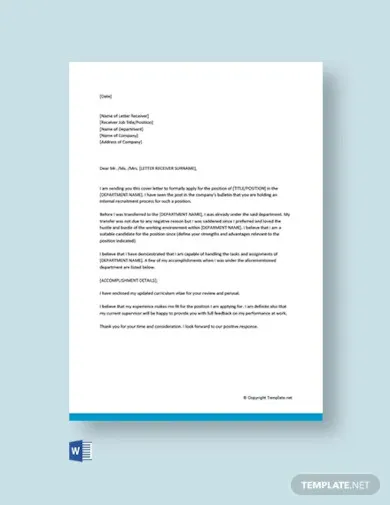
Reviewing a sample cover letter can give you a practical example to guide your writing. The following sample demonstrates how to structure and compose a cover letter effectively, including all the key elements discussed. Consider this sample as a template, adjusting it to include your own information and tailoring it to the specific job requirements. Studying a sample can help you understand how to articulate your qualifications and create a compelling document that stands out.
Header and Salutation
Your Name Your Address Your Phone Number Your Email Address
Date Hiring Manager Name (if known) Title Company Name Company Address
Dear Mr./Ms. [Last Name] or Dear Hiring Manager,
Body of the Letter

I am writing to express my keen interest in the [Job Title] position at [Company Name], as advertised on [Platform]. As a [Your Current Job Title] with [Number] years of experience at [Company Name], I am confident that my skills and experience align perfectly with the requirements of this role. In my current role, I have consistently exceeded expectations, as demonstrated by [Specific Accomplishment 1] and [Specific Accomplishment 2]. For example, I [Quantifiable Result]. I am particularly excited about the opportunity to [Mention specific tasks and responsibilities from the job description]. My career goals include [Mention career goals]. I am enthusiastic about continuing my career within [Company Name] and contributing to the company’s success. Thank you for considering my application. I have attached my resume for your review.
Closing
Sincerely, Your Signature (if printing) Your Typed Name
Proofreading and Submitting Your Cover Letter
Once you have completed your cover letter, it’s essential to proofread it meticulously. This step ensures your document is free of errors and makes a professional impression. Proofreading is critical for enhancing your credibility and presenting yourself as a detail-oriented professional. A cover letter filled with typos and grammatical errors can damage your chances of getting the promotion, regardless of your qualifications. Taking the time to thoroughly review and edit your work shows your commitment and attention to detail. Consider seeking feedback from others to catch anything you may have missed.
Proofreading Checklist
Use a proofreading checklist to ensure you have addressed all the crucial elements. Here’s a checklist for your cover letter: Check all the spelling and grammar. Verify that the recipient’s information is accurate. Confirm that the job title and company name are correct. Ensure that your contact information is current. Verify that your accomplishments are quantified and supported by specific examples. Review the tone and ensure it is professional and enthusiastic. Check for consistency in formatting throughout the document. Read the letter aloud to catch any awkward phrasing. Have someone else proofread your cover letter for a fresh perspective. Use spell-check and grammar-check tools to assist in this process.
Submission Guidelines
Before submitting your cover letter, review the submission guidelines provided by your company. Adhere to the instructions regarding the preferred format (e.g., PDF, Word document), naming conventions, and any specific requirements mentioned in the job posting. If the guidelines specify whether to send the cover letter as an attachment or to include it in the body of the email, follow them precisely. Make sure your cover letter is well-formatted, easy to read, and free of any errors. Submitting the application correctly demonstrates your attention to detail and your respect for the company’s procedures. Following these guidelines can help avoid missteps and increases your chances of getting your application viewed by the hiring manager.