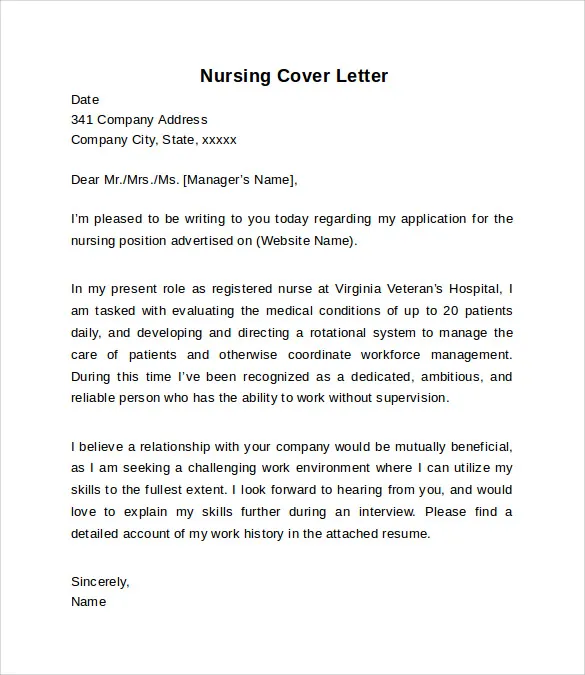
Understanding the Importance of a Nurse Cover Letter
In the competitive world of nursing, a well-crafted cover letter can be your key to unlocking your dream job. It’s more than just a formality; it’s your chance to make a strong first impression and differentiate yourself from other qualified candidates. Your cover letter serves as your personal introduction, offering a glimpse into your skills, experience, and passion for nursing. It allows you to go beyond the basic details of your resume and connect with the hiring manager on a more personal level, showcasing your personality and enthusiasm for the role. A compelling cover letter highlights your unique qualifications and demonstrates your genuine interest in the specific position and the healthcare organization. By investing time and effort into creating a standout cover letter, you significantly increase your chances of landing an interview and ultimately, securing your desired nursing position. A strong cover letter is your voice, giving you an advantage.
Why a Cover Letter Matters
A nurse cover letter is not just a formality, it’s an essential tool for your job application. It allows you to tell your story in a way that your resume cannot. It’s an opportunity to showcase your personality, your passion for nursing, and your genuine interest in the specific position. Unlike a resume, which provides a factual summary of your experience, a cover letter enables you to articulate why you’re the perfect fit for the job, highlighting your skills, experiences, and accomplishments in a narrative format. It demonstrates your communication skills, attention to detail, and your ability to tailor your message to a specific audience - the hiring manager. Furthermore, it gives you a chance to address any gaps in your resume or explain specific career choices. In a crowded job market, a well-written cover letter can set you apart, making you a memorable candidate and increasing your chances of getting an interview. Think of it as your first chance to sell yourself, emphasizing your value proposition and what you bring to the table.
Key Components of a Strong Cover Letter

A strong nurse cover letter is well-structured and includes several key components. Begin with a professional heading including your contact information, the date, and the employer’s details. The introduction should immediately grab the reader’s attention, stating the position you’re applying for and how you learned about it. The body of the letter should highlight your relevant skills, experience, and accomplishments, backing them up with concrete examples. Be specific about how your qualifications align with the job description, demonstrating your understanding of the role and the organization’s needs. In the closing paragraph, reiterate your interest in the position, thank the hiring manager for their time, and express your availability for an interview. Maintain a professional tone throughout, using clear and concise language and proofreading meticulously for any errors in grammar or spelling. By including these essential elements, you can create a cover letter that effectively presents you as a qualified and enthusiastic candidate, increasing your chances of getting hired. Make sure to tailor each cover letter to the specific job you are applying for.
Crafting a Compelling Cover Letter Introduction
The introduction of your nurse cover letter is crucial, as it sets the tone for the entire letter and captures the reader’s attention. Start by clearly stating the position you are applying for and where you saw the job posting. In the first sentence, aim to grab the hiring manager’s interest by briefly mentioning your key qualifications or a compelling achievement. For instance, you could highlight your years of experience, a specific skill, or a successful project you were involved in. Then, briefly state why you are interested in the position and the healthcare organization. Show that you’ve done your research and understand their mission and values. Avoid generic introductions; personalize your letter to demonstrate your genuine interest. The introduction should create a sense of excitement and make the reader want to learn more about you. A strong opening immediately shows the reader that you are the perfect fit and sets the stage for the rest of your cover letter.
Highlighting Your Skills and Experience
In the body of your cover letter, you’ll want to highlight your skills and experience relevant to the nursing position. Don’t just list your skills; provide specific examples of how you’ve utilized them. For instance, if you have experience in critical care, describe how you managed a specific situation, the challenges you overcame, and the positive outcomes you achieved. Use the job description as a guide to identify the key skills the employer is looking for and tailor your examples to match these requirements. Focus on quantifiable achievements whenever possible, such as the number of patients you’ve cared for, the percentage improvement in patient outcomes, or any recognition you received. Explain your experience, making sure to explain how your past experiences align with the needs of the position. By providing tangible evidence of your abilities, you’ll demonstrate your value to the potential employer. Remember to use action verbs to describe your accomplishments and avoid generic statements. Specificity and detail are key in showing your expertise.
Showcasing Relevant Certifications

Highlighting your certifications is a key aspect of showcasing your qualifications in your nurse cover letter. Certifications demonstrate your commitment to professional development and your expertise in specific areas of nursing. Be sure to mention any certifications relevant to the position you are applying for, such as Advanced Cardiac Life Support (ACLS), Pediatric Advanced Life Support (PALS), or Certified Medical-Surgical Registered Nurse (CMSRN). Include the certification’s name, the issuing organization, and the date of your certification or renewal. If you have multiple certifications, prioritize those most relevant to the job requirements. You can mention the certifications in the skills section or in a separate section dedicated to your credentials. Providing your certifications will bolster your application and give the hiring manager assurance of your skills.
Quantifying Achievements
Quantifying your achievements makes your cover letter more impactful and helps the hiring manager understand the value you bring to the table. Instead of simply stating that you improved patient outcomes, provide specific metrics. For example, you could say, “Reduced patient fall rates by 15% through the implementation of a new safety protocol.” Or, if you have experience in training, you could state, “Trained over 50 nurses on new protocols, leading to a 10% improvement in compliance.” Use numbers, percentages, and specific data to demonstrate the impact of your contributions. These quantifiable examples will make your achievements more tangible and memorable. When discussing your achievements, start with an action verb, describe the task or situation, and then state the result, quantifying the positive outcome. By providing concrete evidence of your accomplishments, you clearly showcase your value and increase your chances of getting the job.
Demonstrating Your Passion for Nursing
Showcasing your passion for nursing is critical to setting your cover letter apart. Hiring managers are looking for candidates who genuinely love their profession and are dedicated to providing exceptional patient care. In your cover letter, express your enthusiasm for nursing by sharing what you find most rewarding about the profession. You could describe the satisfaction you gain from helping patients, your commitment to making a difference in their lives, or your dedication to continuous learning and professional development. Share specific experiences that have shaped your passion for nursing, such as a memorable patient encounter or a particularly challenging situation you overcame. Demonstrate your understanding of the nursing field and the qualities that make a successful nurse - compassion, empathy, and attention to detail. Make sure to show that you are driven to grow in the profession, and that you are invested in your patients.
Expressing Your Career Goals

Expressing your career goals in your cover letter helps to show the hiring manager where you see yourself going and that you have long-term plans in the nursing field. Briefly state your aspirations and how the specific position aligns with your professional objectives. Describe the types of experiences you seek, what you hope to learn and the skills you want to develop. For example, you could state that you are eager to advance your knowledge in a specific specialty, take on leadership responsibilities, or contribute to improving patient care outcomes. Show how the position aligns with your long-term goals. Remember to be realistic and avoid vague statements. Focus on how the position will help you achieve your objectives and how your skills and experience will benefit the organization. Showing that you are invested and have a vision for your future will help your application stand out and increase your chances of being hired.
Tailoring Your Letter to the Specific Job
Tailoring your cover letter to each specific job is essential for demonstrating your genuine interest and suitability for the position. Avoid using a generic template; instead, customize your letter to match the requirements and expectations outlined in the job description. Carefully review the job posting, identifying the key skills, experiences, and qualifications the employer is seeking. Then, align your cover letter to address each of these requirements. Highlight your relevant skills and experiences and provide specific examples that demonstrate how you have successfully used those skills in the past. In each cover letter, address your specific qualifications and how they align with the listed needs. Customize the introduction, the body, and the closing to show your enthusiasm for the specific role. Show that you have researched the healthcare organization and understand their mission and values, and that you are excited to contribute to their team. This individualized approach will make a strong impression and increase your chances of getting noticed.
Formatting and Proofreading Your Cover Letter
The formatting and proofreading of your nurse cover letter are just as important as the content. Your cover letter is a reflection of your professionalism and attention to detail. Always use a professional font, such as Times New Roman, Arial, or Calibri, and maintain a consistent font size (11 or 12 points) throughout the document. Use single spacing and ensure a clean, easy-to-read format. Divide your letter into clear sections with headings to make it easy for the hiring manager to navigate. Ensure that the layout is visually appealing and free of errors in grammar and spelling. Before submitting your letter, carefully proofread it for any errors. Read it aloud to catch any awkward phrasing or typos. Ask a friend or colleague to review your letter and provide feedback. A well-formatted and error-free cover letter demonstrates your professionalism and gives the hiring manager a positive first impression.
Formatting Best Practices

Following formatting best practices will enhance the professionalism and readability of your nurse cover letter. Start by using a professional font, like Times New Roman, Arial, or Calibri, with a size of 11 or 12 points. Use single-spacing for the body of the letter and leave a blank line between paragraphs to improve readability. Include your contact information at the top of the letter, followed by the date, and the hiring manager’s information. Use clear and concise language, avoiding overly complex sentences or jargon. Divide your letter into sections with clear headings to make it easy for the reader to scan and find key information. Maintain consistent margins throughout the document. By adhering to these formatting best practices, you’ll create a polished cover letter that makes a positive first impression and shows your attention to detail.
Proofreading Checklist
Before submitting your nurse cover letter, use a proofreading checklist to ensure it is free of errors. Begin by checking for grammatical errors, such as subject-verb agreement, correct tense usage, and proper punctuation. Ensure that all words are spelled correctly. Verify that you’ve used the correct names, dates, and job titles. Check for any typos or formatting inconsistencies. Read your cover letter aloud to catch any awkward phrasing or unclear sentences. Ask a friend or colleague to review your letter for a fresh perspective. Double-check your contact information. Review the letter to ensure it is tailored to the specific job and company. Ensure the language and tone are professional and appropriate. By using this checklist, you will eliminate errors and create a well-written and polished cover letter that demonstrates your attention to detail and commitment to excellence.
Nurse Cover Letter Examples
Reviewing nurse cover letter examples can provide valuable insights and inspiration as you create your own. Look for examples that align with your experience and the type of nursing position you are seeking. Pay attention to the structure, tone, and language used in successful cover letters. Observe how the candidates highlight their skills, experience, and accomplishments and how they tailor their letters to specific job descriptions. Analyze the introductions, body paragraphs, and closing statements to get ideas on how to best present yourself. By studying a range of examples, you can identify the elements that make a cover letter compelling and persuasive. You can also learn how to effectively showcase your unique qualifications and express your enthusiasm for the nursing profession. Remember to personalize each cover letter to match your unique skills.
Example Cover Letter for a Registered Nurse

To give you an idea of how to put everything together, here’s a sample cover letter for a Registered Nurse (RN) position. This is a template, and you should always personalize it to your experience and the specific job. [Your Name] [Your Address] [Your Phone Number] [Your Email] [Date] [Hiring Manager Name] [Hiring Manager Title] [Hospital/Clinic Name] [Hospital/Clinic Address] Dear [Hiring Manager Name], I am writing to express my interest in the Registered Nurse position at [Hospital/Clinic Name], as advertised on [Platform]. With [Number] years of experience in [Specialty, e.g., medical-surgical nursing], I am a highly motivated and compassionate RN dedicated to providing exceptional patient care. I am proficient in [List key skills, e.g., administering medications, wound care, patient assessment] and have a proven track record of [Quantifiable achievement, e.g., improving patient satisfaction scores]. My strong communication and teamwork skills, combined with my ability to remain calm under pressure, make me an ideal candidate. I am eager to contribute my expertise and passion to [Hospital/Clinic Name]’s mission of [Their mission]. Thank you for your time and consideration. I look forward to hearing from you soon. Sincerely, [Your Name]
Example Cover Letter for a Nurse Practitioner
Here’s a sample Nurse Practitioner (NP) cover letter, keeping in mind the importance of personalization. [Your Name] [Your Address] [Your Phone Number] [Your Email] [Date] [Hiring Manager Name] [Hiring Manager Title] [Clinic/Hospital Name] [Clinic/Hospital Address] Dear [Hiring Manager Name], I am writing to express my interest in the Nurse Practitioner position at [Clinic/Hospital Name], as advertised on [Platform]. With [Number] years of experience as a Nurse Practitioner, specializing in [Specialty], I possess the skills and dedication required to contribute to your team. I am certified by [Certifying Body] and have a strong background in [Specific skills and experience]. I am passionate about providing comprehensive and patient-centered care, and I am particularly drawn to [Clinic/Hospital Name]’s commitment to [Their values]. I am eager to help my patients and make a difference in their lives. I am confident that my skills and experience align with the needs of your clinic. Thank you for considering my application. I look forward to the possibility of an interview. Sincerely, [Your Name]
Finalizing and Submitting Your Cover Letter
Before submitting your nurse cover letter, carefully review all the final steps to ensure that your application is complete and professional. Save your cover letter and resume in a professional format, such as PDF, to preserve the formatting. Make sure the file names are clear and concise, for example, “Your Name - Cover Letter” and “Your Name - Resume”. If the job posting specifies how to submit your application, carefully follow those instructions. If not, consider whether to submit your cover letter as an attachment or paste the text directly into the email. Always include a clear and concise subject line in your email. Proofread the email for any typos or formatting issues. After submitting, send a thank-you note to the hiring manager, if appropriate. Keep a copy of your cover letter and resume for your records. By paying close attention to these details, you’ll increase your chances of making a strong first impression and successfully landing an interview.