Understanding the Importance of a Cover Letter HR
In the competitive world of human resources, a well-crafted cover letter can be your secret weapon. It’s often the first impression you make on a hiring manager, and it provides an opportunity to showcase your personality, passion, and qualifications in a way that a resume alone cannot. Many applicants underestimate the value of a cover letter, which is a significant mistake. A strong cover letter can differentiate you from other candidates, highlighting your unique skills and experiences and demonstrating your genuine interest in the specific role and company. Think of it as your personalized introduction, where you articulate not just what you’ve done but why you’re the perfect fit for the job. This document provides a narrative that connects your skills to the job’s requirements, giving context to your resume’s achievements and outlining your professional goals.
Why Cover Letters HR Matter
Cover letters for HR positions are crucial because they allow you to demonstrate your communication skills, attention to detail, and understanding of HR principles. Recruiters and hiring managers in HR often seek candidates who can effectively communicate complex information, demonstrate empathy, and possess strong organizational skills. A well-written cover letter showcases these qualities. It provides a platform to explain career transitions, address potential gaps in your resume, or highlight experiences that might not be immediately obvious from your resume. Furthermore, a compelling cover letter indicates that you’ve taken the time to research the company and the specific role, showing your genuine interest. In a field where interpersonal skills and professionalism are paramount, the cover letter becomes a critical tool for showcasing your suitability for an HR role.
The Role of a Cover Letter in HR Applications

The role of a cover letter in HR applications extends beyond simply introducing yourself. It’s a strategic tool for emphasizing your alignment with the company’s culture and values. By tailoring your letter to each specific job and company, you demonstrate your commitment to the position. This document serves as an opportunity to explain how your experience aligns with the role’s needs, articulating how you can solve their problems and contribute to their success. You can also use it to showcase your understanding of HR best practices, employment laws, and industry trends. It’s a chance to tell a story about your career path and aspirations, adding a personal touch that sets you apart. Remember to be professional and succinct, providing relevant details without overwhelming the reader. The cover letter is your chance to make a memorable first impression.
Key Components of a Winning HR Cover Letter
A winning HR cover letter comprises several key components that work together to make a strong impression. Begin with your contact information, the date, and the hiring manager’s name and title, if known. The opening paragraph should immediately grab the reader’s attention. State the position you’re applying for and briefly explain why you’re interested. In the body of the letter, highlight your relevant skills and experience, providing specific examples that demonstrate your abilities. Quantify your achievements whenever possible, using metrics to showcase your impact. Tailor your letter to the specific role and company, demonstrating that you’ve done your research. Conclude with a strong closing paragraph that reiterates your interest and expresses your enthusiasm for the opportunity. Proofread meticulously and ensure your letter is free of errors.
Contact Information and Salutation HR
Start your HR cover letter with your contact information, including your name, phone number, email address, and LinkedIn profile URL (optional). Place this information at the top of the letter. Then, include the date and the hiring manager’s name and title, if available. Addressing the hiring manager by name shows that you’ve taken the time to research the company and the application process, which indicates your attention to detail. If you can’t find the hiring manager’s name, use a professional salutation, such as “Dear Hiring Manager” or “Dear [Department Name] Team.” Avoid generic greetings like “To Whom It May Concern,” which can make your letter appear impersonal. Ensure the salutation matches the tone and formality of the company culture, demonstrating your understanding of professional communication standards.
Crafting a Compelling Opening HR

The opening paragraph is your first chance to capture the hiring manager’s attention. Instead of simply stating that you’re applying for a job, make it exciting. State the specific position you are applying for and immediately highlight your key qualification or the skill that makes you a strong candidate. You can also mention what initially attracted you to the role. You could state your enthusiasm for the company or their mission, showing your interest and research on the company. Keep it concise, interesting, and relevant to the role. For example, you could open by mentioning a specific achievement or expressing how your passion for HR aligns with the company’s values. The goal is to make the hiring manager want to keep reading. If you are looking for an HR role at a tech company, mention the company’s technology, and how your experience could bring improvement to the HR technology used at the company.
Highlighting Your Skills and Experience HR
In the body of your HR cover letter, highlight your relevant skills and experience. Match your skills to the job description and demonstrate how you meet the required qualifications. Provide specific examples of your accomplishments using the STAR method (Situation, Task, Action, Result) to showcase your abilities. Focus on the skills and experiences that are most relevant to the role, such as recruitment, employee relations, training and development, or compensation and benefits. Back up your claims with concrete evidence; don’t just say you’re a good communicator; describe a situation where you successfully resolved a conflict. Use action verbs to describe your contributions, such as ‘managed,’ ‘implemented,’ ‘developed,’ and ‘coordinated.’ Ensure the information is clear, concise, and easy to read. The examples should emphasize how you’ve made a positive impact in your previous HR roles, demonstrating your value as a candidate.
Showcasing Relevant HR Experience
When showcasing your HR experience, focus on the roles, projects, and accomplishments that align with the job description. Include any experiences in recruitment, employee relations, benefits administration, or training and development, and detail how you have contributed to these areas. For each experience, describe your specific responsibilities, the actions you took, and the positive outcomes. For instance, if you have experience in recruitment, detail the number of successful hires you’ve made, the time-to-hire improvements, and the strategies you used. If you have worked on employee relations, mention how you’ve resolved conflicts, improved employee satisfaction, or implemented new policies. The more relevant your experience, the better your chances of being noticed. If you’re transitioning from another field, describe how your transferable skills, such as communication, problem-solving, or leadership, can be applied to HR.
Quantifying Achievements HR
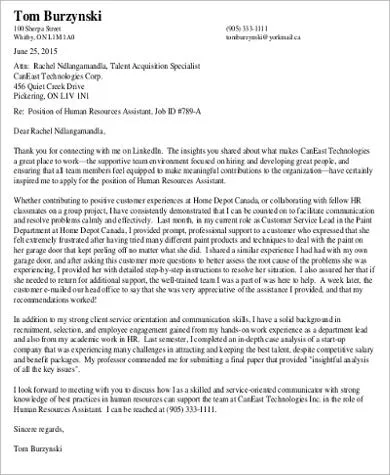
Quantifying your achievements adds significant impact to your cover letter. Instead of stating that you “improved employee retention,” provide specific numbers or percentages to show the degree of that improvement. Use metrics to demonstrate the value you brought to your previous roles. For example, mention the percentage increase in successful hires, the reduction in time-to-hire, or the cost savings you achieved. If you’ve implemented new HR programs or initiatives, quantify the positive outcomes, such as increased employee engagement scores, reduced turnover rates, or improved compliance. By providing these metrics, you give the hiring manager concrete evidence of your capabilities. It makes your claims more credible. Quantifiable achievements give recruiters the ability to better understand the scope of your accomplishments and demonstrate your impact in HR. Always try to use numbers to create a more compelling and credible story.
Tailoring Your Cover Letter to the HR Position
Tailoring your cover letter to the specific HR position is critical for demonstrating your understanding of the role and your genuine interest in the company. Start by carefully reviewing the job description, identifying the key requirements and desired qualifications. Highlight the skills and experiences that match these requirements and provide examples of how you have demonstrated those skills. Make sure the language in your cover letter aligns with the company’s values and culture. Tailoring includes customizing your opening statement to explain why you are particularly interested in working for that specific company, and mentioning any research on HR initiatives or programs that the company is pursuing. By demonstrating that you have thoroughly considered the position and its needs, you significantly increase your chances of getting an interview. This approach shows that you’re not just sending out generic applications; instead, you are investing time in each opportunity.
Researching the Company and HR Team
Researching the company and the HR team shows your genuine interest and commitment to the opportunity. Before writing your cover letter, thoroughly research the company’s mission, values, and culture. Visit their website, read their news releases, and browse their social media pages. Look for information about their HR initiatives, employee benefits, and any recent achievements. If possible, find out the name of the hiring manager or anyone from the HR team. LinkedIn is a great tool to research the HR team’s background and recent activities. When writing your cover letter, mention something specific that you have learned about the company to show you’ve done your homework and that you’re interested in joining them. Doing so will set you apart from other candidates. Expressing that you are interested in a specific HR program at the company will create a positive impression.
Using Keywords and Tailoring Content HR

To make your cover letter stand out, strategically use keywords and tailor your content to match the job description. Carefully review the job posting and identify the key skills, qualifications, and responsibilities listed. Incorporate those keywords naturally throughout your cover letter. Use similar language and phrasing as the job description. This helps your application pass through Applicant Tracking Systems (ATS) and ensures that the hiring manager understands your qualifications. Remember, the goal is to show that you possess the skills and experience the employer is seeking. Also, tailor the content to the company’s culture. Demonstrate your understanding of their values and how you would fit in by aligning your qualifications and experiences with what the company is looking for. By using the right keywords and tailoring your content, you increase your chances of getting noticed and securing an interview.
Formatting and Proofreading Your HR Cover Letter
The formatting and proofreading of your HR cover letter are vital for creating a professional image. A well-formatted letter is easier to read and reflects your attention to detail. Start by using a clear and professional font like Times New Roman or Arial. Maintain consistent formatting throughout the letter, including the font size, spacing, and margins. Keep the letter concise and easy to read. Use paragraphs to break up the text and bullet points for lists of skills or accomplishments. Always proofread your cover letter thoroughly for any grammatical errors, typos, or punctuation mistakes. A single error can create a negative impression and undermine your credibility. Have someone else review your letter as well. This will help you catch any mistakes that you might have missed. By paying attention to formatting and proofreading, you demonstrate that you’re detail-oriented and committed to excellence. It is always important to showcase your understanding of HR principles and practices through your cover letter.
Formatting Guidelines HR
Follow these formatting guidelines for your HR cover letter. Use a professional font like Times New Roman, Arial, or Calibri in a size between 11 and 12 points. Use a one-inch margin on all sides of the document. Keep the letter concise, aiming for no more than one page. Use single-spaced text within paragraphs and double-space between paragraphs. Left-align the text, and use a clear and readable font. Organize your letter logically. Include your contact information, the date, the hiring manager’s name and title (if known), a professional salutation, a compelling opening, the body paragraphs highlighting skills and experience, and a strong closing. Maintain a consistent style throughout the letter. Proofread for any errors in grammar, spelling, and punctuation. A well-formatted cover letter is easy to read, and demonstrates your professionalism and attention to detail, which are qualities that employers value in HR professionals. Your cover letter should be well-organized and aesthetically pleasing.
Proofreading and Editing Your Cover Letter HR

Proofreading and editing are crucial steps in creating a polished HR cover letter. After you’ve written your letter, take the time to carefully review it for any errors. Check for grammatical errors, spelling mistakes, and punctuation issues. Ensure that your sentences are clear, concise, and well-structured. Read your cover letter aloud, which can help you catch any awkward phrasing or inconsistencies. Consider asking someone else to review your letter for feedback. A fresh pair of eyes can catch errors you might have missed. Ensure that your contact information is accurate. A typo in your email address or phone number could cost you the job opportunity. Check the formatting and make sure your letter adheres to the formatting guidelines. This attention to detail shows that you are professional and that you possess the skills required for HR roles. Proofreading is an important step that should not be taken lightly.
Dos and Don’ts of HR Cover Letters
Crafting an effective HR cover letter requires adhering to best practices. Do tailor your letter to each job. Do highlight your relevant skills and experience. Do quantify your achievements whenever possible. Do demonstrate your understanding of HR principles and practices. Do research the company and show your interest. Do use a professional tone and language. Do proofread carefully for errors. On the other hand, don’t use generic templates or phrases. Avoid clichés and buzzwords. Don’t be overly verbose; keep it concise and to the point. Don’t focus solely on what you want; instead, concentrate on how you can contribute to the company. Don’t include any irrelevant information. Don’t submit a letter with errors. By following these guidelines, you can ensure that your cover letter makes a positive impression and increases your chances of getting hired.
What to Include in Your HR Cover Letter
Your HR cover letter should include these key elements. Start with your contact information, date, and the hiring manager’s name and title. Then, write a compelling opening paragraph that states the position you are applying for and highlights your key qualifications. In the body of the letter, showcase your skills and experience, providing specific examples of your achievements. Tailor this section to the job description, emphasizing what the employer is looking for. Include relevant keywords from the job posting to match the requirements. Quantify your achievements whenever possible, using metrics to demonstrate your impact. Show your understanding of the company by mentioning your research and your specific interest in the organization. Conclude with a strong closing paragraph that reiterates your interest, expresses your enthusiasm, and includes a call to action, such as your availability for an interview. Proofread it meticulously.
Common Mistakes to Avoid HR

Avoiding common mistakes can significantly improve your HR cover letter. Avoid using generic templates. Each cover letter should be tailored to the specific role and company. Don’t simply repeat your resume; expand on your experiences and provide more context. Avoid grammatical errors, spelling mistakes, and typos. Proofread carefully, and have someone else review your letter. Avoid using clichés and buzzwords, which can make your letter sound impersonal. Don’t be overly verbose; keep your letter concise and to the point. Avoid being negative or unprofessional. Focus on your accomplishments and skills. Avoid providing information that is not relevant to the job. Finally, don’t submit your cover letter without proper formatting and attention to detail. By avoiding these mistakes, you will increase your chances of making a positive impression and securing an interview.
Examples of Effective HR Cover Letters
Reviewing examples of effective HR cover letters can provide valuable insights and guidance. Look for examples that showcase clear, concise language, strong formatting, and well-structured content. Analyze the opening paragraph, which should grab the reader’s attention and state the applicant’s interest in the specific role. The body paragraphs should highlight relevant skills and experience, providing specific examples and quantifying achievements. The closing paragraph should reiterate the applicant’s interest and include a call to action. Pay attention to how the examples are tailored to the specific job and company. Study the use of keywords, the emphasis on key qualifications, and the overall tone. This will help you create a cover letter that is compelling. Consider how each example addresses potential gaps in the applicant’s background. Adapt the best practices and apply them to your own cover letter.
Example Cover Letter HR for a HR Generalist
This example will help you create a cover letter for an HR Generalist position. Start with your contact information, date, and the hiring manager’s name and title. Then, in the opening paragraph, state the position you are applying for and highlight your experience in a key area. In the body paragraphs, describe your experience in employee relations, recruitment, and performance management, providing specific examples and quantifiable results. For example, if you have experience with employee relations, mention how you have handled conflict resolution and improved employee satisfaction. If you have recruitment experience, state the number of successful hires and the time-to-hire improvements. If you have performance management experience, outline the programs you implemented. Conclude the letter by reiterating your interest and expressing your enthusiasm for the opportunity. Remember, tailor this example to your skills and the specific requirements of the job description, emphasizing the responsibilities that align with your previous HR generalist experiences.
Example Cover Letter HR for a HR Assistant

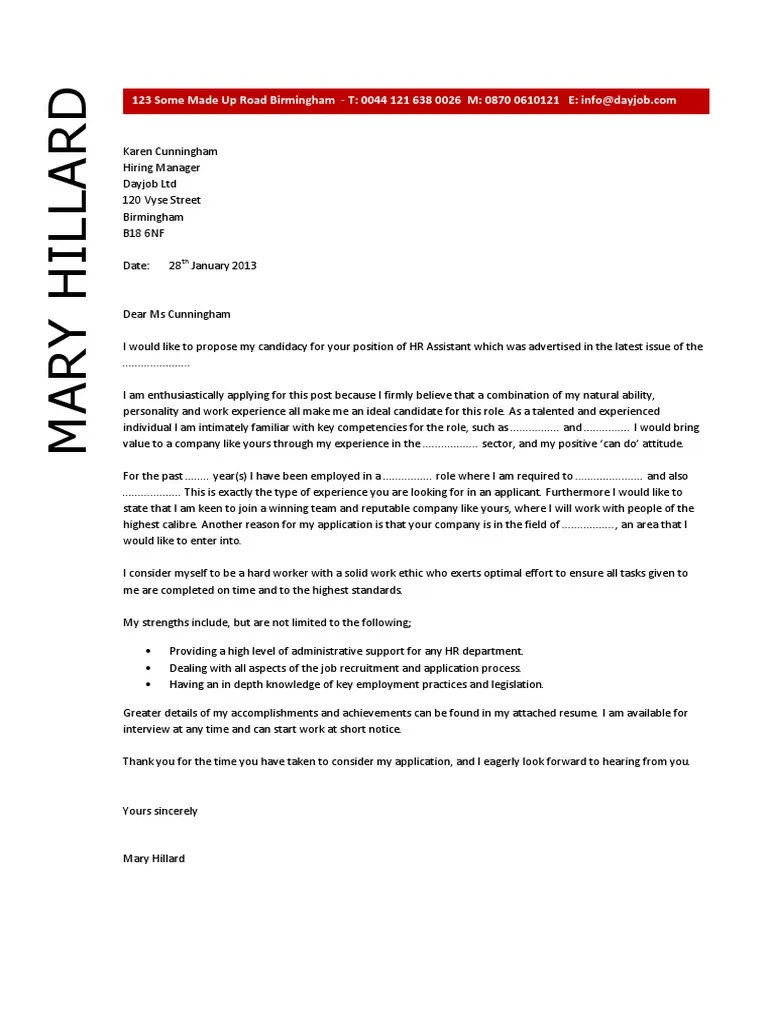
If you’re applying for an HR Assistant role, this example can guide you in crafting a winning cover letter. Start by providing your contact information, the date, and the hiring manager’s name and title. In the opening paragraph, state the position you are applying for and briefly highlight your relevant skills. In the body of the letter, showcase your experience in administrative tasks, such as maintaining employee records, assisting with recruitment efforts, and handling employee inquiries. Provide specific examples of your organizational and communication skills, showing how you have supported HR functions in previous roles. For instance, detail how you’ve organized HR events, managed employee files, and handled various HR administrative functions. Include any experience with HRIS systems or other relevant software. Conclude by expressing your interest in the position and your enthusiasm for supporting the HR team. Tailor the examples to your specific skills and the specific requirements in the job description. Focus on the administrative aspects of the job and the value you can bring to the team.
Finalizing and Submitting Your Cover Letter HR
Finalizing and submitting your HR cover letter is the last step in the job application process. Once you have written, formatted, and proofread your cover letter, save it in the correct format. Ensure that your cover letter is saved in PDF format, unless the job description specifies a different format. This preserves the formatting and ensures that your letter looks the same on any device. Before submitting your application, double-check the instructions to ensure that you are following the correct submission process. If the job posting requires you to upload your cover letter separately, make sure you do so. If the application requires you to paste the text into a field, review the formatting. Sending a well-prepared cover letter will show that you pay attention to detail and increases the likelihood of getting an interview.
Saving Your Cover Letter in the Correct Format HR
Saving your cover letter in the correct format is crucial for ensuring that your document appears as intended to the hiring manager. Unless specified in the job description, save your cover letter as a PDF (Portable Document Format). PDF files preserve the formatting, fonts, and layout of your document, regardless of the software or operating system used to open it. This ensures that the hiring manager views your letter exactly as you intended. Always double-check the job application instructions to see if there are specific file format requirements. Sometimes, employers might prefer Word documents (DOC or DOCX) for ease of editing or to allow for collaboration. However, in most cases, a PDF is the best choice for preserving the integrity of your document. Give your document a descriptive file name that includes your name and the job title, making it easy for the hiring manager to identify your application.
Submitting Your Cover Letter HR
Submitting your HR cover letter correctly is the final step in the application process. Carefully follow the instructions in the job posting to ensure your application is received and considered. If the job posting provides specific instructions, such as the preferred method of submission or file naming conventions, adhere to these precisely. Ensure that you have attached your cover letter and resume correctly, and that the file names are appropriate and easy to identify. Review your application one last time to check for any errors or missing information. After you submit your application, make a note of the date and any reference numbers provided. Follow up on your application after a reasonable amount of time. Showing your interest in the position is important. Make sure your email address is professional and that your voicemail greeting is also professional. This is the last thing you will do, and it should be done correctly.
Conclusion The Path to Your HR Career
A well-crafted cover letter is a powerful tool in your journey toward a successful career in human resources. By following the guidelines and tips discussed in this guide, you can create a cover letter that captures the hiring manager’s attention, highlights your skills and experience, and demonstrates your genuine interest in the role and the company. Remember to tailor your cover letter to each specific job, highlighting the qualifications most relevant to the position. Continuously refine your cover letter writing skills. Take the time to research companies, and showcase your skills. Also, focus on the impact of your accomplishments. Keep your cover letter concise, professional, and free of errors. A strong cover letter will set you apart from other applicants and increases your chances of getting hired.