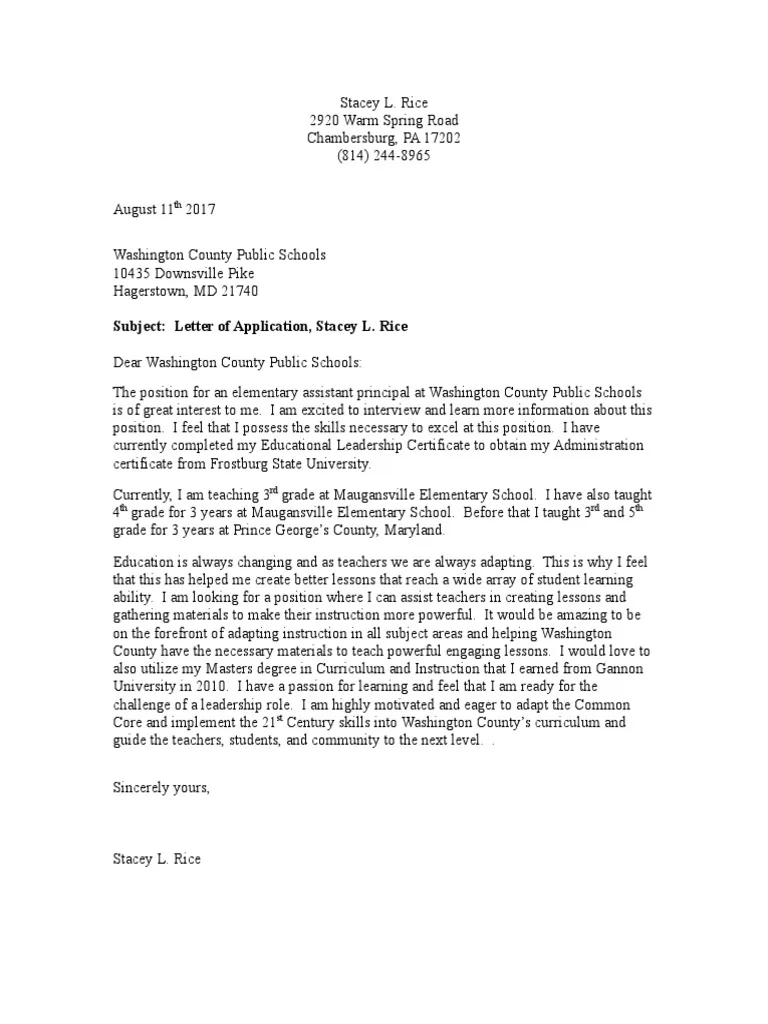
Understanding the Purpose of a Cover Letter
A cover letter serves as your introduction to a potential employer, offering a glimpse beyond your resume. It’s your opportunity to express your personality, highlight your passion for teaching, and demonstrate how your skills and experience align with the specific requirements of the teaching position and the values of the school. This document is not merely a formality; it is a crucial tool in showcasing why you are the ideal candidate for the role. Think of it as a personal narrative, where you connect your past experiences to the future opportunity, demonstrating your understanding and enthusiasm for the role.
Why a Cover Letter is Crucial for Teaching Positions
In the competitive field of education, a well-crafted cover letter can set you apart. It provides context to your resume, allowing you to elaborate on specific experiences and accomplishments that directly relate to the job description. A compelling cover letter showcases your communication skills, attention to detail, and genuine interest in the school and its students. It’s your chance to personalize your application and demonstrate your commitment to the teaching profession, which can significantly influence the hiring principal’s first impression and decision-making process.
Key Components of a Powerful Cover Letter

A strong cover letter is composed of several key elements, each designed to highlight different aspects of your qualifications and personality. These include a professional header with your contact information, a formal greeting, a compelling opening paragraph to grab the reader’s attention, detailed sections on your teaching experience and skills, a clear demonstration of your passion, evidence of your understanding of the school’s needs, a tailored approach that aligns with the school’s values, and a strong closing paragraph that expresses enthusiasm and a call to action. Each section must work together to create a cohesive and persuasive argument for why you are the perfect fit for the teaching role.
Header Contact Information and Date
Start your cover letter with a professional header. Include your full name, address, phone number, and email address. This information should be clearly visible and easy to read. Following this, include the date you are submitting your application. Ensure that your contact information is accurate and up-to-date. This section is crucial for enabling the principal to easily reach you for an interview. A clean and organized header reflects your professionalism and attention to detail, both important traits for a teacher.
Greeting the Principal Professionally
Address the principal by name, if possible. Researching the principal’s name shows that you’ve taken the time to personalize your application. Use a formal greeting such as ‘Dear Mr./Ms./Dr. [Last Name].’ If you are unsure of the principal’s name or title, you can use a more general, yet professional greeting like ‘Dear Hiring Committee’ or ‘To Whom It May Concern,’ but personalized greetings are always preferable. Ensure the name is spelled correctly to show respect and attention to detail. This initial greeting sets the tone for your entire letter, signaling respect and professionalism.
Crafting a Compelling Opening Paragraph

The opening paragraph is your first chance to capture the principal’s attention. Start by clearly stating the position you are applying for and where you saw the job posting. Briefly mention your key qualifications or a unique aspect of your experience that makes you stand out. Show your enthusiasm for the specific school or district. Avoid generic openings; instead, tailor the introduction to demonstrate your understanding of the school’s mission or a specific program that aligns with your teaching philosophy. Make sure your introduction is concise and compelling, enticing the principal to read further. Remember, it’s your initial hook to grab their attention.
Highlighting Your Teaching Experience
In this section, provide specific details about your teaching experience. Instead of merely listing your past roles, describe your responsibilities and accomplishments. Use the STAR method (Situation, Task, Action, Result) to explain how you handled specific challenges or achieved particular goals. Quantify your achievements whenever possible; for example, mention how you improved student test scores or implemented a successful new teaching method. Connect your experience to the requirements of the teaching position, demonstrating how your past experiences have prepared you for the role. This is your opportunity to show how you have made a real impact on students.
Showcasing Your Skills and Qualifications
Detail your skills and qualifications that align with the job description. Refer back to the key requirements outlined in the job posting and explain how you possess those skills. Focus on skills that are relevant to the position, such as classroom management, curriculum development, assessment strategies, or specific subject matter expertise. Provide examples of how you have used these skills to create a positive learning environment and improve student outcomes. Ensure you include any certifications or licenses that are required for the position. Demonstrate how your skills make you a strong candidate for the specific role.
Demonstrating Your Passion for Teaching

Express your enthusiasm for teaching and your commitment to student success. Share what motivates you as an educator and why you are passionate about your subject matter. Discuss your teaching philosophy and how it aligns with the school’s values. Provide examples of how you create engaging lessons, foster a supportive classroom environment, and encourage student participation. This section is where you can truly let your personality shine and demonstrate your dedication to helping students learn and grow. This adds a personal touch and shows you care about education.
Addressing the School’s Needs and Values
Show that you understand the school’s mission, values, and specific needs. Mention any programs, initiatives, or areas of focus that resonate with your teaching philosophy. Tailor your application by addressing how your skills and experience can contribute to the school’s goals. This could include discussing your ability to work collaboratively, implement innovative teaching methods, or support student diversity and inclusion. Demonstrate that you have researched the school and are genuinely interested in being a part of their community. This shows that you are serious about this specific position.
Tailoring Your Cover Letter to the School
Customize your cover letter for each school you apply to. Avoid using a generic template; instead, personalize your letter to reflect the specific requirements and values of each school. Refer to the school’s website, mission statement, and any information available about their programs or initiatives. Mention specific aspects of the school that appeal to you and explain why you are a good fit for their community. This demonstrates that you are serious about the position and have invested time in understanding the school’s culture. Customization makes a significant difference in the impact of your cover letter.
Researching the School’s Mission and Values

Before writing your cover letter, thoroughly research the school’s mission statement, values, and any recent initiatives. Understand their approach to education, their goals for student success, and their community involvement. Look for information about their teaching methods, any special programs they offer, and the overall school culture. This information will help you tailor your cover letter to reflect your understanding of the school and explain how your skills and experience align with their specific needs. Use the information to show you’ve done your homework and are genuinely interested in the school.
Adapting Your Skills to the School’s Requirements
Carefully review the job description and identify the specific requirements of the teaching position. Highlight the skills and experiences that match these requirements. Provide clear examples of how you have demonstrated these skills in previous roles. If the school emphasizes a specific teaching method or has a particular focus, such as technology integration or project-based learning, tailor your cover letter to show how you can contribute to these areas. Demonstrate your ability to adapt and thrive in their specific environment. Show that you meet the school’s specific needs.
Writing a Strong Closing Paragraph
End your cover letter with a strong closing paragraph that reiterates your interest in the position and your qualifications. Express your enthusiasm for the opportunity and reaffirm your commitment to the school’s mission. Thank the principal for their time and consideration, and clearly state your availability for an interview. Include a specific call to action, such as ‘I look forward to hearing from you soon’ or ‘I am eager to discuss how I can contribute to your school.’ Ensure your closing is professional, polite, and leaves a positive final impression. This will help ensure the principal remembers you.
Expressing Enthusiasm and Gratitude

Throughout your cover letter, express your genuine enthusiasm for the teaching position and the school. Show your passion for education and your excitement about the opportunity to contribute to the school’s community. Express gratitude for the principal’s time and consideration. A sincere expression of thanks leaves a positive impression and demonstrates your professionalism. This can be as simple as saying ‘Thank you for considering my application’ or ‘I appreciate your time in reviewing my qualifications.’
Requesting an Interview
Clearly state your desire for an interview in your closing paragraph. Indicate your availability and willingness to discuss your qualifications further. You can write, ‘I am available for an interview at your earliest convenience and would welcome the opportunity to discuss my qualifications in more detail.’ Include your contact information again, such as your phone number and email address, to make it easy for the principal to reach you. Make it easy for the hiring manager to contact you.
Proofreading and Editing Your Cover Letter
Before submitting your cover letter, carefully proofread and edit it for any errors. Ensure that your letter is free of grammatical errors, typos, and spelling mistakes. A polished and error-free cover letter reflects your attention to detail and professionalism. Read your letter aloud to catch any awkward phrasing or unclear sentences. It is also helpful to have a trusted friend or colleague review your cover letter. Ensure your writing is clear, concise, and easy to understand. Ensure that your writing reflects your level of attention and detail.
Checking for Grammatical Errors and Typos

Thoroughly check your cover letter for grammatical errors, typos, and spelling mistakes. These errors can detract from your professionalism and make a negative impression on the principal. Use spell-check and grammar-check tools, but also read your letter carefully to catch any errors that these tools might miss. Ensure that your punctuation is correct and that your sentences are structured properly. Mistakes can cause your application to be quickly discarded. Check and recheck for clarity.
Ensuring Clarity and Conciseness
Make sure your cover letter is clear, concise, and easy to read. Use strong verbs and avoid jargon or overly complex language. Keep your sentences and paragraphs short and to the point. Avoid rambling or including unnecessary information. Ensure that your key qualifications and experiences are clearly stated. Edit out any unnecessary words or phrases to ensure that your message is direct and easy to understand. Remember, your cover letter should be persuasive, not lengthy. Communicate clearly and concisely.
Formatting Your Cover Letter for Readability
Proper formatting can significantly enhance the readability of your cover letter. Use a professional font, such as Times New Roman, Arial, or Calibri, and use a font size between 10 and 12 points. Use single-spacing and a clear layout with sufficient margins. Break up long paragraphs into shorter ones to make the text more accessible. Use bullet points or numbered lists to highlight key information or accomplishments. A well-formatted cover letter shows that you pay attention to detail and respect the principal’s time. Make it easy for the hiring manager to read the letter.
Using a Professional Font and Layout

Choose a professional font for your cover letter, such as Times New Roman, Arial, or Calibri. These fonts are easy to read and project a sense of professionalism. Avoid using decorative or overly stylized fonts that can be distracting. Use a clear layout with standard margins and single-spacing. Keep your text aligned and ensure that your contact information and the date are clearly visible. A clean and well-organized layout enhances readability and shows your attention to detail. This also helps the hiring manager see the document at a glance.
Keeping Your Cover Letter Concise
Keep your cover letter concise and focused. Aim for one page in length, as principals are often busy and do not have time to read lengthy documents. Focus on the most relevant information and tailor your letter to the specific requirements of the teaching position. Avoid unnecessary details or irrelevant information. Be selective about what you include, and ensure that every sentence serves a purpose. The goal is to highlight your strengths effectively in a brief amount of space. Use the space efficiently and show that you respect the principal’s time.
Finalizing and Submitting Your Cover Letter
Before submitting your cover letter, review it one last time to ensure everything is correct and polished. Make sure you have addressed the principal by name, the date is accurate, and all contact information is correct. Double-check that the cover letter is tailored to the specific school and teaching position. Save your cover letter as a PDF file to preserve the formatting and ensure it can be opened on any computer. Follow the instructions provided in the job posting for submitting your application. Submitting a polished, well-crafted cover letter is your final step in making a positive impression.