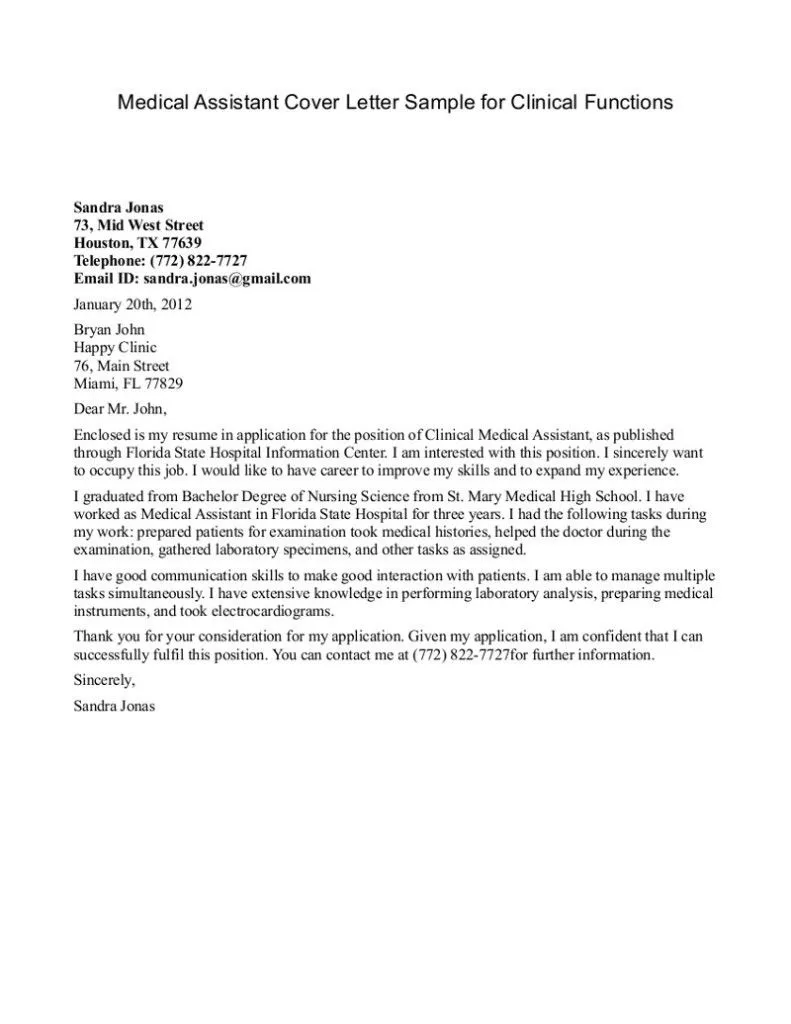
The Importance of a Medical Assistant Cover Letter
In the competitive field of healthcare, a well-crafted cover letter is your first opportunity to make a strong impression and distinguish yourself from other candidates. For medical assistants, the cover letter serves as a crucial introduction, allowing you to showcase your personality, enthusiasm, and relevant skills beyond what’s listed on your resume. It’s your chance to tell a compelling story about why you’re the ideal fit for the specific medical assistant position and the healthcare facility. A cover letter is not just a formality; it’s a strategic tool that can significantly increase your chances of landing an interview. This document provides a platform to elaborate on your qualifications and explain how your unique experiences and qualities align with the employer’s needs and values. Therefore, taking the time to create a tailored and impactful cover letter is a key step in your job search strategy.
Why a Cover Letter Matters
A cover letter matters because it humanizes your application. Resumes often present a list of skills and experiences, but they lack the personal touch. Your cover letter allows you to connect with the hiring manager on a more personal level, conveying your passion for the role and your dedication to providing excellent patient care. It demonstrates your communication skills and your ability to articulate why you are the best candidate. Moreover, a cover letter provides an opportunity to address any gaps in your employment history or explain why you are transitioning to a new area of healthcare. It shows initiative and attention to detail, which are highly valued in the medical field. By tailoring your cover letter to each job application, you demonstrate that you’ve taken the time to understand the specific needs of the employer, which significantly boosts your chances of being noticed and selected for an interview. A well-written cover letter can set you apart by making a memorable first impression.
Highlighting Key Skills and Qualifications

Your cover letter is your space to highlight the skills and qualifications that align most closely with the job description. Instead of simply repeating what’s on your resume, use the cover letter to elaborate on your experiences, providing specific examples of how you’ve successfully utilized your skills. For instance, if the job description emphasizes patient communication, you can share a story about a time when you effectively explained a complex medical procedure to a nervous patient, emphasizing empathy and clarity. If the role requires proficiency in electronic health records (EHR) systems, provide specific details about the systems you’ve used and the types of tasks you’ve performed. This allows the hiring manager to see how your skills translate into real-world application. The cover letter should also focus on any specialized skills, such as phlebotomy, vital signs measurement, or medication administration, as well as your familiarity with medical terminology. Be sure to quantify your accomplishments whenever possible, such as the number of patients you assisted daily or the efficiency improvements you contributed to in a previous role.
Cover Letter Structure Step-by-Step
Header Contact Information
Start your cover letter with a clear header that includes your full name, address, phone number, and professional email address. Make sure your email address is professional and easy to read. This information should be at the top left corner of your cover letter. It ensures that the employer can easily contact you if they are interested in moving forward with your application. Ensuring that your contact information is correct is a fundamental but critical step. Double-check the accuracy of all details to avoid any communication issues.
Date and Recipient Information

Following your contact information, include the date. Then, add the recipient’s information, including the name of the hiring manager (if known), their title, the name of the medical facility, and the facility’s address. If you cannot find the name of the hiring manager, research the company website, LinkedIn, or call the facility. Addressing the letter to a specific person makes a more personal connection, which helps you stand out. This level of attention to detail indicates your initiative and interest in the position.
Salutation
Use a professional salutation, such as “Dear Mr./Ms./Dr. [Last Name].” If you don’t know the hiring manager’s name, use “Dear Hiring Manager” or “Dear [Department Name] Team.” Avoid generic greetings like “To Whom It May Concern.” A specific greeting shows respect and shows that you have taken the time to tailor your letter to the recipient.
Body Paragraph 1 The Introduction
The introduction is your first chance to grab the reader’s attention. State the specific position you’re applying for and where you found the job posting. Briefly mention your most relevant qualifications and your enthusiasm for the role. This paragraph should serve as a concise summary of your key strengths and why you’re interested in the position and the medical facility. Start with a strong hook, such as a key skill or experience that directly relates to the job requirements. This helps the hiring manager understand the value you bring right away.
Body Paragraph 2 Highlighting Skills and Experience

In the second paragraph, provide more detail about your relevant skills and experience. Use specific examples to showcase how you’ve applied these skills in previous roles. Mention relevant certifications, such as Certified Medical Assistant (CMA) or Registered Medical Assistant (RMA). Quantify your achievements whenever possible. For instance, mention any experience with patient scheduling software, electronic health records, or insurance verification processes. Highlight the types of medical environments you have worked in, such as primary care, specialized clinics, or hospitals. Emphasize skills such as patient communication, clinical procedures, and administrative tasks. Demonstrate your ability to work as a team player and your adaptability to diverse environments.
Body Paragraph 3 Expressing Enthusiasm and Fit
In this paragraph, demonstrate your genuine interest in the medical facility and the specific role. Research the facility and mention something that attracts you to their mission, values, or reputation. Explain why you believe your skills and experience make you a good fit for the team and the work environment. Show that you understand the facility’s values and how you can contribute to its goals. Briefly discuss what you hope to achieve in this position and how it aligns with your career goals. This shows your long-term interest and commitment.
Body Paragraph 4 Call to Action
Conclude your cover letter with a strong call to action. Express your eagerness for an interview and reiterate your contact information. Thank the hiring manager for their time and consideration. Make it easy for them to move forward with your application by clearly stating your availability for an interview. You can also mention your willingness to provide references upon request. This final paragraph should leave a positive and proactive impression. Make sure to proofread the letter carefully for any errors before submitting.
Closing Sincerely and Signature

Use a professional closing, such as “Sincerely” or “Respectfully,” followed by your typed name. If you’re submitting a hard copy, leave space for your handwritten signature above your typed name. This is standard practice for formal business correspondence and adds a professional touch to your application. Always proofread your cover letter to ensure there are no grammatical errors or typos before sending it. Also, ensure the tone and language are professional and reflect your enthusiasm for the role.
Key Skills to Include in Your Cover Letter
Clinical Skills
When highlighting clinical skills, be specific. Mention your proficiency in taking vital signs, assisting with examinations, administering medications (if certified), and performing phlebotomy. If you have experience with specific medical instruments or procedures, such as EKG or spirometry, list them. If you are familiar with specific patient populations, state those. This could include experience in pediatrics, geriatrics, or other specialties. Always mention any certifications, licenses, or specialized training you possess, such as CPR or first aid certifications. Emphasize your ability to maintain a clean and organized clinical environment and follow safety protocols. Include any experience with patient education, such as explaining procedures, medications, or pre- and post-operative care.
Administrative Skills

Administrative skills are equally important. These include patient scheduling, managing medical records, handling insurance verification, and processing billing and coding. If you are experienced with specific electronic health record (EHR) systems like Epic or Cerner, mention these as well. Highlight your ability to handle phone calls professionally, manage patient correspondence, and maintain confidentiality. Also, mention any experience with managing patient files, and any office management tasks. If you are familiar with appointment scheduling software, be sure to include that. Emphasize your attention to detail, organizational skills, and ability to multitask effectively in a busy medical office. Include skills related to insurance claims and billing processes.
Soft Skills
Soft skills are crucial in the healthcare field. Highlight your communication skills, both written and verbal. Demonstrate your ability to communicate with patients and colleagues effectively and empathetically. Mention your ability to work in a team environment, demonstrating cooperation and collaboration. Include your problem-solving skills and your capacity to remain calm under pressure. Emphasize your organizational skills, time management, and ability to prioritize tasks. Your interpersonal skills and your ability to deal with diverse individuals and situations are also important. Any experience with patient empathy should also be mentioned. Showcase your commitment to providing excellent patient care.
Tailoring Your Cover Letter to the Job
Researching the Employer

Before you write your cover letter, research the medical facility or clinic. Learn about their mission, values, and the services they provide. Visit their website and social media profiles to gain insight into their culture. Understanding their values enables you to highlight how your skills and experiences align with their specific needs. Look for information about their approach to patient care, their commitment to innovation, and their work environment. This research will help you tailor your cover letter to show that you’re genuinely interested in working for that specific organization. This process helps ensure that your cover letter is not generic, but personalized to the specific job.
Matching Skills to Job Requirements
Carefully review the job description and identify the key skills and qualifications the employer is seeking. Tailor your cover letter to directly address these requirements. Use the same keywords and phrases from the job description to demonstrate that you possess the skills they are looking for. If the job posting emphasizes patient communication skills, provide examples of how you’ve excelled in this area. Match your qualifications to the specific needs of the role. Highlight your most relevant experiences and showcase your ability to deliver the required services.
Using Keywords from the Job Description
Incorporate relevant keywords from the job description throughout your cover letter. This helps your application pass through applicant tracking systems (ATS), which often scan for these keywords. However, use the keywords naturally, not stuffing them in at the expense of clarity. Integrate keywords into your sentences to show how your skills and experiences align with the job requirements. This demonstrates that you’ve thoroughly reviewed the job posting and understood the employer’s needs. Doing this is critical to getting your application read by a real person and moving on to the next phase of the hiring process. This also helps demonstrate that you are an ideal fit.
Common Mistakes to Avoid

Generic Cover Letters
Avoid using a generic cover letter that can be sent to any employer. Tailor each cover letter to the specific job and the organization. Generic cover letters show a lack of genuine interest and initiative. Demonstrate your research on the employer, and match your skills to the job requirements. Personalized cover letters demonstrate your genuine interest in the role and increases your chances of being selected for an interview. Tailor your cover letter to match the tone and style of the organization, also.
Typos and Grammatical Errors
Proofread your cover letter meticulously before submitting it. Typos and grammatical errors can create a negative impression and suggest a lack of attention to detail. Use spell-check and grammar-check tools, but also manually review your letter. Ask a friend or family member to proofread it for a fresh perspective. Correct grammar and spelling demonstrate professionalism and attention to detail, which are essential for medical assistant positions. Ensuring a clean and polished cover letter is an important step to present your qualifications. Reviewing the document for any spelling and grammatical errors are essential.
Focusing on Yourself Too Much
While it’s important to highlight your skills and experiences, avoid making your cover letter solely about yourself. Instead, focus on how your skills and experience can benefit the employer and the patients they serve. Show how you can contribute to the team and meet the organization’s goals. Highlight your understanding of the employer’s needs and explain how you plan to meet them. Demonstrate a genuine interest in the position and a commitment to providing high-quality patient care, demonstrating that you’re considering the needs of the organization.
Cover Letter Examples
Review sample medical assistant cover letters to get an idea of format and style. Adapt these examples to reflect your qualifications and tailor them to the specific job description. There are numerous resources available online, including those offered by career websites and professional organizations. Use these as a guide, but always customize your cover letter to reflect your unique skills and experiences. Be sure to avoid simply copying and pasting a template, as this will result in a generic cover letter. By personalizing your letter, you create a document that showcases your unique qualifications.