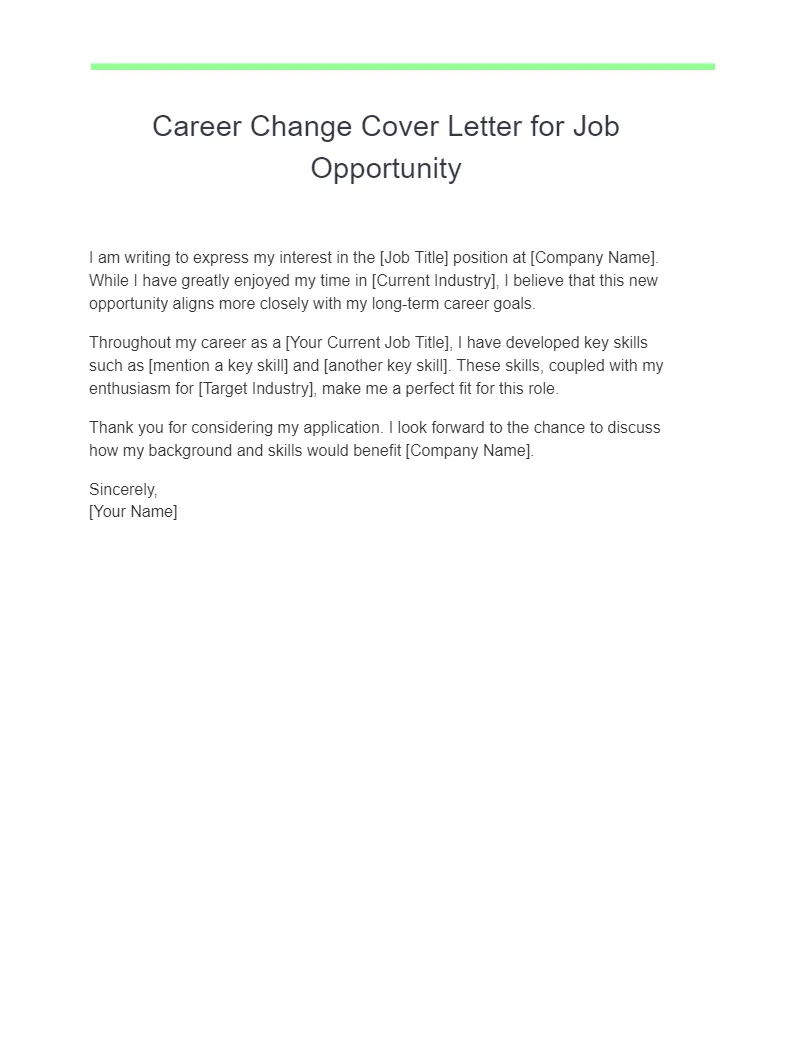
Why Explain Your Career Change in a Cover Letter
A career change can be a significant leap, and it’s crucial to address it head-on in your cover letter. Many hiring managers will immediately notice the shift in your professional trajectory. Ignoring this transition can leave them to speculate, potentially leading to assumptions that might not be favorable. This is your opportunity to control the narrative, providing a clear and concise explanation of your decision. The cover letter is where you can connect the dots between your past experiences and your future aspirations, demonstrating that your career change is not just a random occurrence, but a strategic move aligned with your long-term professional goals. By proactively explaining your career change, you show initiative, self-awareness, and a clear vision for your career, making you a more compelling candidate and increase your chances to get the job. This approach helps alleviate any concerns the hiring manager might have, replacing potential doubts with understanding and appreciation for your proactive approach. This is your opportunity to show the recruiter why you made the switch, and why the switch makes you ideal for the job.
Highlight Transferable Skills
One of the most effective strategies for explaining a career change is to focus on your transferable skills. These are the skills you’ve developed in previous roles that are valuable in your new desired field. These skills can encompass a broad range of expertise, from project management and communication to problem-solving and leadership. By pinpointing these skills, you can bridge the gap between your past experience and the requirements of your new role. The key is to identify which skills align with the job description, highlighting their relevance with specific examples. This is how you create a powerful narrative to show the recruiter that you are capable and have the necessary skills to do the job. For example, if you are moving from a marketing role to project management, emphasize your communication skills, your ability to work under pressure and your ability to manage multiple tasks at once. These are highly desirable skills that hiring managers will find valuable.
Identify Relevant Skills for the New Role

When highlighting transferable skills, it’s crucial to tailor your focus to the specific requirements of the new role. Analyze the job description carefully to identify the skills the employer values most. Then, align your past experiences with those skills, providing concrete examples of how you’ve demonstrated them. This targeted approach demonstrates that you understand the needs of the new role and have the capabilities to succeed. It shows that you’ve done your research and are not just applying for any job, but one that aligns with your skills and aspirations. For instance, if the job requires strong data analysis skills, emphasize any past experiences where you used data to make decisions or improve outcomes, even if your previous role wasn’t directly related to data analysis. This shows that you have the capacity to learn and apply new skills.
Give Specific Examples of Your Achievements
To make your claims of transferable skills credible, provide specific examples of your achievements. Instead of simply stating that you possess a skill, describe a situation where you used it to achieve a positive outcome. Use the STAR method – Situation, Task, Action, Result – to structure your examples. For example, instead of saying “I am good at problem-solving,” you could say: “In my previous role, we faced a significant decrease in customer satisfaction. My task was to identify the root cause and implement a solution. I analyzed customer feedback, identified key issues, and implemented new processes, leading to a 20% increase in customer satisfaction within three months.” This level of detail demonstrates your skills in action, making your application more impactful and helping the recruiter to see the value that you will bring. Quantifying your results further strengthens your claims and shows the value you brought to previous employers.
Show Enthusiasm and Motivation
Demonstrating genuine enthusiasm and motivation for the new career path is essential. Hiring managers are looking for candidates who are truly invested in their work and excited about the opportunity. Your cover letter should reflect this passion through your tone and your choice of words. Explain what attracts you to the new field, what aspects of the job excite you the most, and why you believe your skills align with the role’s requirements. Showing enthusiasm isn’t just about using positive language; it’s about conveying a sense of purpose and dedication. This can be achieved by clearly explaining the specific reasons behind your career change, aligning your goals with the company’s mission, and showcasing your excitement to use your skills in a new context. This approach helps the recruiter to envision you thriving in the new role, bringing positive energy and commitment.
Research the Company and Role

Thorough research is critical to demonstrate your genuine interest and motivation. Before writing your cover letter, learn as much as possible about the company and the specific role you’re applying for. Understand their mission, values, culture, and recent projects. Tailor your letter to align with the company’s goals and values, showing how your skills and aspirations fit within their environment. This will help you to not only express your passion but also to show that you see yourself in this environment. By showcasing this knowledge, you convey that your decision is informed and strategic, not just a random choice. This research should also extend to the role itself. Understand the responsibilities, the required skills, and the day-to-day tasks. This will help you tailor your skills and experiences to better fit the role, making your application stronger.
Tailor Your Letter to the Specific Job
Every cover letter should be customized to the specific job you’re applying for, especially when explaining a career change. A generic cover letter that doesn’t address the specific requirements and nuances of the role can be quickly dismissed. Review the job description carefully and identify the key skills, experiences, and qualities the employer is seeking. Then, tailor your cover letter to directly address those needs. This includes using keywords from the job description, highlighting relevant experiences, and explaining how your transferable skills can be applied to the new role. This level of customization showcases your attention to detail, your genuine interest in the position, and your understanding of the company’s requirements. If you are sending a generic cover letter, most of the time, it means that you are not the right person to do the job.
Address the Career Change Directly and Positively
Avoiding the topic of your career change is not an option. Instead, address it directly and in a positive manner. Explain why you decided to make the change, framing it as a strategic decision to pursue your passions, utilize your skills in a new context, or seek greater professional fulfillment. This approach demonstrates self-awareness and a proactive attitude. It’s important to avoid negative language or disparaging comments about your previous roles or industry. Instead, focus on what excites you about the new path and how it aligns with your long-term career goals. A positive and confident explanation will reassure the hiring manager that you have carefully considered your decision and are fully committed to your new direction. You can also mention what you learned in your previous job, and how you use that knowledge to succeed in your new role.
Frame Your Change as a Strategic Decision

To further strengthen your explanation, frame your career change as a strategic and well-thought-out decision. Show that you’ve considered your options, researched the new industry, and have a clear understanding of what the new role entails. You can achieve this by highlighting the steps you took to prepare for the transition, such as acquiring new skills, pursuing relevant certifications, or networking with professionals in the field. Explain how your previous experiences have prepared you for this new path, and how your career change is aligned with your long-term career objectives. By positioning your career change as a deliberate move, you demonstrate that you’re not just changing jobs randomly, but that you have a clear vision for your future, and that you are committed to achieving your goals. The recruiter will find this information particularly useful when assessing your capacity to fit in the new work environment.
Focus on Your Future Goals
When explaining your career change, shift the focus towards your future goals and aspirations. While acknowledging your past experiences is important, the primary emphasis should be on where you want to go and how this new role will help you get there. Articulate your career objectives and explain how this new opportunity aligns with your long-term career plan. Discuss the specific aspects of the role that excite you, the skills you are eager to develop, and the impact you hope to make. Show the hiring manager that you are thinking long-term, and that you see this role as a stepping stone towards achieving your professional goals. By focusing on the future, you demonstrate ambition, drive, and a clear vision for your career. This can effectively highlight your commitment to the new role, assuring the recruiter of your future success.
Emphasize Your Value Proposition
Ultimately, your cover letter is an opportunity to highlight your value proposition – what you bring to the table and why the employer should hire you. Even with a career change, focus on the unique skills, experiences, and qualities that make you a strong candidate. Communicate how your transferable skills, combined with your enthusiasm and drive, will benefit the company. Show the hiring manager what you can do for them, and the value you offer in terms of results, problem-solving, or team contribution. By emphasizing your value, you position yourself as a desirable candidate, demonstrating how your unique background and experience can contribute to the company’s success. Showing your value proposition will give you an edge over the other applicants.
Quantify Your Accomplishments

Whenever possible, quantify your accomplishments. Using numbers and data to illustrate your successes makes your claims more concrete and impactful. Provide specific metrics to demonstrate the impact you’ve made in previous roles. For example, instead of saying “Improved customer satisfaction,” you could say “Increased customer satisfaction by 15% through implementing a new feedback system.” The more specific you can be, the more convincing your argument will be. Quantifiable achievements make your value proposition clear and provide tangible evidence of your ability to achieve results. Quantifying your accomplishments provides a clearer picture of your capabilities and gives the recruiter a real image of your impact.
Showcase Your Adaptability
Adaptability is a highly valued trait in today’s job market, especially when explaining a career change. Highlight your ability to adapt to new environments, learn new skills, and overcome challenges. Provide examples of times when you successfully navigated a significant change or took on a new responsibility outside of your comfort zone. This could include instances where you took on new projects, learned new technologies, or worked in diverse teams. By showcasing your adaptability, you reassure the hiring manager that you can thrive in a new role and quickly integrate into the company culture. Showcasing adaptability is crucial in the recruitment process.
Demonstrate Your Understanding of the New Industry
To convince a recruiter of your abilities, you must demonstrate a solid understanding of the new industry. Research the industry thoroughly to gain insights into its trends, challenges, and key players. Mention relevant industry knowledge in your cover letter, such as industry-specific terminology, best practices, or current events. Show that you are actively engaged with the industry by referencing relevant publications, attending industry events, or participating in professional development activities. Demonstrate your understanding of the new industry and make you more credible, more trustworthy. This will give the recruiter the impression that you are well-informed and that you are genuinely invested in the industry.
Conclusion

Explaining a career change in a cover letter requires careful consideration and strategic communication. By following these tips – highlighting transferable skills, showing enthusiasm, addressing the change directly, emphasizing your value proposition, and providing specific examples – you can create a compelling narrative that reassures the hiring manager of your potential. Remember to tailor your letter to each specific job and company, showcasing your understanding of their needs and how your skills and experiences align. With a well-crafted cover letter, you can successfully navigate the challenges of a career change and increase your chances of landing your dream job. Remember, the goal is to convince the hiring manager that your career change is a strategic decision, driven by your ambition and your desire to contribute meaningfully to the company. With a clear and confident approach, you can make a positive impression and secure your place in your new career.