Understanding the Purpose of a Graphic Designer Cover Letter
A graphic designer’s cover letter is more than just a formality; it’s a powerful tool that can significantly influence your job application’s success. It serves as your first introduction to a potential employer, providing an opportunity to showcase your personality, communication skills, and passion for design. Unlike your resume, which provides a snapshot of your experience, the cover letter allows you to tell a story, explaining why you’re the perfect fit for the role and the company. It’s your chance to connect with the hiring manager on a personal level, demonstrating your enthusiasm and making a memorable impression that goes beyond the list of skills and experiences detailed on your resume. Crafting a compelling cover letter is crucial to stand out in a competitive job market, especially within the design field where creativity and communication are paramount.
Why a Cover Letter Matters for Designers
In the realm of graphic design, a cover letter is not just supplementary; it is essential for several reasons. Firstly, it allows you to personalize your application. Design is a field of creativity and individual expression, and the cover letter allows you to express your unique style, design philosophy, and how your work aligns with the company’s values. Secondly, it’s an avenue to explain any gaps in your resume or why your experience might be unconventional. For example, if you’ve had a career change or taken a break, the cover letter is a great place to address it. Finally, it demonstrates your attention to detail and professionalism, qualities highly valued in design. A well-written, error-free cover letter proves that you can communicate effectively and pay attention to every aspect of your work, from concept to final product. Therefore, in a profession where visual and verbal communication is key, a well-crafted cover letter becomes an extension of your design skills.
Key Components of a Graphic Designer Cover Letter

A successful cover letter is structured strategically, incorporating several key components to make a strong impression. These elements work in concert to showcase your skills, personality, and enthusiasm. From the header to the closing, each section contributes to the overall impact of your application. A comprehensive cover letter is not merely a repetition of your resume; it’s a strategic narrative of your skills, experiences, and personality, tailored to the specific job and company. Incorporating these components ensures your application is both professional and compelling. The following points will guide you through creating a well-structured cover letter that highlights your qualifications and communicates your genuine interest in the role.
Header and Contact Information
Your header should include your full name, professional title (e.g., Graphic Designer, Junior Designer), phone number, email address, and a link to your online portfolio or website. It should be clearly visible and formatted consistently. This allows the hiring manager to quickly access your contact information. Make sure your email is professional and that your portfolio is up-to-date. Including your LinkedIn profile is also a good idea, providing an additional avenue for the recruiter to learn more about your professional background and networking. Maintain a clean and professional look throughout your header, using a readable font and sufficient spacing. Ensure the information is accurate; a typo here could cost you an interview opportunity.
Professional Greeting
Always address your cover letter to a specific person if possible. Research the hiring manager’s name through the company website or LinkedIn. Using ‘Dear [Hiring Manager Name]’ is much more effective than a generic greeting like ‘To Whom It May Concern.’ If you can’t find a specific name, ‘Dear Hiring Team’ is a better alternative. This shows that you have taken the time to research the company and are genuinely interested in the position. Avoid overly casual greetings; maintain a professional tone throughout your letter. Your greeting sets the tone for your entire cover letter, so ensure it is respectful and appropriate for the company culture and role.
Writing a Compelling Opening Paragraph

The opening paragraph is your hook; it needs to grab the reader’s attention immediately. State the position you are applying for and how you learned about it. Briefly mention why you are excited about the opportunity, highlighting what specifically interests you about the role or the company. This is your chance to make an initial, positive impression and capture the hiring manager’s interest. Start with a strong, concise statement that shows your enthusiasm. For example, you could say something like, ‘I am writing to express my keen interest in the Graphic Designer position at [Company Name], as advertised on [Platform]. I am excited about the opportunity to contribute my skills in [specific skill] to your team.’ This helps to create a positive first impression and sets the tone for the rest of your letter.
Highlighting Your Skills and Experience
This is where you match your skills and experience to the job description. Identify the key requirements mentioned in the job posting and demonstrate how your background aligns with them. Provide specific examples of your accomplishments and the results you achieved in previous roles. Quantify your achievements whenever possible (e.g., ‘Increased website traffic by 20%’). Tailor this section to the specific requirements of the job; avoid generic statements. Showcase skills such as proficiency in design software (Adobe Creative Suite, etc.), understanding of design principles (typography, color theory, layout), and experience with various design projects. Be specific about your achievements and focus on what makes you an ideal candidate.
Showcasing Design Projects and Portfolio
Your design portfolio is your most important asset. In your cover letter, briefly mention a few key projects that highlight your best work and are relevant to the job. Provide a link to your online portfolio, making it easy for the hiring manager to view your work. If the job requires specific design skills, make sure to include examples in your portfolio that showcase those skills. Describe the projects, your role, and the outcomes. This gives context to your portfolio and explains how your skills align with their needs. Use descriptive language and focus on the impact of your work. Highlighting specific projects and your role in them helps demonstrate your creativity and your ability to deliver impactful results.
Quantifiable Achievements

Whenever possible, quantify your achievements. Numbers and data make your accomplishments more credible and impactful. Instead of saying, ‘Improved marketing materials,’ say, ‘Redesigned marketing materials, resulting in a 15% increase in click-through rates.’ Focus on what you achieved in previous roles and how it benefited your employers. Including numbers helps hiring managers quickly understand the value you can bring to their team. Use metrics such as increased sales, reduced costs, or improved efficiency to showcase your impact. Quantifiable results create a compelling narrative that differentiates you from other applicants. Make sure the numbers you use are accurate and supported by your experiences.
Tailoring Your Cover Letter to the Job
One of the biggest mistakes is sending a generic cover letter. Each cover letter should be tailored to the specific job and company you are applying to. This requires you to research the company, understand the job requirements, and customize your letter accordingly. A personalized cover letter shows that you are genuinely interested in the opportunity and have taken the time to understand the company’s needs. Generic letters are often disregarded, so it’s crucial to demonstrate your attention to detail and your genuine interest in the position. Make it clear that you understand their brand and are interested in their specific projects.
Researching the Company
Before writing your cover letter, conduct thorough research on the company. Visit their website, social media profiles, and read industry publications. Understand their mission, values, recent projects, and their target audience. This information will help you tailor your cover letter to showcase your alignment with their culture and goals. Look for any information related to the job, and tailor your letter to show that you have taken the time to understand the company. Tailoring your letter shows that you care enough to customize your application, and this could make a lasting impression on the hiring manager.
Matching Skills to Job Requirements

Carefully read the job description and identify the skills and qualifications the employer is looking for. Highlight the skills and experiences in your cover letter that align with the job requirements. Use the same keywords and terminology used in the job posting (where appropriate) to demonstrate that you meet their needs. When you match your skills to the job description, show examples of your work that reflect the required skills. This is where your research and preparation pay off, demonstrating that you are a perfect fit for the role. This also helps your cover letter get past applicant tracking systems, and directly into the hands of the recruiter.
Structuring Your Cover Letter for Maximum Impact
A well-structured cover letter is easy to read and makes a positive impression. Divide your cover letter into clear, concise paragraphs. Use a professional font, and keep your letter to one page. Use a clear structure with an introduction, body paragraphs, and a conclusion. Each paragraph should focus on a specific aspect of your qualifications or experience. This structure helps the hiring manager quickly understand your key selling points and how your skills align with their needs. Keep your letter concise and to the point, focusing on what is relevant to the job. A well-organized and formatted letter makes it easy for the hiring manager to find the information they are looking for.
Body Paragraph Strategies
Your body paragraphs are the core of your cover letter, where you provide details about your skills and experiences. Use specific examples to illustrate your abilities. Tell a story that engages the reader and demonstrates your accomplishments. Use the STAR method (Situation, Task, Action, Result) to structure your responses and make your accomplishments more memorable. For example, ‘In my previous role (Situation), I was tasked with redesigning our website (Task). I researched user preferences and redesigned the site (Action), leading to a 25% increase in user engagement (Result).’ Be specific about your achievements and the results you achieved. Show how your skills and experiences align with the company’s requirements, and highlight anything that differentiates you from other candidates.
Crafting a Strong Closing
Your closing should reiterate your interest in the position and express your enthusiasm for the opportunity. Thank the hiring manager for their time and consideration. Reiterate how your skills and experience align with the job requirements. Summarize your key qualifications and express your confidence in your ability to contribute to the company. Close with a strong call to action. Proofread carefully to ensure your closing leaves a lasting positive impression. A well-written closing reinforces your key points and leaves the reader with a clear understanding of your capabilities and how you can contribute to the company’s success. The closing statement is your final chance to make a positive impression.
Call to Action
Include a clear call to action in your closing paragraph, such as, ‘I am eager to discuss how my skills can benefit your team. I look forward to the opportunity to speak with you soon.’ Or you can say, ‘Thank you for your time and consideration. I am available for an interview at your earliest convenience and can be reached at [phone number] or [email address].’ This encourages the hiring manager to take the next step and contact you. Make it easy for them to follow up by providing your contact information. A strong call to action signals your interest and makes the next step clear. This is your final chance to influence the hiring manager to contact you, so make sure your call to action is both compelling and easy to follow.
Proofreading and Editing Your Cover Letter
Proofreading and editing are critical steps in the cover letter writing process. Carefully review your cover letter for any grammatical errors, typos, or formatting inconsistencies. Read the letter aloud to catch any awkward phrasing or unclear sentences. Ask a friend or colleague to review your letter as well. They can provide a fresh perspective and identify errors you might have missed. A polished, error-free cover letter demonstrates your attention to detail and professionalism. Errors can undermine your credibility, so make sure you take the time to proofread and edit your letter thoroughly. Checking for errors shows professionalism, and ensures that your letter is polished and reflects well on your work.
Common Mistakes to Avoid

Several common mistakes can hurt your cover letter. Avoid generic cover letters; always tailor your letter to the specific job and company. Do not simply repeat your resume; your cover letter should provide additional context and demonstrate your personality. Don’t use jargon or overly complex language; keep your writing clear and concise. Do not exceed one page; a concise, well-written letter is more effective. Avoid negative language or complaining about previous employers. Always proofread and edit your letter carefully for any errors. Poor writing can negatively impact your chances of landing an interview, so make sure your cover letter is free of errors. Remember, your cover letter is a direct reflection of your design skills and communication skills.
Using Keywords for Applicant Tracking Systems
Many companies use Applicant Tracking Systems (ATS) to screen applications. To increase your chances of getting past the ATS, incorporate keywords from the job description into your cover letter. Review the job posting and identify the key skills and qualifications the employer is looking for. Use these keywords naturally throughout your letter. Keywords help ensure that your cover letter is flagged by the ATS. However, do not stuff your letter with keywords; it should still read naturally. A well-written cover letter with relevant keywords shows that you meet the job requirements and increases your chances of getting noticed. It also helps your cover letter get passed directly to the hiring manager.
Formatting Your Cover Letter
Your cover letter’s formatting should be professional and easy to read. Use a clean, readable font (e.g., Arial, Calibri, or Times New Roman) and a font size of 11 or 12 points. Use one-inch margins and single spacing. Ensure that your paragraphs are separated by a blank line. This will make your letter easier to read and more visually appealing. Maintain consistency throughout the document. Make sure your header, body text, and closing have a consistent look. Poor formatting can distract the hiring manager and make a negative impression. Choose a professional template and adhere to a consistent format throughout your cover letter, which is important for ensuring that your cover letter looks professional and is easy to read.
Example Cover Letter Template
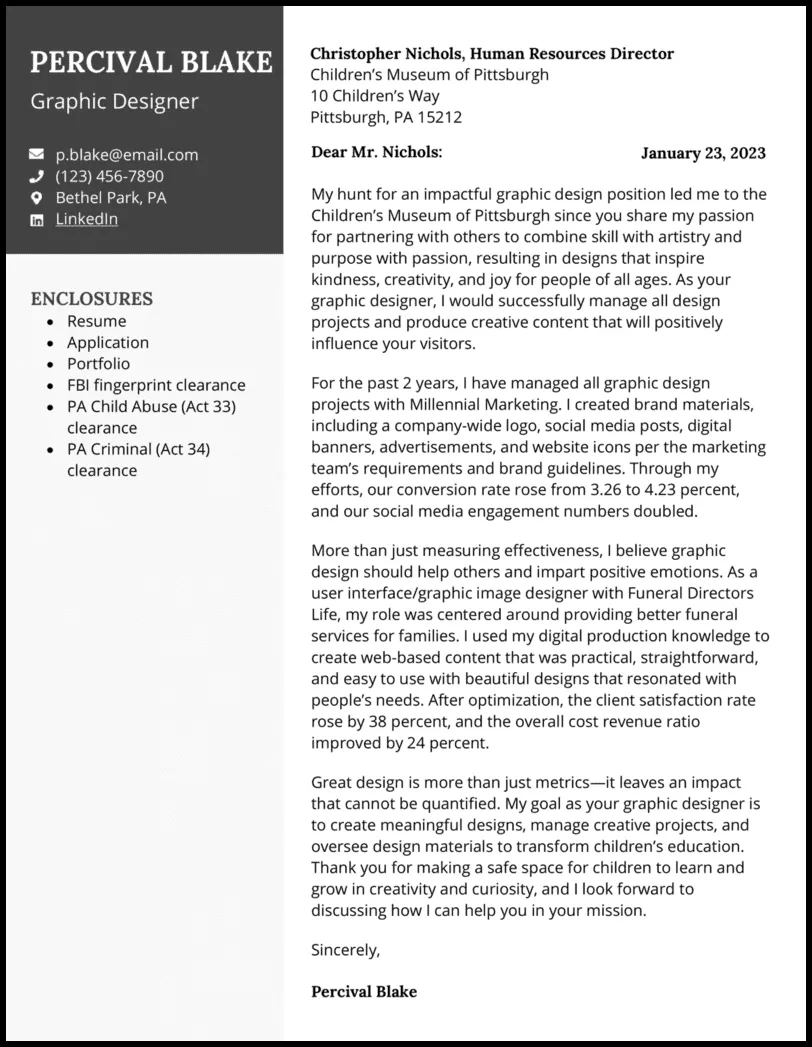
Use a well-structured template as a starting point for your cover letter. Start with your header, including your contact information, and the date. Include the hiring manager’s name, their title, and the company’s address. Use a professional greeting. Write a compelling opening paragraph stating the position and your interest. Include body paragraphs that highlight your skills and experience and tailor them to the job requirements. Craft a strong closing with a call to action. Always proofread and edit your letter before sending it. There are numerous cover letter templates available online that you can adapt to your needs. Using a template will make the writing process easier and ensures your cover letter is structured professionally.
Example Cover Letter Paragraphs
To help you get started, consider these example paragraphs. In your opening, you might write: ‘I am writing to express my enthusiastic interest in the Graphic Designer position at [Company Name], as advertised on [Platform]. With a strong background in [specific skill] and a passion for creating impactful visuals, I am confident I can make a significant contribution to your team.’ For the body, you could say: ‘In my previous role at [Previous Company], I was responsible for designing marketing materials that increased brand awareness by 20%. I have a solid understanding of [specific design software] and a proven ability to manage projects from concept to completion. For the closing you could try: ‘Thank you for considering my application. I am eager to discuss how my creativity and skills can benefit your team. I look forward to the opportunity to speak with you soon.’
Tips for Sending Your Cover Letter
When sending your cover letter, use a professional email address and subject line. Save your cover letter as a PDF to preserve the formatting. Attach both your cover letter and your resume to your email. Review your email before sending it for any errors or typos. Consider sending a follow-up email a week after submitting your application to check on the status. Always maintain a professional tone throughout the entire application process. When sending your cover letter, make sure to double-check everything before sending it to the hiring manager. Your attention to detail should be reflected in every aspect of your application.