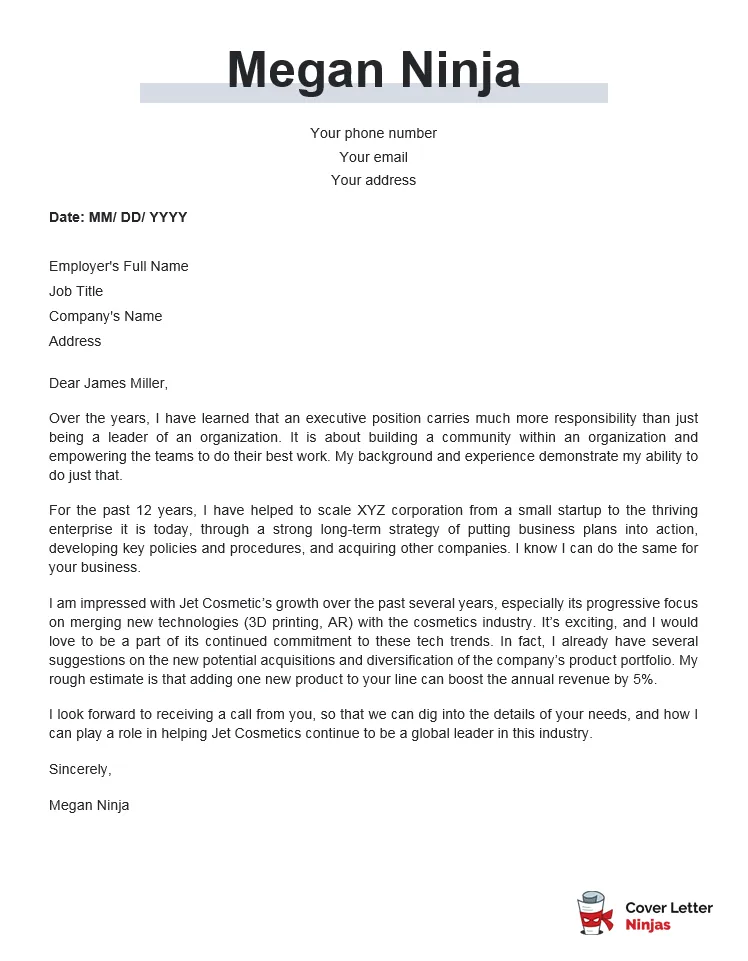
What is an Executive Cover Letter?
An executive cover letter is a crucial document accompanying a resume when applying for a high-level management or leadership position. Unlike a standard cover letter, it’s tailored to showcase an executive’s significant achievements, leadership capabilities, and strategic vision. It provides a concise summary of your career highlights, demonstrating how your expertise aligns with the prospective employer’s needs and goals. This document is a powerful tool that grabs attention, especially when you consider that hiring managers and recruiters often spend only a few seconds scanning a cover letter initially.
Why is an Executive Cover Letter Important?
Executive cover letters are critical because they give you an opportunity to demonstrate leadership skills and highlight strategic thinking, which are vital to executive roles. They bridge the gap between the resume, which lists skills, and the person you present. The document allows you to provide a narrative of your career path, showcasing your decision-making ability and strategic contributions. This document provides insights into your personality, leadership style, and your ability to communicate effectively. It’s a vital opportunity to differentiate yourself from other candidates, by aligning your profile and expertise with the target organization’s specific requirements.
Key Components of an Executive Cover Letter

An executive cover letter has various parts. From the header, which includes your contact information and the date, to the recipient’s details, the opening paragraph should immediately grab the reader’s attention. The body needs to emphasize your significant accomplishments, leadership skills, and relevant experience, supported by quantifiable results. The closing paragraph should reinforce your interest and suggest the next steps. You want to make sure that you include correct formatting and design elements, and don’t make common mistakes.
Header of Your Executive Cover Letter
The header is the initial segment of your executive cover letter, and must include essential contact details to ensure easy communication. Make sure your name, professional title, phone number, email address, and LinkedIn profile URL (if applicable) are clearly displayed. These details should align with the information on your resume. Consistency builds trust. The header should be formatted for a professional look. Consider using a clean, easy-to-read font to ensure your details are accessible. It should provide easy and quick contact. This is the first point of contact, so it is important that you make it right.
Your Contact Information
Your contact information, including your name, professional title, phone number, and email address, needs to be prominently displayed in the header. Verify that this information is accurate and current, as this is how potential employers will contact you. You should also consider adding a link to your LinkedIn profile, as it provides a professional overview of your career. This allows the employer to quickly verify your qualifications.
Date

Below your contact information, include the date on which you are sending the cover letter. This is important for record-keeping and helps in tracking the application process. The date should be formatted in a standard manner, such as Month Day, Year (e.g., January 20, 2024). The date helps the recipient to know when the document was sent and also helps to keep all records in order.
Recipient’s Information
Directly below the date, include the recipient’s details. This usually includes the hiring manager’s name, their title, the company name, and the company’s address. If you are unable to find the hiring manager’s name, try to find it on LinkedIn. If this is not possible, use a general salutation like ‘Dear Hiring Manager.’ Ensure the recipient’s details are accurate to show you have taken the time to prepare the application carefully.
Opening Paragraph Crafting an Impactful Start
The opening paragraph of an executive cover letter is crucial, as it is the first chance to make an impression. Start with a strong statement that grabs attention, outlining your interest in the position and the company. This paragraph should capture the reader’s attention and demonstrate your understanding of the company’s needs. Clearly state the specific role you are applying for, and immediately highlight what you can offer to the organization, focusing on your significant achievements and skills that make you the right fit. Use action verbs and impactful language to keep the reader engaged.
Highlighting Your Executive Achievements

In the body of your executive cover letter, concentrate on showcasing your significant achievements. Instead of listing job duties, focus on accomplishments that demonstrate your impact. Discuss specific projects, initiatives, and outcomes that have improved your past organizations. Quantify your results whenever possible. Include examples where you have led successful teams, managed complex projects, or increased profitability. This will clearly display your value. This allows you to demonstrate your impact in previous roles, and show the employer what they can expect.
Quantifiable Results and Metrics
To make your achievements more impactful, use quantifiable metrics to illustrate your success. Whenever possible, include numbers, percentages, and specific figures to demonstrate the tangible results you’ve achieved. Instead of stating you ‘increased sales,’ specify the percentage increase or dollar amount. Include things such as ‘improved customer satisfaction by 15%’ or ‘increased efficiency by 20%’ to showcase your ability to drive positive outcomes. This is important, as it adds value to your achievements, and provides concrete proof of your abilities.
Demonstrating Leadership Skills
An executive cover letter should prominently display your leadership skills. Highlight your ability to lead and inspire teams, make strategic decisions, and drive organizational change. Include examples of how you have motivated teams, managed conflict, and fostered a positive work environment. Mention experiences where you have developed and executed strategic plans, overseen large budgets, or implemented new technologies. Showcase how you align these skills with the requirements of the specific role.
Showcasing Relevant Experience

Focus on demonstrating that your experience is highly relevant to the job. Select the key experience that aligns with the requirements outlined in the job description. Highlight the skills and accomplishments that directly match what the employer is seeking. Ensure that you tailor your examples to illustrate how you have previously excelled in a role similar to the one you are applying for. Show a clear connection between your past successes and the prospective role’s expectations.
Tailoring Your Letter to the Job
Customize your executive cover letter for each application. Carefully analyze the job description and tailor the content to reflect the specific requirements of the position. Highlight the skills and experiences that are most relevant to the role and the company’s needs. Research the company’s mission, values, and recent initiatives to customize the letter and demonstrate your understanding of the organization. This personalization shows your strong interest and attention to detail. This gives you a competitive edge.
Addressing the Employer’s Needs
When writing your cover letter, focus on addressing the employer’s needs. Understand their challenges, goals, and expectations. Frame your accomplishments and skills in a way that shows you can meet these needs. Demonstrate that you understand their industry and are able to contribute to their success. Highlighting your ability to solve problems and improve key areas that the company is prioritizing will greatly enhance your application.
Matching Skills and Qualifications

Carefully align your skills and qualifications with the requirements listed in the job description. Use the same keywords and phrases that the employer uses to illustrate your relevant skills and experience. Ensure that you emphasize the leadership, management, and strategic thinking abilities that the employer is looking for. Be specific about how your skills and qualifications meet the employer’s needs, emphasizing what you can bring to the role.
Writing a Compelling Closing
The closing of your executive cover letter should reinforce your interest and offer a clear call to action. Reiterate your enthusiasm for the opportunity and summarize how your skills and experience align with the company’s needs. Thank the reader for their time and consideration, and express your interest in discussing your qualifications further. Make sure to include your contact information to ensure they can easily connect with you. A strong closing can leave a memorable impression and increase your chances of moving forward in the application process.
Expressing Gratitude and Next Steps
End your cover letter by expressing gratitude to the reader for considering your application. Show appreciation for their time and attention. Then, suggest the next steps you would like the hiring manager to take. Include a call to action, such as offering to provide additional information or scheduling an interview. Make sure that you are open to follow-up calls and meetings to further discuss your qualifications.
Formatting and Design Tips for Executives

The format and design of an executive cover letter are critical for conveying professionalism and attention to detail. It should be easy to read, well-organized, and visually appealing. A clean, uncluttered layout with ample white space will improve readability. Using a professional font and clear headings will keep the reader’s attention. Make sure to proofread the letter to eliminate any errors and ensure that it makes a good impression.
Font and Layout
Choose a professional font that is easy to read. Consider using fonts such as Times New Roman, Arial, or Calibri. Make sure the font size is between 10 and 12 points for the main text and 14 for headings. Ensure there is adequate white space to improve readability. Use a consistent layout throughout the document, with clear headings and subheadings to organize the content. A well-designed layout is a sign of the attention to detail.
Proofreading and Editing for Perfection
Proofreading and editing are essential steps to ensure your cover letter is free of errors. Thoroughly check the letter for any spelling, grammatical, or punctuation mistakes. Read the cover letter multiple times, preferably aloud, to catch any awkward phrasing or unclear sentences. Consider having someone else review the letter, as a fresh pair of eyes can often spot errors you might miss. A polished and error-free cover letter is a sign of your professionalism.
Common Mistakes to Avoid

There are several common mistakes to avoid when writing an executive cover letter. Avoid the use of excessive jargon and generic language. Make sure that you tailor the letter to the specific role and company, and be mindful of length and brevity. By avoiding these mistakes, you will improve your chances of making a good impression.
Using Too Much Jargon
Avoid using excessive industry-specific jargon. The purpose of the letter is to be easily understood by anyone who reads it. While some industry-specific language is expected, avoid technical terms or complex phrases that the reader may not be familiar with. Make sure that you are clear and concise in the language. Use simple terms and explain any complicated concepts. This is important to ensure that your message is easily understood.
Generic Language
Avoid using generic language and clichés that don’t provide any specific information about your qualifications. Do not use phrases that could apply to any candidate. Customize the cover letter to reflect your unique experience, skills, and accomplishments. Use specific examples to showcase your achievements. Make sure that you are specific. Generic language will not make a good impression.
Length and Brevity
Keep your executive cover letter concise and focused. Recruiters and hiring managers are busy, so it’s important to make every word count. Aim for a cover letter that is no longer than one page, and ensure that you are including only the most important information. Select the most relevant information, and avoid including unnecessary details that might distract from your key selling points. This is a professional document, so it is important to be brief and to the point.
Examples of Successful Executive Cover Letters
Review examples of successful executive cover letters. They can help you understand how to structure your letter, format your content, and present your achievements effectively. Seek samples tailored to your specific industry or job role. Note the language, tone, and organization of the letter. This can help you learn key formatting strategies, and to align your own document.
Executive Cover Letter for CEO Position
An executive cover letter for a CEO role must demonstrate a strong strategic vision and a proven track record of leadership. Highlight your experience in driving company growth, improving profitability, and leading successful organizational transformations. Mention your ability to make strategic decisions, build strong relationships with stakeholders, and manage complex operations. Include quantifiable results. The letter should convey your confidence in your ability to lead and your clear strategic goals.
Executive Cover Letter for CFO Role
For a CFO role, your executive cover letter must emphasize your financial acumen, experience in financial planning and analysis, and your knowledge of compliance and risk management. Highlight instances where you have improved financial performance, reduced costs, and ensured compliance with financial regulations. Highlight your experience with budgeting, forecasting, and financial reporting. Include specific metrics and quantifiable achievements to showcase the impact of your financial expertise.
Executive Cover Letter for CMO Role
An executive cover letter for a CMO role should highlight your marketing leadership, brand management, and strategic marketing abilities. Showcase your experience in developing and executing successful marketing strategies that have increased brand awareness, customer acquisition, and revenue growth. Mention your experience in market research, digital marketing, and building high-performing marketing teams. Use specific examples to demonstrate your ability to create brand strategies. Provide measurable results.
Executive Cover Letter for COO Role
An executive cover letter for a COO role needs to showcase your operational expertise, leadership capabilities, and experience in improving efficiency and productivity. Highlight your experience in streamlining operations, managing large teams, and overseeing complex projects. Mention your successes in improving processes, increasing operational efficiency, and reducing costs. Use data to showcase the impact of your efforts.