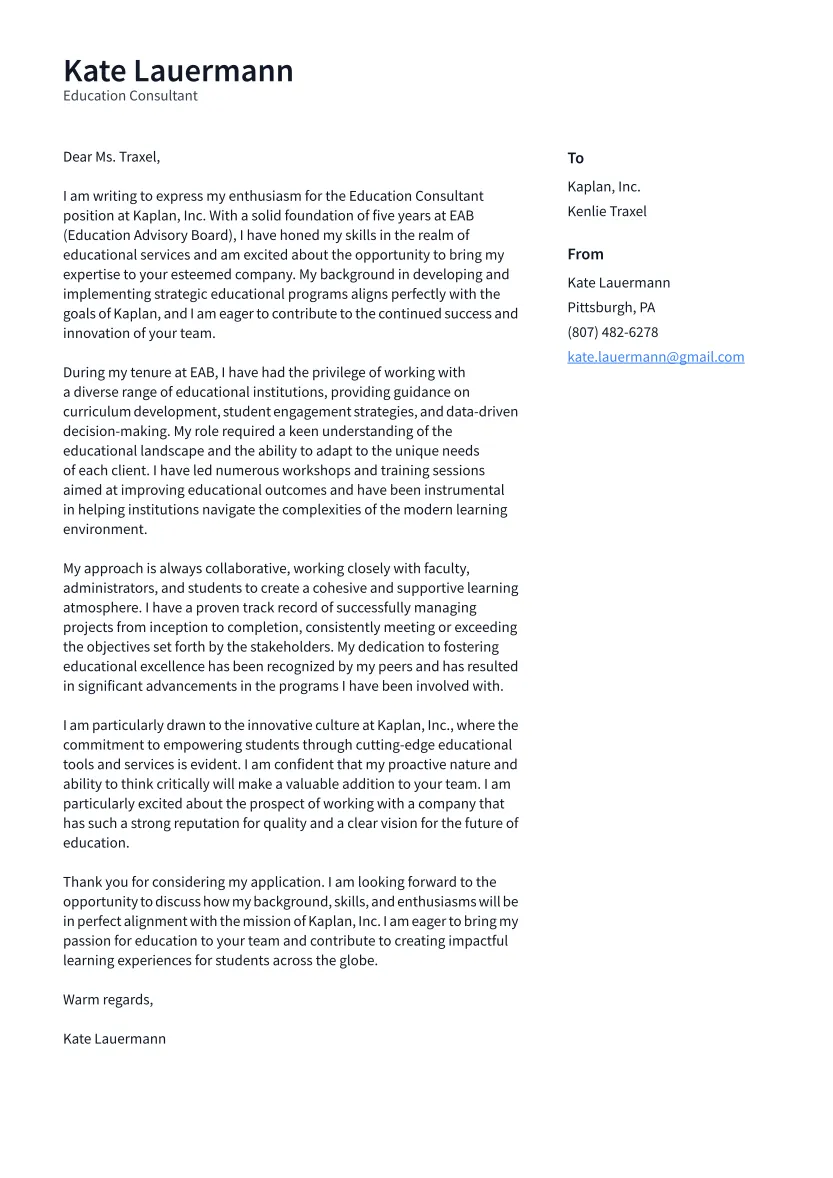
Understanding the Education Consultant Cover Letter
An education consultant cover letter is your first chance to impress a potential employer. It’s a crucial document that introduces you, highlights your key skills and experiences, and expresses your enthusiasm for the position. Unlike a resume, which provides a factual overview of your career, a cover letter allows you to tell a story, connecting your qualifications to the specific needs of the job. It’s an opportunity to demonstrate your writing skills, attention to detail, and understanding of the role you are applying for. A well-crafted cover letter can significantly increase your chances of securing an interview, setting the stage for a successful job application. Think of it as your personal sales pitch, showcasing why you are the perfect fit for the education consultant role and the company culture. It should complement your resume, providing context and depth to your qualifications and demonstrating your genuine interest in the position. The tone should be professional yet personable, reflecting your personality and commitment to the field of education consulting.
Why a Cover Letter Matters for Education Consultants
For education consultants, a cover letter is particularly vital because it allows you to demonstrate your understanding of the challenges and opportunities within the education sector. It showcases your ability to analyze, strategize, and communicate effectively, all critical skills for an education consultant. Many job applications in education consulting require a cover letter to screen candidates. A strong cover letter shows that you’ve taken the time to understand the role and the organization, setting you apart from applicants who may only submit a resume. Moreover, it provides a space to address specific requirements or preferences mentioned in the job description and to explain how your experience aligns with the position’s objectives. By tailoring your cover letter, you demonstrate your genuine interest and commitment to the role, which is essential for making a positive first impression and ultimately securing an interview. Additionally, it offers the opportunity to highlight relevant skills or experiences that may not be fully apparent in your resume, providing a more complete picture of your capabilities and potential contributions.
Key Elements of a Compelling Cover Letter

Contact Information
Begin your cover letter with your contact information. This section should be at the top of the page and include your full name, phone number, professional email address, and optionally, your LinkedIn profile URL. Ensuring this information is accurate and easily accessible allows recruiters to contact you promptly. Verify your email address and phone number are up-to-date to avoid missing important communications about the job application. Using a professional email address is vital; avoid using informal email addresses, as this can impact your credibility. The header should be formatted clearly and be easily readable, ensuring recruiters can quickly find and reach out to you. You can also include the date of the cover letter. Remember to proofread this section meticulously, as a simple mistake can be detrimental.
Professional Header
The professional header includes your name, contact details, and the date. This header should be neatly aligned, often on the left side of the page. Use a professional font, such as Times New Roman, Arial, or Calibri, and maintain a consistent font size throughout your letter. Ensure that your contact information is easily visible and includes your phone number and a professional email address. For a polished look, align the header and the recipient’s information neatly, making it easy for the reader to quickly identify key details. This creates a positive first impression, showcasing your attention to detail and professionalism.
Personalized Greeting

Address the hiring manager or the specific person mentioned in the job posting by name. This personalization demonstrates that you’ve taken the time to research the company and the role, which shows initiative and interest. Use “Dear Mr./Ms./Dr. [Last Name],” as a formal greeting unless the job posting specifies otherwise. If you can’t find a name, try to find the name on the company website, LinkedIn, or even by calling the company’s HR department. Avoid generic greetings such as “To Whom It May Concern,” as this lacks a personal touch and may suggest that you’re sending a mass application. Personalization makes a strong first impression, indicating respect and diligence. By directly addressing the hiring manager, you make a connection that can positively influence the way they view your application.
Body Paragraph 1 Highlight Your Value
Start your first body paragraph with a concise statement of why you are applying for the position and what interests you about the company. Then, briefly mention your key qualifications and how they align with the role’s requirements. Focus on showcasing your value to the company, such as your experience in specific areas of education, your ability to work with different stakeholders, or your proven track record of success. This paragraph should act as an introduction, grabbing the reader’s attention and making them want to learn more about your qualifications. Keep this section focused on the job description, making sure you address the core needs of the role. Clearly and concisely communicate your strengths and how they relate to the responsibilities of an education consultant. The goal is to make a strong first impression and encourage the hiring manager to keep reading.
Quantify Achievements
Use data and metrics to support your claims and demonstrate the impact of your work. Whenever possible, quantify your achievements by providing specific numbers and percentages. For example, instead of saying “Improved student performance,” you could say “Increased student test scores by 15% through the implementation of targeted intervention strategies.” Provide concrete evidence of your success by using phrases such as “managed projects that resulted in a 20% reduction in costs,” or “led training programs that increased teacher proficiency by 25%.” This approach offers a clear and measurable representation of your accomplishments, creating a compelling case for your value as a candidate. Show the hiring manager that you can deliver real results.
Body Paragraph 2 Show Your Enthusiasm

In the second paragraph, delve deeper into your relevant experiences and accomplishments. Provide specific examples that illustrate your skills, knowledge, and abilities. Explain how your past roles have prepared you for the education consultant position and what makes you a strong fit for the company. Demonstrate your enthusiasm by highlighting how your career goals align with the company’s mission and values. Mention how you’ve previously overcome challenges, worked collaboratively, or led initiatives that have contributed to success in the education field. Personalize your cover letter by mentioning a specific project or achievement that aligns with the company’s work, demonstrating your attention to detail and genuine interest in the position. Share your passion for education consulting and how you’re excited about contributing to the company’s goals.
Tailor to the Job Description
Customize your cover letter to the specific requirements and responsibilities listed in the job description. Carefully read the job posting and identify the key skills and experiences the employer is seeking. Then, highlight your relevant qualifications, using keywords from the job description to demonstrate that you meet their requirements. Tailoring your letter shows that you understand the role and are a great fit. Incorporate examples that directly address the needs and goals of the company, making it clear that you’re invested in their success. By carefully aligning your skills and experiences with the job’s demands, you significantly increase your chances of making a positive impression and securing an interview. Show the hiring manager that you have the essential skills and knowledge for the role.
Body Paragraph 3 Call to Action
Conclude your cover letter with a clear and concise call to action. Express your interest in an interview and indicate your availability. Thank the hiring manager for their time and consideration. Reiterate your enthusiasm for the position and the company. Make it easy for the hiring manager to contact you by including your phone number and email again. End with a professional closing such as “Sincerely” or “Best regards.” A well-defined call to action helps to keep the momentum and keeps the reader engaged, encouraging them to take the next step in the hiring process. Make sure the call to action is professional and concise, allowing the recruiter to easily schedule an interview and proceed with your job application. A strong closing can create a lasting positive impression.
Closing and Signature

Use a professional closing such as “Sincerely,” “Best regards,” or “Thank you.” Leave some space for your signature if you are printing the document, and then type your full name below. Proofread the entire letter one last time, paying close attention to grammar, spelling, and punctuation. Ensure your contact information is accurate and up-to-date. Before submitting the cover letter, save it in a professional format, such as PDF, to maintain the formatting across different devices. A polished closing leaves a positive final impression. Make sure your name is clearly visible and correctly spelled.
Top 5 Education Consultant Cover Letter Tips
Research the Company
Thoroughly research the company, understanding its mission, values, and current projects. This demonstrates your genuine interest and allows you to tailor your cover letter effectively. Visit their website, read articles, and check their social media accounts to gain a deep understanding of their work. Identify their goals, challenges, and recent achievements to tailor your letter to their specific needs. Mentioning specific initiatives or projects that align with your experience and the company’s objectives will help you stand out. Personalize your application by demonstrating your knowledge of the company and your desire to contribute to its success, as it shows the hiring manager that you have put in the effort.
Highlight Relevant Skills

Identify and highlight the skills that align with the job description and the company’s needs. Education consultants should showcase skills such as project management, data analysis, communication, leadership, and problem-solving. Provide specific examples of how you’ve used these skills in previous roles. Tailor your skills section by including keywords from the job description, this way you’ll ensure that you are a strong fit for the position. Quantify your accomplishments to highlight the impact of your skills. It’s important to demonstrate not just that you possess these skills, but also how you have successfully applied them in real-world scenarios. Emphasize your ability to work collaboratively and to provide results, as these are key qualities for an education consultant.
Showcase Accomplishments
Instead of just listing your responsibilities, focus on showcasing your accomplishments. Quantify your achievements with data and metrics to demonstrate your impact. For example, you could mention how you improved student outcomes, reduced costs, or increased efficiency. Use the STAR method (Situation, Task, Action, Result) to structure your examples, providing context and detailing the steps you took to achieve your results. Choose accomplishments that are relevant to the job description and the company’s goals. Highlighting your past successes can build confidence with the hiring manager, providing them with concrete examples of your abilities. This approach will make your cover letter more compelling and showcase your value as a candidate, demonstrating your ability to drive positive change.
Proofread and Edit Meticulously
Carefully proofread your cover letter for any errors in grammar, spelling, and punctuation. Poorly written letters can undermine your credibility and diminish the impact of your application. Read the letter aloud and ask a friend or colleague to review it. Check for consistency in formatting and tone. Ensure all contact information is accurate. Using grammar and spell-checking tools can help catch errors, but they are not a substitute for thorough review. Pay attention to sentence structure, clarity, and flow. A polished, error-free cover letter demonstrates your professionalism and attention to detail. Proofreading enhances the quality of your application and makes sure that you make a positive impression.
Use a Professional Format
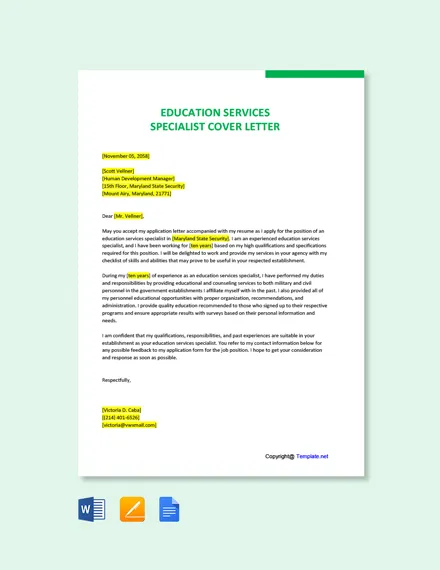
Use a clean and professional format. Choose a standard font, such as Times New Roman, Arial, or Calibri, and use a readable font size (11 or 12 points). Structure your letter logically with clear headings, paragraphs, and bullet points. Use a professional business letter format, including your contact information, the date, the hiring manager’s name and address, and a formal closing. Avoid using overly creative fonts, colors, or formatting that may distract the reader. Ensure your letter is easy to read and visually appealing. A well-formatted cover letter looks professional and shows that you have attention to detail. The visual presentation can enhance your impact and make a strong impression.
Examples of Strong Phrases
Skills to Highlight
In your cover letter, emphasize key skills relevant to education consulting. Use phrases that highlight your abilities. You can include phrases like “Project management expertise,” “Data-driven decision-making,” and “Exceptional communication skills.” Stress the ability to “Develop and implement effective educational strategies.” Also, you can use phrases such as “Proven ability to collaborate with diverse stakeholders,” or “Expertise in curriculum development and evaluation.” Ensure your language reflects your qualifications and matches the job requirements, and highlight your ability to “Analyze and interpret data to improve student outcomes.” By using specific and targeted phrases, you will be able to show what you have to offer.
Keywords to Include

Include keywords from the job description to demonstrate your familiarity with the role and its requirements. Integrate terms like “Curriculum development,” “Educational assessment,” “Stakeholder engagement,” and “Data analysis.” Use industry-specific jargon and phrases related to the area of education consulting. Also, include terms like “Project management,” “Strategic planning,” and “Program evaluation.” Incorporate terms like “Training and development,” and “Policy analysis.” By including these words, you’re helping the hiring manager quickly understand how your skills and experience align with their needs. Using the right keywords increases your chances of getting noticed by applicant tracking systems and hiring managers.
Common Mistakes to Avoid
Generic Letters
Avoid sending a generic cover letter that isn’t tailored to the specific job or company. A generic letter lacks personalization, and it fails to show your genuine interest in the position. Always research the company and tailor your cover letter to their specific needs. Show the hiring manager that you understand the role and the organization. Customize your cover letter by mentioning specific projects, goals, or values of the company. A customized letter can show the hiring manager your effort and dedication to the role and company, improving your chances of landing an interview.
Typos and Grammatical Errors
Carefully proofread your cover letter for any errors. Typos and grammatical mistakes can create a negative impression and undermine your credibility. Make sure to spell-check and read the letter aloud to catch errors. Ask a friend to review your letter, because it is easy to miss errors in your own writing. Errors demonstrate a lack of attention to detail, which is crucial for an education consultant, making it harder to get past the initial screening phase. Taking the time to proofread shows professionalism and respect for the hiring manager. A clean, error-free cover letter represents your quality and your application.
Lack of Personalization
Ensure your cover letter is personalized, by mentioning specific names and details about the company. Avoid generic greetings like “To Whom It May Concern,” and address the hiring manager by name. Demonstrate your knowledge by researching the company and mentioning specific projects or goals that resonate with you. Show the hiring manager that you understand their needs and that you’re excited about the position and the organization. A personalized cover letter can show your effort, making it more likely you’ll be considered. Taking the time to personalize your letter will demonstrate genuine interest and set you apart from the competition. In the end, it will make a positive impression on the hiring manager.
Cover Letter Templates and Examples
Where to Find Templates
Use cover letter templates and examples to get started, but make sure to tailor them to your unique qualifications. You can find templates on websites such as Resume.com, or MyPerfectResume. These resources provide various templates tailored for different professions. Additionally, you can find examples of successful cover letters for education consultant roles online. Use these templates as a starting point, not a complete solution. Remember to adapt them to your experience, tailoring each letter to the job requirements and the company’s values. This is critical for making the letter your own, showing your knowledge, and highlighting your value, this will help you to get the job!
How to Adapt Examples
Adapt the examples and templates by replacing the generic information with your specific experiences and skills. Start by modifying the contact information and personalized greetings to match the company and hiring manager. Then, highlight your accomplishments by quantifying your results with data. Review the job description, and align your skills with the required qualifications. Personalize your cover letter by mentioning the company’s values and mentioning specific projects. Always proofread your adapted letter to ensure it is free from errors and reflects your personal brand. By adapting examples, you’ll ensure that your cover letter is a unique reflection of your abilities and your enthusiasm.