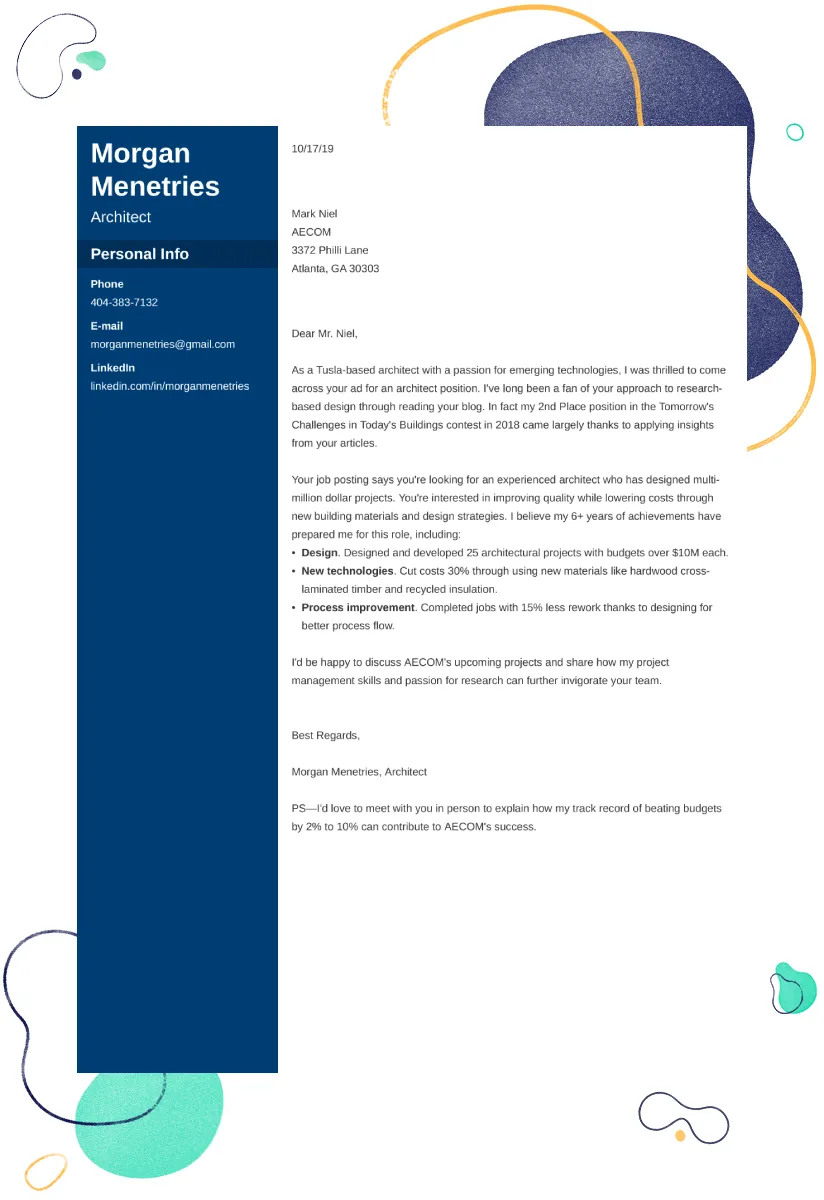
Understanding the Architect Cover Letter
An architect cover letter is more than just a formality; it’s your first chance to make a lasting impression on a potential employer. It’s a tailored introduction that complements your architectural resume, providing a deeper dive into your skills, experience, and passion for the field. Think of it as a narrative, a story that showcases your unique value proposition and convinces the hiring manager that you’re the perfect fit for their team and the specific role. A well-crafted cover letter can set you apart from other applicants, demonstrating your communication skills and attention to detail, both crucial in the architectural profession. It is an opportunity to personalize your application, highlighting specific projects and experiences that align with the firm’s values and the job’s requirements. Remember that the best architect cover letters are not generic templates but are unique and tailored to the firm you’re applying to.
Purpose of an Architect Cover Letter
The primary purpose of an architect cover letter is to persuade the hiring manager to read your resume and consider you for an interview. It’s a marketing tool designed to showcase your qualifications in a compelling way. It also serves as a platform to explain any gaps in your employment history or to elaborate on specific projects that are particularly relevant to the role. Cover letters allow architects to express their enthusiasm for the specific firm and role, demonstrating a genuine interest that goes beyond a simple application. Furthermore, a cover letter helps you to highlight your soft skills, such as communication, teamwork, and problem-solving, which are essential in architecture. A well-written cover letter can significantly increase your chances of landing an interview, as it provides context to your resume and showcases your ability to write clearly and persuasively, a skill crucial in client communication and project presentations.
Highlighting Your Architectural Skills

Your architect cover letter should spotlight your relevant skills and experiences, aligning them with the job description’s requirements. Instead of just listing your abilities, provide concrete examples of how you’ve used them to achieve successful outcomes. For instance, if the job requires proficiency in Revit, describe a project where you utilized the software to design complex structures and managed the project’s modeling aspects. If you excel in project management, highlight your experience in leading a team, meeting deadlines, and managing budgets. Emphasize your design capabilities, illustrating your ability to create innovative and functional spaces. Be sure to demonstrate your understanding of building codes, regulations, and sustainability practices. Showcasing your expertise in areas like construction documentation, site analysis, or client communication can significantly enhance your cover letter’s appeal. This section should not only show what you can do but also illustrate your ability to contribute immediately to the company.
Essential Elements for a Strong Architect Cover Letter
Several key elements are essential for a strong architect cover letter. Start with a professional heading that includes your contact information and the date. Address the hiring manager by name, if possible; this shows that you’ve done your research and are committed to the role. The body of your letter should include an engaging introduction, a detailed explanation of your relevant experience, and a conclusion that expresses your enthusiasm for the opportunity. Ensure your cover letter is well-organized, with clear paragraphs and concise sentences. Tailor your letter to the specific job and company, highlighting the skills and experiences most relevant to their needs. Proofread carefully for any typos or grammatical errors, as these can undermine your credibility. Moreover, a compelling cover letter clearly states the position you are applying for and how your skills align with the firm’s values and the job requirements, making it an effective marketing tool.
Formatting Your Architect Cover Letter
Proper formatting enhances the readability and professionalism of your architect cover letter. Use a standard business letter format, with left-aligned text and single-spacing between lines. Choose a readable font like Arial, Calibri, or Times New Roman, and use a font size between 10 and 12 points. Keep your cover letter concise, ideally within one page. Use clear headings and subheadings to organize your content, making it easy for the hiring manager to scan and find key information. Use bullet points to highlight specific skills or accomplishments. Ensure consistent margins and spacing throughout your letter. Avoid using overly decorative fonts or graphics, which can distract from your message. Aim for a clean, uncluttered layout that reflects your attention to detail and professionalism. A well-formatted cover letter not only presents your information effectively but also demonstrates your understanding of professional standards.
Contact Information and Date

Begin your architect cover letter with your contact information, including your name, address, phone number, and email address. Place this information at the top left or right corner of your letter. Following your contact information, include the date. This provides the hiring manager with the date the letter was written. Ensure your email address is professional and appropriate for a job application. Double-check that your phone number is accurate and that you are available to answer calls. This initial section sets the tone for your entire application, making it easy for the employer to reach you if they are interested in your qualifications. Presenting your contact information clearly and accurately demonstrates your attention to detail and professionalism.
Salutation
The salutation is your opening greeting and should be formal and respectful. Whenever possible, address the hiring manager by name. This shows that you’ve taken the time to research the company and the person in charge of hiring. If the name is not available, use a general salutation like “Dear Hiring Manager” or “Dear [Company Name] Hiring Team.” Avoid casual greetings like “Hey” or “Hi.” The salutation sets the tone for your letter and demonstrates your professionalism. It’s a small but significant detail that can make a positive first impression. Make sure to spell the name correctly, as this shows that you have paid attention to the details. A personalized salutation also indicates your genuine interest in the role and the company, which sets you apart from other applicants who may have used a generic approach.
Body Paragraphs
The body paragraphs are the core of your architect cover letter, where you present your qualifications and express your interest in the role. The body should consist of three or four paragraphs, each focusing on a specific aspect of your candidacy. The structure of these paragraphs is critical for showcasing your skills and experience effectively. You should introduce yourself in the first paragraph, explain your relevant experience in the second, and in the third, demonstrate why you are interested in this firm. Each paragraph should have a clear topic sentence that introduces the main idea and is supported by specific examples and details. Use action verbs to describe your accomplishments and skills. Keep the language clear, concise, and tailored to the specific job and company. The body paragraphs should weave together a narrative that highlights your abilities, demonstrates your passion, and convinces the hiring manager that you are the ideal candidate. It is where you articulate your value and align it with the employer’s needs.
First Paragraph Introduce Yourself

The first paragraph should serve as an introduction, clearly stating the position you’re applying for and how you found out about it. Briefly introduce yourself and highlight your most relevant qualifications or the most exciting aspect of your experience. Show your enthusiasm for the role and the company. For example, mention any projects you’ve been particularly proud of or any specific skills that align perfectly with the job description. This paragraph should catch the reader’s attention and make them want to continue reading. It should set the stage for the rest of the letter by providing a brief overview of your suitability for the role. Be sure to show how you discovered the job; whether it was through a job board, a company website, or a personal connection. A strong opening paragraph immediately signals your interest and qualifications for the role.
Second Paragraph Showcasing Experience
The second paragraph should delve into your relevant experience, highlighting your key skills and accomplishments. Provide specific examples of your work that align with the job requirements. Quantify your achievements whenever possible. Use action verbs to describe your responsibilities and successes. For instance, instead of saying you ‘worked on designs,’ say you ’led the design team on a 20,000 sq ft commercial project, completing the project under budget.’ Focus on the experiences and skills that make you a great fit for the job. Tailor this section to each application, emphasizing the experiences and skills that match the job’s requirements. Make sure to discuss any relevant software, certifications, and specializations. This paragraph is your opportunity to highlight the projects and skills that make you stand out among other applicants, showing that you are a strong fit for the role.
Third Paragraph - Why This Firm?
In the third paragraph, explain why you’re interested in working for this specific firm. Research the company to demonstrate your knowledge of their values, mission, and recent projects. Discuss what specifically attracts you to the firm. Mention any projects or aspects of their work that resonate with you. This section helps you show your passion for the company, demonstrating that your interest goes beyond just wanting a job. Mention their company culture or their unique approach to design. This section shows the hiring manager that you’ve researched the company and have a genuine interest in contributing to their team. Your enthusiasm is a key factor in persuading the hiring manager that you are the right person for the job. Tailor this to each firm, illustrating that your application is not a generic cover letter but rather a thoughtful expression of your interest in that company.
Concluding Your Architect Cover Letter

The concluding paragraph should summarize your interest in the position and reiterate your key qualifications. Express your enthusiasm for the opportunity and your confidence in your ability to contribute to the company. Thank the hiring manager for their time and consideration. Clearly state your intention to follow up, and indicate how you will do so, such as by email or phone. Keep it brief and professional. The conclusion reinforces your suitability for the role and leaves a lasting positive impression. A strong conclusion reinforces your interest and leaves the reader with a call to action and a sense of your professionalism and eagerness to contribute to the company. This should leave a lasting impression and should make the hiring manager remember you.
The Closing
The closing is the formal farewell at the end of your cover letter. Use a professional closing like “Sincerely,” “Best regards,” or “Yours sincerely.” Avoid casual closings such as “Thanks” or “Cheers.” The closing adds a final touch of professionalism to your letter. This indicates respect and attention to detail. It underscores your commitment to professionalism and leaves a positive impression. Be sure to maintain the formal tone used throughout your letter. It’s the final touch that leaves the reader with a lasting impression of your professionalism.
Signature and Contact Information
After the closing, leave a space for your signature. If you’re submitting a digital cover letter, you can simply type your name. If you’re printing the letter, sign it by hand. Below your signature, type your full name. Reiterate your contact information, including your phone number and email address, in case the recipient has misplaced your original contact information. This ensures that the hiring manager can easily reach you. Presenting your contact information again reinforces your availability and willingness to be contacted. This also makes it easy for the hiring manager to reach out, even if they are not looking at your resume. This ensures you are easy to contact, increasing your chances of getting the interview.
Proofreading and Editing

Proofreading and editing your architect cover letter are critical steps to ensure it is polished and professional. Carefully review your letter for any typos, grammatical errors, and inconsistencies. Read it aloud to catch any awkward phrasing or sentence structure issues. Have a friend or colleague review your letter as well, as a fresh pair of eyes can often spot errors you might have missed. Pay close attention to spelling, punctuation, and grammar. Use a spell checker and grammar checker, but don’t rely on them entirely. Proofreading demonstrates your attention to detail, which is essential in the field of architecture. A well-proofread cover letter can leave a lasting impression and increase your chances of getting an interview. Ensure that the content flows logically and that your language is clear and concise. Correcting these minor errors can elevate your cover letter from average to impressive.
Architect Cover Letter Examples to Inspire You
Examining architect cover letter examples can provide invaluable guidance and inspiration as you write your own. Seeing how other successful candidates have presented their skills, experience, and enthusiasm can offer insight into best practices and formatting. Examples demonstrate how to tailor a cover letter to various roles, experience levels, and firms. They also offer templates for structuring your letter, allowing you to focus on content rather than getting bogged down in formatting. Studying examples can help you identify language and phrases that resonate with hiring managers. It can give you ideas on how to articulate your value. Adapt and tailor those examples to your unique situation. Remember, your goal is to create a cover letter that truly reflects your individual qualifications and ambitions.
Example 1 Recent Graduate
For a recent graduate, a cover letter should emphasize academic achievements, relevant coursework, and any internship or volunteer experiences. Highlight any design awards, studio projects, or technical skills you’ve acquired. Mention your proficiency with architectural software. In the example, focus on demonstrating your eagerness to learn and contribute to the firm. Showcase your understanding of architectural principles and your passion for design. Illustrate your involvement in relevant extracurricular activities. Tailor the letter to the specific company. Demonstrate a willingness to learn and adapt. The content must show your potential. This should give the employer confidence in your potential to grow and make meaningful contributions to the team.
Example 2 Experienced Architect

An experienced architect should use their cover letter to showcase their professional experience, significant projects, and leadership skills. Focus on projects that align with the firm’s expertise, emphasizing your role and the successful outcomes achieved. Quantify your accomplishments, such as ‘managed projects valued at over $X million’ or ‘reduced project costs by Y%.’ Highlight your experience in client communication, project management, and team leadership. Mention any specific challenges you overcame and the solutions you implemented. Demonstrate your ability to take on additional responsibilities. Focus on the value you can bring to the company. The letter should reflect a history of successful projects and a clear demonstration of expertise.
Example 3 Project Manager
A project manager cover letter should concentrate on your ability to manage architectural projects from concept to completion. Provide concrete examples of your successful project management experience. Highlight your skills in budgeting, scheduling, team coordination, and client communication. Emphasize your ability to keep projects on time, within budget, and to high-quality standards. Showcase your experience with construction documents and contract administration. Describe your ability to solve problems. Quantify the successes of the projects that you have managed. The letter should illustrate a track record of successfully completing projects, along with excellent organizational, leadership, and communication skills. The goal is to highlight your experience in leading teams to successful project outcomes.
Tailoring Your Cover Letter
Tailoring your cover letter to each job application is critical to making a strong impression. This involves carefully reviewing the job description and highlighting the skills and experiences that directly match the requirements. Customize the content to reflect the specific needs of the company. Research the company’s projects, values, and mission, and incorporate this information into your letter. Show the hiring manager that you’ve taken the time to understand the company and the role. Address the specific needs of the company, while demonstrating a genuine interest in their work. This approach increases the likelihood of being selected for an interview. Demonstrate your understanding of the job requirements. Show that you have carefully considered their needs and tailored your letter to their specific needs.
Adapting to Different Architectural Roles
Adapt your cover letter based on the specific role you’re applying for. For a design architect position, focus on your design skills, creativity, and ability to conceptualize innovative spaces. If applying for a project architect role, emphasize your project management experience, organizational skills, and ability to manage budgets and timelines. If applying for a technical architect role, highlight your knowledge of building codes, construction methods, and technical expertise. Ensure your cover letter reflects the specific skills and experiences most relevant to the role. Tailor your language and examples to resonate with the hiring manager. Highlight your proficiency in specific software and technologies used in the role. Focus on showing your suitability for the particular position.
Cover Letter for Residential Projects
When applying for a role focused on residential projects, your cover letter should emphasize your experience with residential design, client communication, and understanding of building codes and regulations specific to residential construction. Showcase your ability to create functional and aesthetically pleasing living spaces. Highlight your experience with different residential building types, from single-family homes to multi-unit dwellings. Mention your experience with materials, construction techniques, and sustainable design practices relevant to residential projects. Provide examples of your client communication skills, as these are vital in the residential field. Show that you can create spaces that meet the needs and preferences of the homeowner. Show that you understand the specific needs of the residential sector.
Cover Letter for Commercial Projects
For a cover letter targeting commercial projects, showcase your experience with commercial building design, project management, and knowledge of building codes and regulations relevant to commercial construction. Emphasize your understanding of complex design challenges and your ability to manage large-scale projects. Highlight your experience with different types of commercial buildings, such as offices, retail spaces, and healthcare facilities. Mention your experience with budget management, contract administration, and team coordination. Show your ability to meet tight deadlines and complex requirements. Describe your experience in working with a variety of clients and stakeholders. Highlight your proficiency in architectural software and technologies. Show your ability to handle the challenges of commercial projects.
Common Mistakes to Avoid
Several common mistakes can hurt your architect cover letter. Avoid using generic templates. Failing to tailor your letter to the specific job and company makes your application appear lazy. Ignoring the job description and not addressing the specific requirements is a major mistake. Sending a cover letter with typos, grammatical errors, and formatting inconsistencies damages your credibility. Don’t submit a cover letter that is too long, unfocused, or lacks relevant details. Avoid negative language or complaints about previous jobs. Avoid listing every single skill you have. Be careful about using jargon or technical terms that the hiring manager might not understand. Making these mistakes reduces the chances of getting an interview.
Ignoring the Job Description
Ignoring the job description is a significant mistake. The job description is your guide. Failing to carefully read and understand the requirements can lead to your cover letter missing key points. Make sure you address the skills, experiences, and qualifications requested in the job posting. If the description emphasizes specific software proficiency, include this in your letter. If the description stresses certain project management or design skills, be sure to highlight your experience in these areas. Tailor your letter to meet the specific needs of the role and demonstrate that you understand what the employer is looking for. Failure to do this shows you aren’t paying attention to detail and could be detrimental to your application.
Generic Cover Letters
Sending a generic cover letter is a common mistake that can prevent you from getting an interview. Generic cover letters lack personalization and fail to demonstrate your genuine interest in the company and the role. A generic letter can come across as impersonal. Make sure your cover letter is tailored to the specific company. Research the company’s values, mission, and recent projects, and incorporate this information into your letter. Address the hiring manager by name and show that you understand the specific requirements of the job. Avoid simply reusing a template. Craft a cover letter that highlights your unique qualifications and expresses your enthusiasm for the specific opportunity. Your efforts will pay off if you show your interest is genuine and specific.
Typos and Grammatical Errors
Typos and grammatical errors can undermine your credibility. Proofread your architect cover letter carefully before submitting it. Errors undermine your attention to detail and your ability to communicate effectively. Use a spell checker and grammar checker, but don’t rely on them entirely. Read the letter aloud to catch any awkward phrasing or sentence structure issues. Have a friend or colleague review your letter as well. These can help identify errors you might have missed. Ensuring your cover letter is free of errors demonstrates your commitment to professionalism. It also showcases your ability to communicate clearly and effectively. The slightest errors can make your application appear unprofessional and detract from your qualifications. A polished and well-edited cover letter leaves a strong and positive impression.
What to Include in Your Architect Cover Letter
Your architect cover letter should include several essential elements. Start with your contact information, the date, and the hiring manager’s name and title. Provide a brief introduction that states the position you are applying for and how you learned about it. In the body paragraphs, highlight your relevant skills and experience, providing concrete examples and quantifiable achievements. Express your interest in the specific firm and explain why you’re a good fit. Conclude the letter by summarizing your interest and reiterating your key qualifications, expressing enthusiasm, and expressing your intention to follow up. Close the letter with a professional farewell and your signature. Make sure to tailor each component to the specific requirements of the role, using clear and concise language. The best cover letters show how you match what the firm is looking for and present the best version of yourself. Your well-crafted cover letter can make the difference.