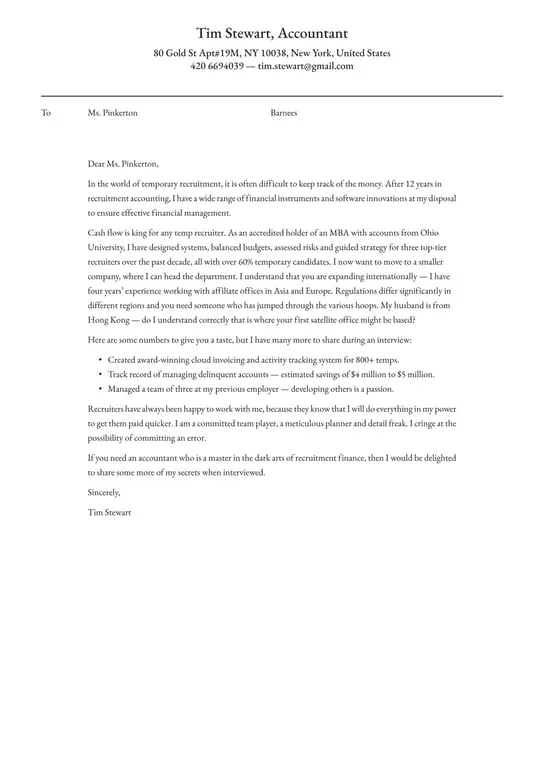
Understanding the Importance of an Accounting Cover Letter
In the competitive field of accounting, a well-crafted cover letter can be the key that unlocks your dream job. While your resume provides a detailed account of your skills and experience, the cover letter offers a crucial opportunity to demonstrate your personality, enthusiasm, and understanding of the specific role and company. It’s your chance to make a strong first impression and convince the hiring manager that you are the ideal candidate. Many applicants underestimate the importance of this document, leading to missed opportunities. A great cover letter is not just a formality, it’s a strategic tool to differentiate yourself and highlight what makes you unique.
Why a Cover Letter Matters for Accounting Roles
For accounting positions, precision, attention to detail, and communication skills are highly valued. A cover letter allows you to showcase these traits directly. It’s an opportunity to highlight your understanding of accounting principles, your ability to explain complex concepts clearly, and your interest in the company. Hiring managers often use cover letters to gauge your writing ability, a crucial skill in accounting. A poorly written letter can be an immediate red flag. A compelling cover letter demonstrates your genuine interest in the specific job and the company, setting you apart from candidates who may simply submit a generic resume.
Highlighting Relevant Skills and Experience

Your cover letter should directly address the key skills and experiences required for the position. Carefully review the job description and identify the specific qualifications the employer is seeking. Then, use your cover letter to provide concrete examples of how your skills and experience align with those requirements. This might involve mentioning specific software proficiencies (like QuickBooks, SAP, or Oracle), experience with financial reporting, or knowledge of relevant accounting standards (like GAAP or IFRS). By tailoring your letter to the specific job, you demonstrate your understanding of the role and your ability to perform the required duties effectively.
Key Components of a Successful Accounting Cover Letter
Contact Information and Salutation
Start your cover letter with your contact information, including your name, address, phone number, and email address. Following this, address the hiring manager directly, if possible. Research the company website or LinkedIn to find the name of the hiring manager or recruiter. If you cannot find a specific name, use a professional salutation like “Dear Hiring Manager” or “Dear [Company Name] Team.” Avoid generic greetings like “To Whom It May Concern.”
Crafting a Compelling Opening

The opening paragraph is your chance to grab the reader’s attention. Instead of stating the obvious (e.g., “I am writing to apply for the position of…”), make a strong statement about your interest in the company or the role. Consider mentioning how you learned about the position, what initially attracted you to the company, or a brief summary of your relevant qualifications. Your opening should immediately convey your enthusiasm and set the tone for the rest of the letter. The goal is to make the hiring manager want to read more.
Showcasing Your Qualifications and Achievements
The body of your cover letter is where you demonstrate how your skills and experience align with the job requirements. Focus on providing specific examples of your achievements and quantifying your results whenever possible. Explain how your previous roles have prepared you for this new opportunity. Use action verbs to highlight your accomplishments. For instance, instead of saying “Responsible for accounts payable,” say “Managed accounts payable for a portfolio of over 100 vendors, resulting in a 15% reduction in processing time.” This section should be tailored to the specific job description, emphasizing the skills and experiences most relevant to the role.
Quantifying Your Accomplishments
Whenever possible, quantify your achievements to demonstrate the impact you have made in previous roles. Instead of simply stating that you improved efficiency, provide specific numbers, percentages, or dollar amounts. For example, “Reduced month-end closing time by 20%” or “Saved the company $50,000 annually through improved cost controls.” These quantifiable results provide concrete evidence of your abilities and make a strong impression on the hiring manager. These numbers showcase your accomplishments and make them more impactful.
Tailoring Your Letter to the Specific Job

Avoid sending generic cover letters. Take the time to tailor each letter to the specific job you are applying for. Research the company, understand its values, and identify the key skills and experiences the employer is seeking. Then, use your cover letter to address those specific requirements directly. Highlight the relevant skills and experiences from your resume and explain how they align with the job responsibilities. This shows the hiring manager that you have taken the time to understand the role and are a good fit for the company.
Expressing Enthusiasm and Closing Effectively
In your closing paragraph, reiterate your interest in the position and express your enthusiasm for the opportunity. Thank the hiring manager for their time and consideration. Clearly state your availability for an interview. Include a call to action, such as “I look forward to hearing from you soon” or “I am eager to discuss my qualifications further.” Proofread your cover letter one final time before sending it, ensuring that it is free of any typos or grammatical errors.
Cover Letter Example for Accounting
Example 1 Staff Accountant

Dear [Hiring Manager Name],
I am writing to express my keen interest in the Staff Accountant position at [Company Name], as advertised on [Platform]. With my [Number] years of experience in accounting, combined with my strong understanding of GAAP principles and proficiency in [Software], I am confident that I possess the skills and dedication to excel in this role and contribute to your team’s success.
In my previous role at [Previous Company], I was responsible for [List of Responsibilities, Quantified if possible]. For instance, I successfully streamlined the accounts payable process, reducing processing time by 15%. I have a proven track record of accuracy, efficiency, and meeting deadlines. I am particularly drawn to [Company Name]’s commitment to [Company Value] and believe my values align well with your company culture.
I am eager to learn more about this opportunity and discuss how my skills and experience can benefit your organization. Thank you for your time and consideration. I look forward to hearing from you soon.
Sincerely, [Your Name]
Example 2 Senior Accountant
Dear [Hiring Manager Name],
I am writing to express my enthusiastic interest in the Senior Accountant position at [Company Name], as advertised on [Platform]. With my extensive experience in financial reporting, budgeting, and financial analysis, coupled with my leadership skills and CPA certification, I am confident that I am well-equipped to make a significant contribution to your finance team.
In my previous role at [Previous Company], I was responsible for [List of Responsibilities, Quantified if possible]. For instance, I led the monthly closing process, ensuring accuracy and timely completion of financial statements. I successfully managed a team of [Number] accountants and implemented [Specific Improvement], resulting in a [Percentage] improvement in efficiency. I am particularly impressed by [Company Name]’s innovative approach to [Industry] and believe my experience in [Specific Area] aligns perfectly with your company’s strategic goals.
I am eager to discuss how my expertise can help [Company Name] achieve its financial objectives. Thank you for considering my application. I look forward to the possibility of an interview.
Sincerely, [Your Name]
Example 3 Accounting Manager
Dear [Hiring Manager Name],
I am writing to apply for the Accounting Manager position at [Company Name], as advertised on [Platform]. Having [Number] years of experience in accounting management, coupled with a strong focus on leadership, process improvement, and financial strategy, I am confident I can make a significant impact on your organization’s financial operations.
At [Previous Company], I was responsible for [List of Responsibilities, Quantified if possible]. I led a team of [Number] accountants, oversaw the annual budget, and implemented a new accounting software system, resulting in a [Percentage] reduction in errors. I have a proven record of developing strong teams, optimizing financial processes, and driving financial performance. I am particularly excited by [Company Name]’s commitment to [Company Value] and am eager to bring my experience and leadership to your team.
I am enthusiastic about the opportunity to contribute to [Company Name]’s success and would welcome the opportunity to discuss my qualifications in detail. Thank you for your time and consideration.
Sincerely, [Your Name]
Tips for Writing an Exceptional Accounting Cover Letter

Proofreading and Editing Your Cover Letter
Proofreading is an essential step in the cover letter writing process. Carefully review your cover letter for any typos, grammatical errors, or inconsistencies in formatting. Reading your letter aloud can help you catch mistakes that you might miss when reading silently. Consider asking a friend, colleague, or career counselor to review your letter as well. Fresh eyes can often spot errors that you might overlook. A polished and error-free cover letter demonstrates professionalism and attention to detail, qualities that are highly valued in the accounting field.
Using Action Verbs to Showcase Your Skills
Use strong action verbs to describe your accomplishments and responsibilities. Action verbs make your cover letter more engaging and dynamic, while showcasing your skills. Instead of using passive language like “Responsible for,” use active verbs like “Managed,” “Led,” “Implemented,” “Analyzed,” “Streamlined,” or “Developed.” Action verbs provide a clear and concise picture of your accomplishments. For example, rather than writing “Duties included preparing financial statements,” you could write “Prepared accurate and timely financial statements in accordance with GAAP.” Action verbs highlight your skills and make your accomplishments more impactful.
Formatting and Presentation Best Practices

Pay close attention to the formatting and presentation of your cover letter. Use a professional font, such as Times New Roman, Arial, or Calibri, and maintain a consistent font size (typically 11 or 12 points). Use standard margins (1 inch on all sides) and single-space your text, with a blank line between paragraphs. Keep your letter concise and easy to read, aiming for no more than one page. Use clear and concise language, and avoid jargon or overly technical terms unless they are essential to the role. A well-formatted cover letter shows that you are detail-oriented and professional.
Common Mistakes to Avoid in Your Cover Letter
Generic and Uninspired Language
Avoid using generic, boilerplate language that could apply to any job or company. Generic cover letters lack personality and fail to highlight your unique qualifications and interest in the specific role. Instead, tailor your letter to the specific job and company, highlighting your relevant skills, experience, and accomplishments. Use specific examples to demonstrate your abilities. The hiring manager can immediately identify a generic letter and will likely move on to the next application.
Focusing on What You Want Instead of What You Offer
Your cover letter should focus on what you can offer the employer, not just what you are looking for in a job. While it is important to express your interest in the position, the main focus should be on showcasing your skills, experience, and accomplishments. Highlight how your qualifications align with the job requirements and how you can contribute to the company’s success. Avoid excessive self-promotion and instead emphasize how you can solve the company’s problems or help it achieve its goals. Focus on how your skills and experience can benefit the employer.
Typos and Grammatical Errors
Typos and grammatical errors can severely damage your credibility and professionalism. Proofread your cover letter carefully before submitting it. Use spell-check and grammar-check tools, but do not rely on them exclusively. Read your letter aloud to catch any errors that might be missed when reading silently. Ask a friend, colleague, or career counselor to review your letter as well. Even a single typo can make a negative impression on the hiring manager and may lead them to overlook your application.